26. which of the following is an example of potential energy being converted into kinetic energy?\na) a…
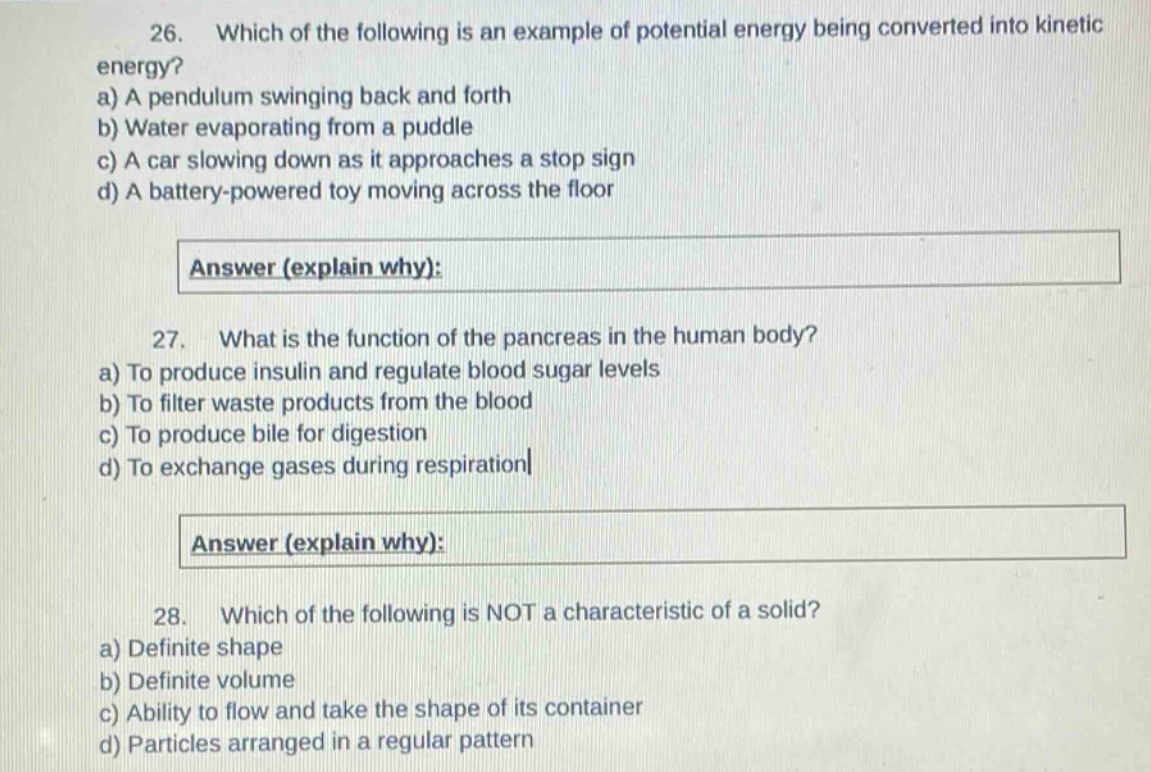
26. which of the following is an example of potential energy being converted into kinetic energy?\na) a pendulum swinging back and forth\nb) water evaporating from a puddle\nc) a car slowing down as it approaches a stop sign\nd) a battery - powered toy moving across the floor\n\nanswer (explain why):\n\n27. what is the function of the pancreas in the human body?\na) to produce insulin and regulate blood sugar levels\nb) to filter waste products from the blood\nc) to produce bile for digestion\nd) to exchange gases during respiration\n\nanswer (explain why):\n\n28. which of the following is not a characteristic of a solid?\na) definite shape\nb) definite volume\nc) ability to flow and take the shape of its container\nd) particles arranged in a regular pattern
Answer
Brief Explanations:
Question 26:
A pendulum at its highest - point has maximum potential energy. As it swings down, this potential energy is converted into kinetic energy. Water evaporating is a phase - change process related to heat energy. A car slowing down is converting kinetic energy into other forms (like heat due to friction). A battery - powered toy uses chemical energy from the battery to move, not potential to kinetic in the mechanical sense described here.
Question 27:
The pancreas produces insulin and glucagon which regulate blood sugar levels. The kidneys filter waste from the blood. The liver produces bile for digestion. The lungs exchange gases during respiration.
Question 28:
Solids have a definite shape, definite volume, and particles arranged in a regular pattern. The ability to flow and take the shape of its container is a characteristic of liquids, not solids.