applications assessment\nfind the answers to the following questions. show all work.\n1. an arrow is shot…
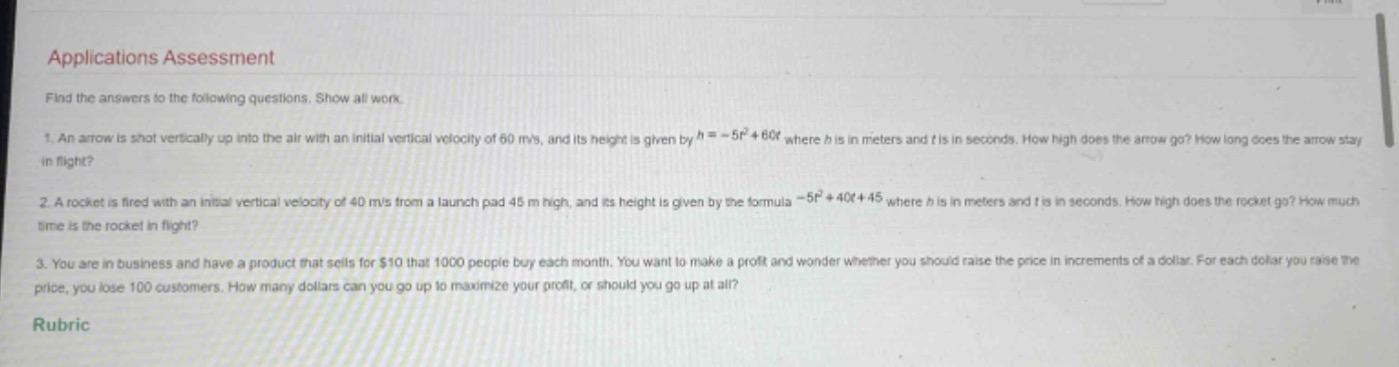
applications assessment\nfind the answers to the following questions. show all work.\n1. an arrow is shot vertically up into the air with an initial vertical velocity of 60 m/s, and its height is given by (h = - 5t^{2}+60t) where h is in meters and t is in seconds. how high does the arrow go? how long does the arrow stay in flight?\n2. a rocket is fired with an initial vertical velocity of 40 m/s from a launch pad 45 m high, and its height is given by the formula (-5t^{2}+40t + 45) where h is in meters and t is in seconds. how high does the rocket go? how much time is the rocket in flight?\n3. you are in business and have a product that sells for $10 that 1000 people buy each month. you want to make a profit and wonder whether you should raise the price in increments of a dollar. for each dollar you raise the price, you lose 100 customers. how many dollars can you go up to maximize your profit, or should you go up at all?\nrubric
Answer
1. For the arrow problem
Explanation:
Step1: Find the time to reach maximum height
The height - time function of the arrow is $h=-5t^{2}+60t$. The velocity function $v = h^\prime(t)=-10t + 60$. At the maximum - height, the velocity $v = 0$. So, we set $-10t+60 = 0$. $-10t+60 = 0\Rightarrow10t = 60\Rightarrow t = 6$ s.
Step2: Find the maximum height
Substitute $t = 6$ into the height function $h=-5t^{2}+60t$. $h=-5\times6^{2}+60\times6=-5\times36 + 360=-180 + 360=180$ m.
Step3: Find the time of flight
Set $h=-5t^{2}+60t = 0$. Factor out $-5t$: $-5t(t - 12)=0$. So, $t = 0$ (initial time) or $t = 12$ s.
Answer:
The arrow goes 180 m high and stays in flight for 12 s.
2. For the rocket problem
Explanation:
Step1: Find the time to reach maximum height
The height - time function of the rocket is $h=-5t^{2}+40t + 45$. The velocity function $v=h^\prime(t)=-10t + 40$. At the maximum - height, $v = 0$. So, we set $-10t + 40=0$. $-10t+40 = 0\Rightarrow10t = 40\Rightarrow t = 4$ s.
Step2: Find the maximum height
Substitute $t = 4$ into the height function $h=-5t^{2}+40t + 45$. $h=-5\times4^{2}+40\times4 + 45=-5\times16+160 + 45=-80 + 160+45=125$ m.
Step3: Find the time of flight
Set $h=-5t^{2}+40t + 45 = 0$. Divide through by $-5$ to get $t^{2}-8t - 9 = 0$. Factor the quadratic equation: $(t - 9)(t+1)=0$. So, $t=-1$ (rejected) or $t = 9$ s.
Answer:
The rocket goes 125 m high and is in flight for 9 s.
3. For the business - profit problem
Explanation:
Step1: Define the profit function
Let $x$ be the number of one - dollar price increases. The price per unit is $p=10 + x$, and the number of customers is $n = 1000-100x$. The profit function $P(x)=(10 + x)(1000-100x)$. Expand $P(x)$: $P(x)=10\times1000-10\times100x+1000x-100x^{2}=10000 - 1000x+1000x-100x^{2}=10000-100x^{2}$. This is a quadratic function of the form $y = ax^{2}+bx + c$ with $a=-100$, $b = 0$, and $c = 10000$. Since $a=-100\lt0$, the function has a maximum. The vertex of a quadratic function $y = ax^{2}+bx + c$ occurs at $x=-\frac{b}{2a}$. In our case, $x = 0$.
Answer:
You should not raise the price to maximize profit.