c. cube c d. cube d\n32.the diagram below shows a wave with its wavelength indicated in red. what will…
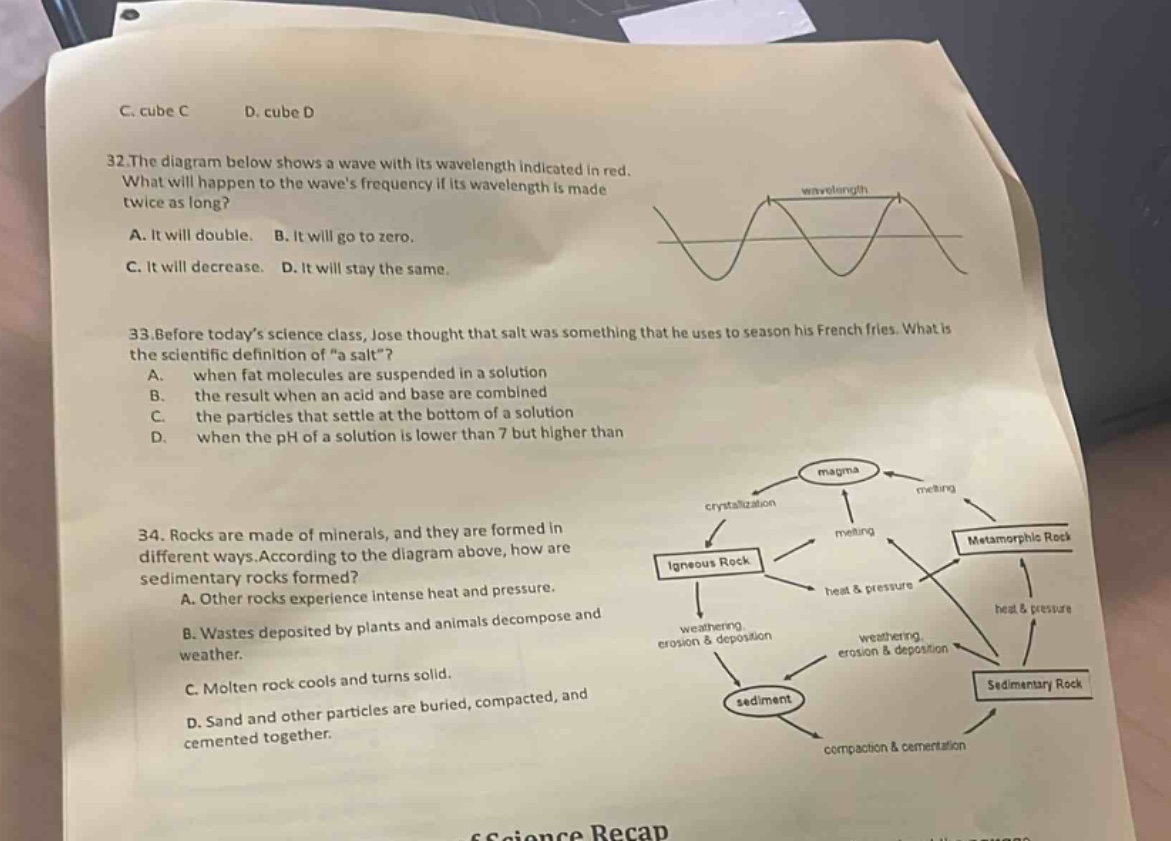
c. cube c d. cube d\n32.the diagram below shows a wave with its wavelength indicated in red. what will happen to the waves frequency if its wavelength is made twice as long?\na. it will double. b. it will go to zero.\nc. it will decrease. d. it will stay the same.\n33.before todays science class, jose thought that salt was something that he uses to season his french fries. what is the scientific definition of \a salt\?\na. when fat molecules are suspended in a solution\nb. the result when an acid and base are combined\nc. the particles that settle at the bottom of a solution\nd. when the ph of a solution is lower than 7 but higher than\n34. rocks are made of minerals, and they are formed in different ways.according to the diagram above, how are sedimentary rocks formed?\na. other rocks experience intense heat and pressure.\nb. wastes deposited by plants and animals decompose and weather.\nc. molten rock cools and turns solid.\nd. sand and other particles are buried, compacted, and cemented together.
Answer
Answer:
- C. It will decrease.
- B. the result when an acid and base are combined
- D. Sand and other particles are buried, compacted, and cemented together.
Brief Explanations:
- The relationship between wavelength ($\lambda$) and frequency ($f$) is $v = f\lambda$ (where $v$ is the wave - speed). If $v$ is constant and $\lambda$ doubles, $f$ must decrease.
- In chemistry, a salt is formed when an acid and a base react in a neutralization reaction.
- Sedimentary rocks are formed from the compaction and cementation of sediments like sand and other particles.