9. the diagram shows two fixed cogwheels which can only rotate around their own axis. a toothed belt is…
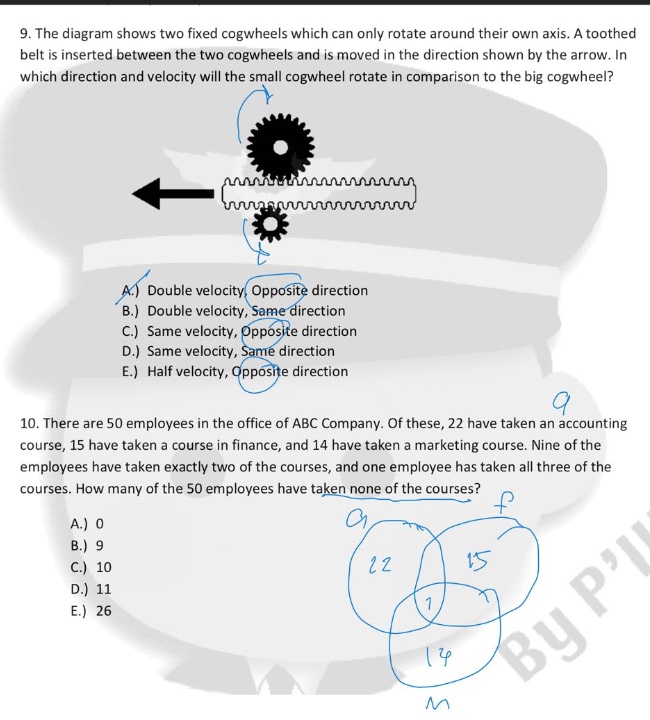
9. the diagram shows two fixed cogwheels which can only rotate around their own axis. a toothed belt is inserted between the two cogwheels and moved in the direction shown by the arrow. in which direction and velocity will the small cogwheel rotate in comparison to the big cogwheel? a.) double velocity, opposite direction b.) double velocity, same direction c.) same velocity, opposite direction d.) same velocity, same direction e.) half velocity, opposite direction 10. there are 50 employees in the office of abc company. of these, 22 have taken an accounting course, 15 have taken a course in finance, and 14 have taken a marketing course. nine of the employees have taken exactly two of the courses, and one employee has taken all three of the courses. how many of the 50 employees have taken none of the courses? a.) 0 b.) 9 c.) 10 d.) 11 e.) 26
Answer
Question 9
Explanation:
Step1: Analyze direction of rotation
When a toothed - belt is used between two cogwheels, if the belt moves in a certain direction, the two cogwheels rotate in the same direction.
Step2: Analyze velocity relationship
The linear velocity of the belt is the same throughout. The linear velocity (v = r\omega) (where (r) is the radius and (\omega) is the angular velocity). Let the radius of the big cogwheel be (R) and that of the small cogwheel be (r) ((R>r)). Since (v_1 = v_2) (where (v_1 = R\omega_1) and (v_2=r\omega_2)), (\omega_2=\frac{R}{r}\omega_1). If we assume the radius of the big cogwheel is twice that of the small cogwheel ((R = 2r)), then (\omega_2 = 2\omega_1). So the small cogwheel rotates at double the velocity of the big cogwheel in the same direction.
Answer:
B. Double velocity, Same direction
Question 10
Explanation:
Step1: Use the principle of inclusion - exclusion formula
The formula for (|A\cup B\cup C|) is (|A|+|B|+|C|-|A\cap B|-|A\cap C|-|B\cap C|+|A\cap B\cap C|). We know that the number of employees who took exactly two - course combinations is (|A\cap B|+|A\cap C|+|B\cap C|- 3|A\cap B\cap C|=9), and (|A\cap B\cap C| = 1). So (|A\cap B|+|A\cap C|+|B\cap C|=9 + 3\times1=12). Also, (|A| = 22), (|B| = 15), (|C| = 14). Then (|A\cup B\cup C|=22 + 15+14-12 + 1=40).
Step2: Calculate the number of employees who took no courses
The total number of employees is (N = 50). The number of employees who took no courses is (50-|A\cup B\cup C|=50 - 40=10).
Answer:
C. 10