humans are unable to see ultraviolet (uv) light. however, bees and many other insects can detect ultraviolet…
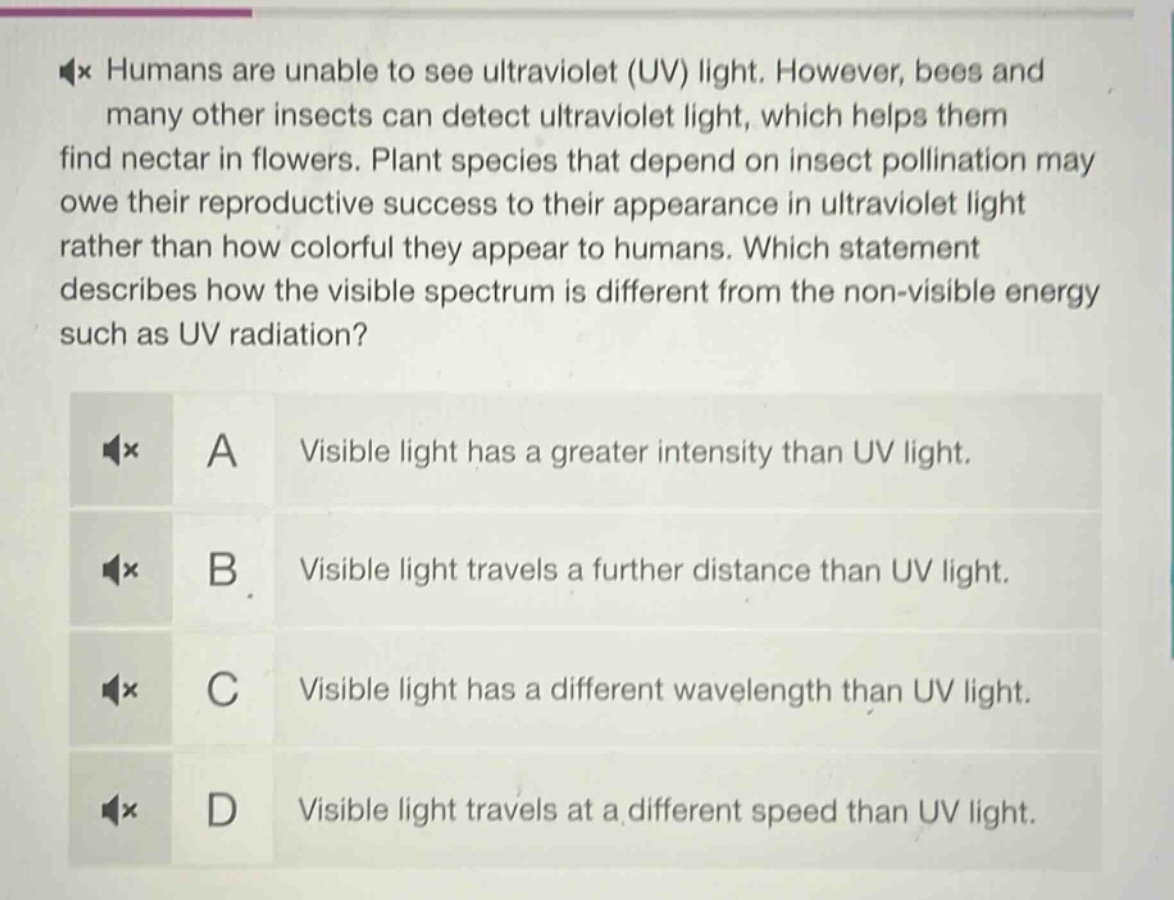
humans are unable to see ultraviolet (uv) light. however, bees and many other insects can detect ultraviolet light, which helps them find nectar in flowers. plant species that depend on insect pollination may owe their reproductive success to their appearance in ultraviolet light rather than how colorful they appear to humans. which statement describes how the visible spectrum is different from the non - visible energy such as uv radiation? a visible light has a greater intensity than uv light. b visible light travels a further distance than uv light. c visible light has a different wavelength than uv light. d visible light travels at a different speed than uv light.
Answer
Brief Explanations:
Visible light and UV - radiation are part of the electromagnetic spectrum. The main difference between them is in their wavelengths. All electromagnetic waves, including visible light and UV light, travel at the speed of light in a vacuum. Intensity and travel distance are not inherent differences between visible and UV light. The key distinguishing factor is wavelength, with visible light having wavelengths in the range of approximately 400 - 700 nanometers and UV light having shorter wavelengths.
Answer:
C. Visible light has a different wavelength than UV light.