1 - measure the mass of the object. 2 - locate the object at a known high (use ruler) 3 - let it fall and…
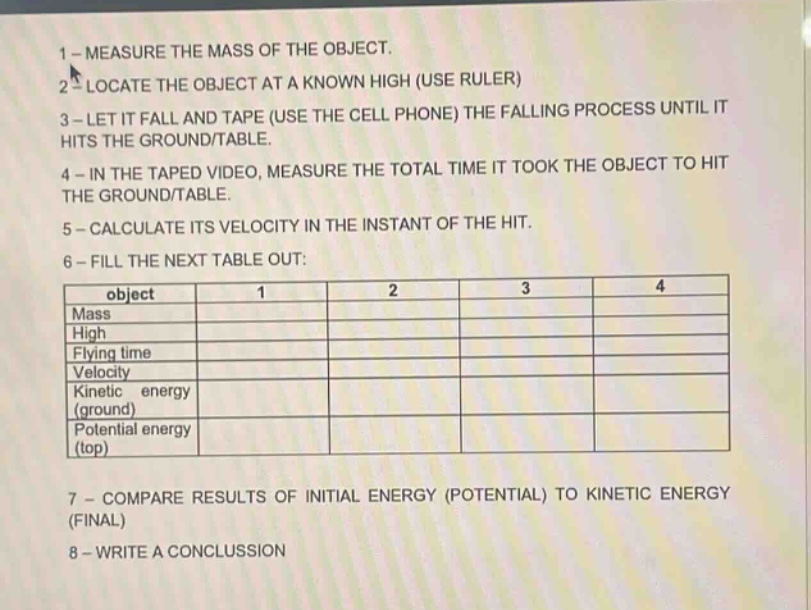
1 - measure the mass of the object. 2 - locate the object at a known high (use ruler) 3 - let it fall and tape (use the cell phone) the falling process until it hits the ground/table. 4 - in the taped video, measure the total time it took the object to hit the ground/table. 5 - calculate its velocity in the instant of the hit. 6 - fill the next table out: object 1 2 3 4 mass high flying time velocity kinetic energy (ground) potential energy (top) 7 - compare results of initial energy (potential) to kinetic energy (final) 8 - write a conclusion
Answer
Explanation:
Step1: Identify relevant formulas
The potential - energy formula is $U = mgh$ (where $m$ is mass, $g$ is the acceleration due to gravity, $g\approx9.8m/s^{2}$, and $h$ is height), the velocity formula for free - fall is $v = gt$ (where $t$ is the time of fall), and the kinetic - energy formula is $K=\frac{1}{2}mv^{2}$.
Step2: Measure mass
Use a balance to measure the mass $m$ of the object.
Step3: Measure height
Use a ruler to measure the height $h$ at which the object is located.
Step4: Measure time
From the taped video, determine the time $t$ it takes for the object to fall.
Step5: Calculate velocity
Using the formula $v = gt$, substitute the values of $g$ and $t$ to find the velocity $v$ at the instant of the hit.
Step6: Calculate kinetic energy
Using the formula $K=\frac{1}{2}mv^{2}$, substitute the values of $m$ and $v$ (calculated in step 5) to find the kinetic energy $K$ at the ground.
Step7: Calculate potential energy
Using the formula $U = mgh$, substitute the values of $m$, $g$, and $h$ (measured in step 3) to find the potential energy $U$ at the top.
Step8: Compare energies
Compare the values of potential energy $U$ and kinetic energy $K$. If there is no air - resistance, $U = K$ (conservation of mechanical energy). In reality, due to air - resistance, $U>K$.
Step9: Write conclusion
The conclusion should state whether the results support the conservation of mechanical energy (with or without considering air - resistance), and discuss any sources of error in the experiment such as inaccuracies in measuring mass, height, or time, and the effect of air - resistance on the results.
Answer:
Follow the above steps to fill in the table and draw a conclusion. The values in the table will depend on the actual measurements made during the experiment. For example, if for object 1, $m = 0.1kg$, $h = 1m$, $t = 0.45s$:
- Velocity $v=gt=9.8\times0.45 = 4.41m/s$
- Kinetic energy $K=\frac{1}{2}mv^{2}=\frac{1}{2}\times0.1\times(4.41)^{2}\approx0.97J$
- Potential energy $U = mgh=0.1\times9.8\times1 = 0.98J$ (approximate values due to rounding). Fill in similar calculated values for other objects in the table.