all parts of the electromagnetic spectrum travel at a speed of 3×10⁸ m/s when traveling through no medium. a…
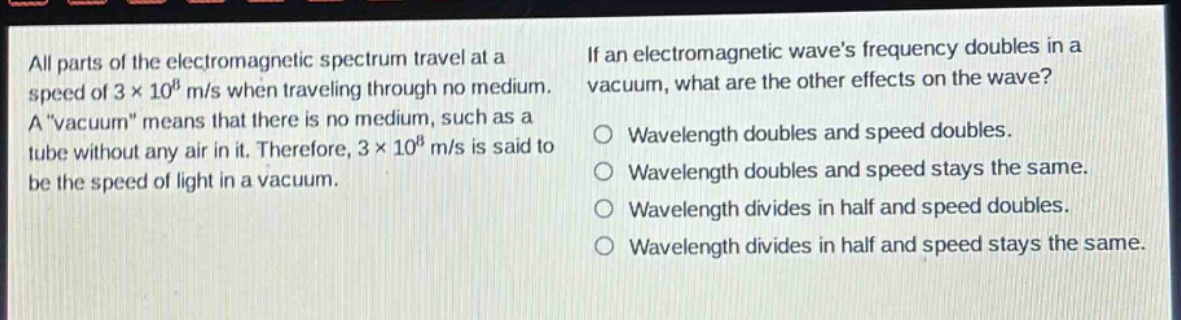
all parts of the electromagnetic spectrum travel at a speed of 3×10⁸ m/s when traveling through no medium. a \vacuum\ means that there is no medium, such as a tube without any air in it. therefore, 3×10⁸ m/s is said to be the speed of light in a vacuum. if an electromagnetic waves frequency doubles in a vacuum, what are the other effects on the wave? wavelength doubles and speed doubles. wavelength doubles and speed stays the same. wavelength divides in half and speed doubles. wavelength divides in half and speed stays the same.
Answer
Explanation:
Step1: Recall the wave - speed formula
The speed of an electromagnetic wave in vacuum is given by $c = \lambda f$, where $c$ is the speed of light ($c = 3\times10^{8}\text{ m/s}$ in vacuum), $\lambda$ is the wavelength and $f$ is the frequency.
Step2: Analyze the change in frequency
We are given that the frequency doubles, i.e., $f'=2f$. Since the speed of light in vacuum $c$ is a constant ($c = 3\times10^{8}\text{ m/s}$), from $c=\lambda f$ and $c = \lambda'f'$, we substitute $f' = 2f$ into $c=\lambda'f'$ to get $c=\lambda'(2f)$.
Step3: Solve for the new wavelength
Since $c=\lambda f$ and $c=\lambda'(2f)$, we can equate $\lambda f=\lambda'(2f)$. Canceling out $f$ (since $f\neq0$), we find $\lambda'=\frac{\lambda}{2}$. So the wavelength divides in half while the speed remains the same.
Answer:
Wavelength divides in half and speed stays the same.