question 13 (1 point)\nluis rubbed a balloon on his hair and held the balloon next to the wall. he observed…
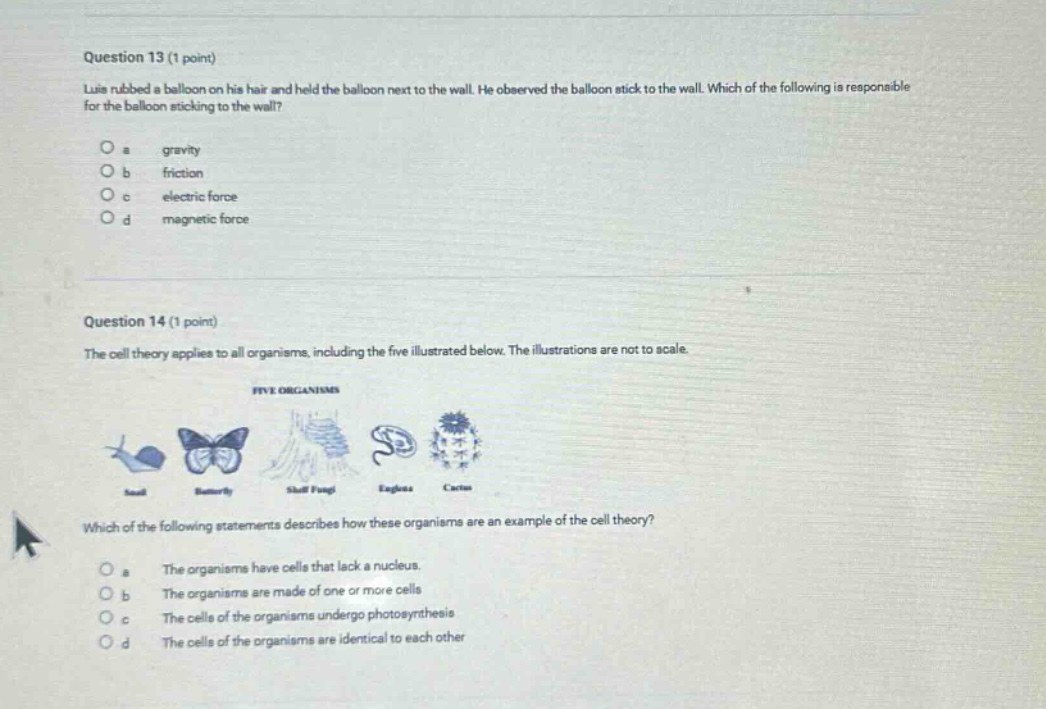
question 13 (1 point)\nluis rubbed a balloon on his hair and held the balloon next to the wall. he observed the balloon stick to the wall. which of the following is responsible for the balloon sticking to the wall?\n\na gravity\n\nb friction\n\nc electric force\n\nd magnetic force\n\nquestion 14 (1 point)\nthe cell theory applies to all organisms, including the five illustrated below. the illustrations are not to scale.\nfive organisms\n\nwhich of the following statements describes how these organisms are an example of the cell theory?\n\na the organisms have cells that lack a nucleus.\n\nb the organisms are made of one or more cells\n\nc the cells of the organisms undergo photosynthesis\n\nd the cells of the organisms are identical to each other
Answer
Question 13
Brief Explanations:
When rubbing a balloon on hair, electrons are transferred, giving the balloon a net charge. Opposite - charged objects attract. The electric force between the charged balloon and the neutral wall causes the balloon to stick. Gravity pulls objects downwards and is not responsible for this sticking. Friction is a force that resists motion between surfaces in contact and is not relevant here. Magnetic force acts between magnetic materials and is not involved in this scenario.
Answer:
C. electric force
Question 14
Brief Explanations:
The cell - theory has three main points: all living organisms are made up of one or more cells, the cell is the basic unit of life, and all cells come from pre - existing cells. The organisms shown (snail, butterfly, slime mold, fungus, cactus) are all made of one or more cells. Not all of these organisms have cells that lack a nucleus (they are mostly eukaryotes with a nucleus). Only plants (like the cactus) among them can undergo photosynthesis. The cells of these organisms are not identical as they have different functions and structures.
Answer:
B. The organisms are made of one or more cells