the rocket club is planning to launch a pair of model rockets. to build the rocket, the club needs a rocket…
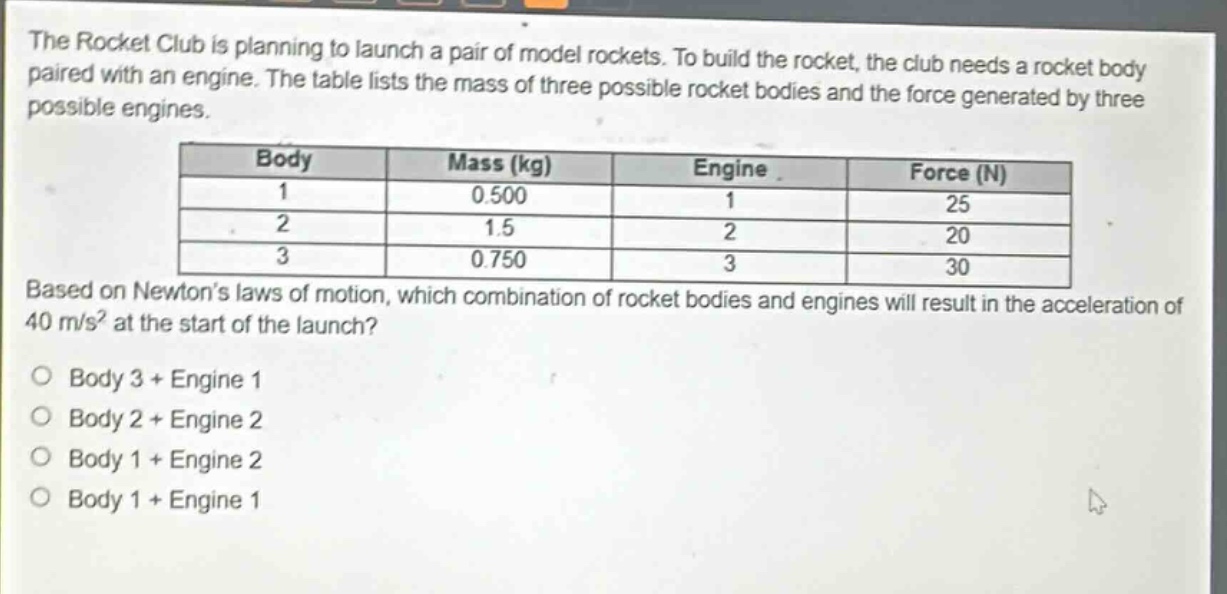
the rocket club is planning to launch a pair of model rockets. to build the rocket, the club needs a rocket body paired with an engine. the table lists the mass of three possible rocket bodies and the force generated by three possible engines. body mass (kg) engine force (n) 1 0.500 1 25 2 1.5 2 20 3 0.750 3 30 based on newtons laws of motion, which combination of rocket bodies and engines will result in the acceleration of 40 m/s² at the start of the launch? body 3 + engine 1 body 2 + engine 2 body 1 + engine 2 body 1 + engine 1
Answer
Explanation:
Step1: Recall Newton's second - law formula
According to Newton's second - law, $F = ma$, where $F$ is force, $m$ is mass, and $a$ is acceleration. We can solve for $a=\frac{F}{m}$.
Step2: Calculate acceleration for Body 3 + Engine 1
$m = 0.750$ kg, $F = 25$ N. Then $a=\frac{F}{m}=\frac{25}{0.750}=\frac{100}{3}\approx33.33$ m/s².
Step3: Calculate acceleration for Body 2 + Engine 2
$m = 1.5$ kg, $F = 20$ N. Then $a=\frac{F}{m}=\frac{20}{1.5}=\frac{40}{3}\approx13.33$ m/s².
Step4: Calculate acceleration for Body 1 + Engine 2
$m = 0.500$ kg, $F = 20$ N. Then $a=\frac{F}{m}=\frac{20}{0.500}=40$ m/s².
Step5: Calculate acceleration for Body 1 + Engine 1
$m = 0.500$ kg, $F = 25$ N. Then $a=\frac{F}{m}=\frac{25}{0.500}=50$ m/s².
Answer:
Body 1 + Engine 2