students in a science classroom performed an experiment in which crayons are placed in a large container of…
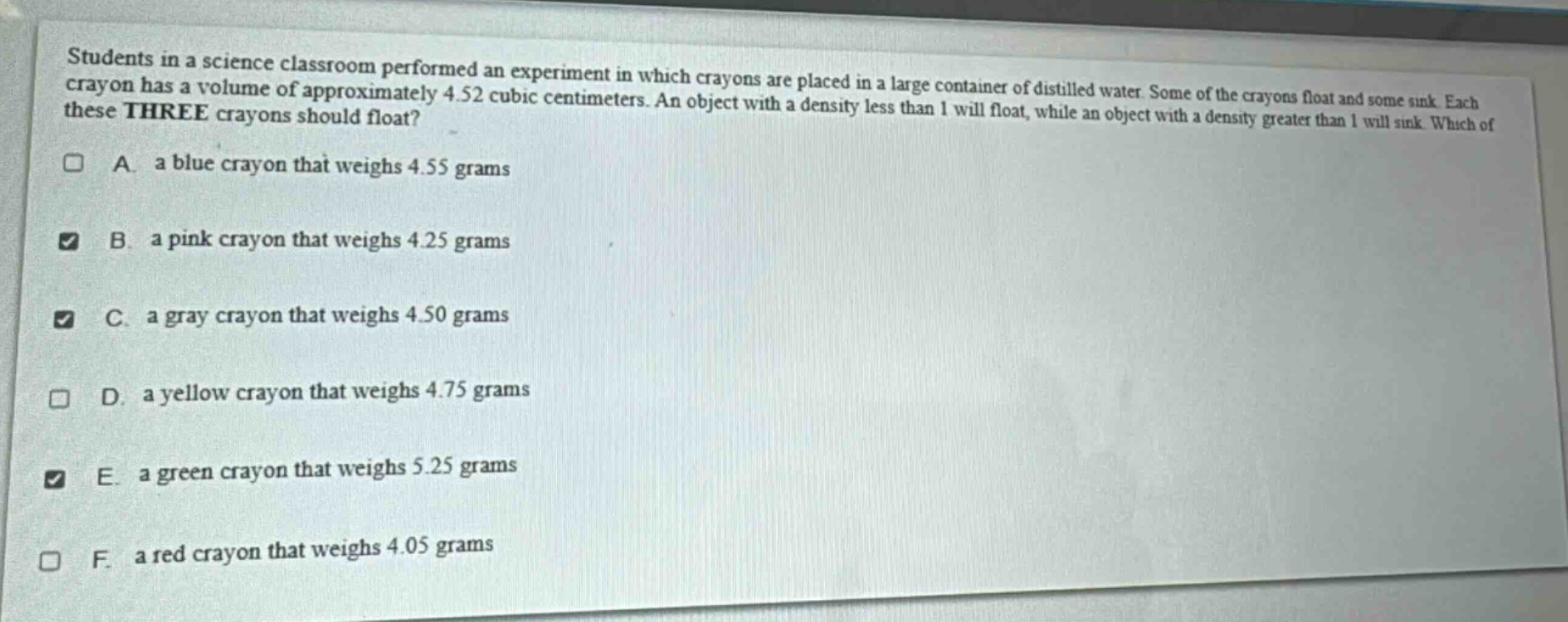
students in a science classroom performed an experiment in which crayons are placed in a large container of distilled water. some of the crayons float and some sink. each crayon has a volume of approximately 4.52 cubic centimeters. an object with a density less than 1 will float, while an object with a density greater than 1 will sink. which of these three crayons should float? a. a blue crayon that weighs 4.55 grams b. a pink crayon that weighs 4.25 grams c. a gray crayon that weighs 4.50 grams d. a yellow crayon that weighs 4.75 grams e. a green crayon that weighs 5.25 grams f. a red crayon that weighs 4.05 grams
Answer
Explanation:
Step1: Recall density formula
Density $\rho=\frac{m}{V}$, where $m$ is mass and $V$ is volume. Given $V = 4.52$ $cm^{3}$.
Step2: Calculate density for each crayon
For option A: $\rho_A=\frac{4.55}{4.52}\approx1.01$ g/cm³. For option B: $\rho_B=\frac{4.25}{4.52}\approx0.94$ g/cm³. For option C: $\rho_C=\frac{4.50}{4.52}\approx0.996$ g/cm³. For option D: $\rho_D=\frac{4.75}{4.52}\approx1.05$ g/cm³. For option E: $\rho_E=\frac{5.25}{4.52}\approx1.16$ g/cm³. For option F: $\rho_F=\frac{4.05}{4.52}\approx0.896$ g/cm³.
Step3: Determine floating crayons
Objects with $\rho< 1$ g/cm³ float. So options B, C, F have densities less than 1.
Answer:
B. a pink crayon that weighs 4.25 grams, C. a gray crayon that weighs 4.50 grams, F. a red crayon that weighs 4.05 grams