the universal gas law, pv = nrt, describes the relationship among the pressure, volume, and temperature of a…
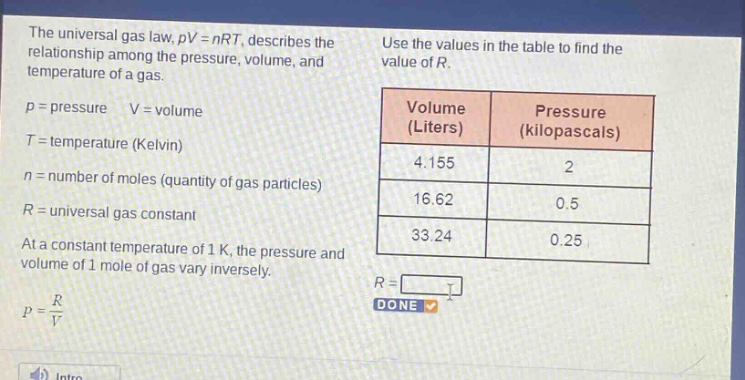
the universal gas law, pv = nrt, describes the relationship among the pressure, volume, and temperature of a gas. p = pressure v = volume t = temperature (kelvin) n = number of moles (quantity of gas particles) r = universal gas constant at a constant temperature of 1 k, the pressure and volume of 1 mole of gas vary inversely. p = r/v use the values in the table to find the value of r. volume (liters) pressure (kilopascals) 4.155 2 16.62 0.5 33.24 0.25 r = done
Answer
Answer:
$8.31$
Explanation:
Step1: Recall the ideal - gas law formula
$pV = nRT$. Given $n = 1$ mole and $T=1$ K, the formula simplifies to $pV=R$.
Step2: Use the first set of data
For $V = 4.155$ L and $p = 2$ kPa, $pV=2\times4.155 = 8.31$.
Step3: Check with other data
For $V = 16.62$ L and $p = 0.5$ kPa, $pV=0.5\times16.62 = 8.31$. For $V = 33.24$ L and $p = 0.25$ kPa, $pV=0.25\times33.24 = 8.31$. So, $R = 8.31$ L·kPa/(mol·K).