during wwii, the air force administrators noticed that a large number of fighter pilots were being killed…
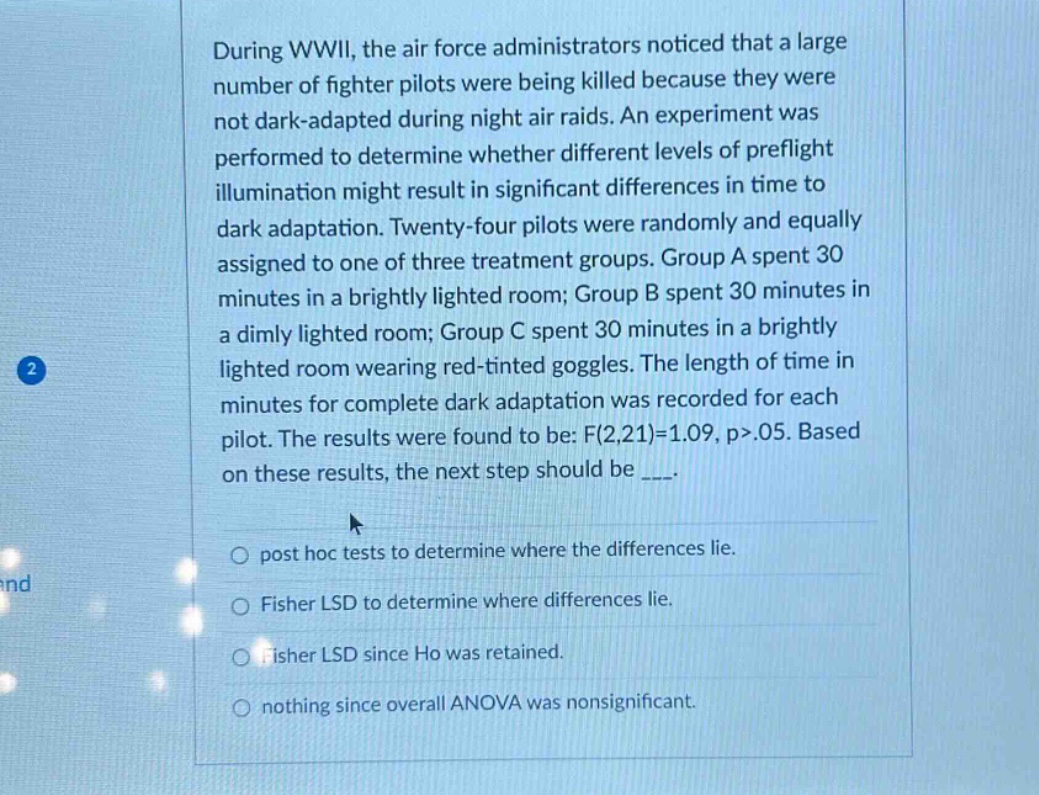
during wwii, the air force administrators noticed that a large number of fighter pilots were being killed because they were not dark - adapted during night air raids. an experiment was performed to determine whether different levels of preflight illumination might result in significant differences in time to dark adaptation. twenty - four pilots were randomly and equally assigned to one of three treatment groups. group a spent 30 minutes in a brightly lighted room; group b spent 30 minutes in a dimly lighted room; group c spent 30 minutes in a brightly lighted room wearing red - tinted goggles. the length of time in minutes for complete dark adaptation was recorded for each pilot. the results were found to be: f(2,21)=1.09, p>.05. based on these results, the next step should be ___.\npost hoc tests to determine where the differences lie.\nfisher lsd to determine where differences lie.\nfisher lsd since ho was retained.\nnothing since overall anova was nonsignificant.
Answer
Answer:
nothing since overall ANOVA was nonsignificant.
Explanation:
Step1: Analyze ANOVA result
The F - statistic is (F(2,21) = 1.09) and (p>0.05). This means the null hypothesis (no difference between group means) is not rejected in the overall ANOVA test.
Step2: Consider post - hoc tests
Post - hoc tests (like Fisher LSD or other post - hoc procedures) are used to find where the differences lie when the overall ANOVA is significant. Since the overall ANOVA here is non - significant, there is no need for post - hoc tests. So the next step is nothing.