for questions 10 - 27, match the scenario to the sampling method that was used. each will only be used…
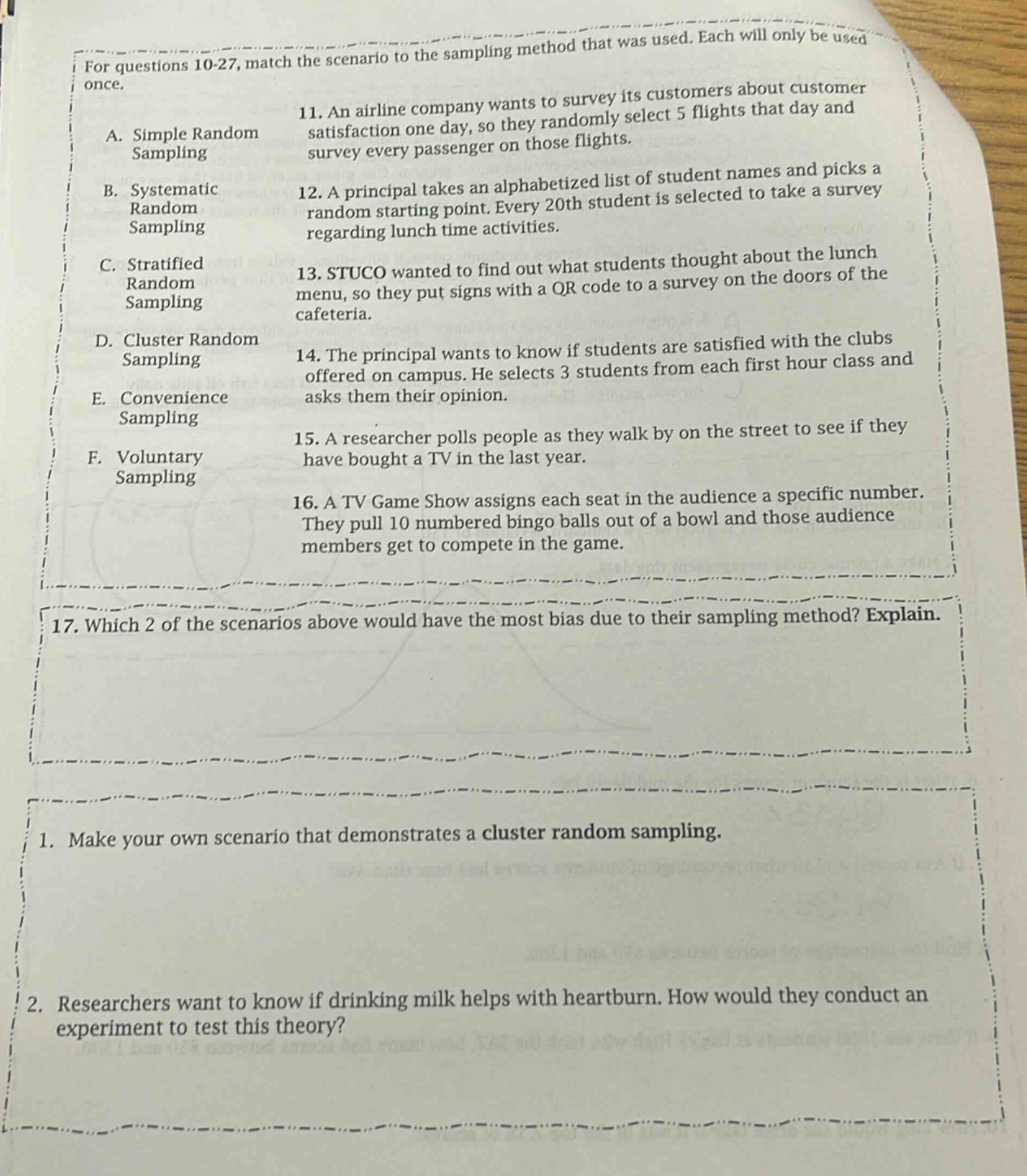
for questions 10 - 27, match the scenario to the sampling method that was used. each will only be used once.\na. simple random sampling\n11. an airline company wants to survey its customers about customer satisfaction one day, so they randomly select 5 flights that day and survey every passenger on those flights.\nb. systematic random sampling\n12. a principal takes an alphabetized list of student names and picks a random starting point. every 20th student is selected to take a survey regarding lunch - time activities.\nc. stratified random sampling\n13. stuco wanted to find out what students thought about the lunch menu, so they put signs with a qr code to a survey on the doors of the cafeteria.\nd. cluster random sampling\n14. the principal wants to know if students are satisfied with the clubs offered on campus. he selects 3 students from each first hour class and asks them their opinion.\ne. convenience sampling\n15. a researcher polls people as they walk by on the street to see if they have bought a tv in the last year.\nf. voluntary sampling\n16. a tv game show assigns each seat in the audience a specific number. they pull 10 numbered bingo balls out of a bowl and those audience members get to compete in the game.\n17. which 2 of the scenarios above would have the most bias due to their sampling method? explain.\n1. make your own scenario that demonstrates a cluster random sampling.\n2. researchers want to know if drinking milk helps with heartburn. how would they conduct an experiment to test this theory?
Answer
Brief Explanations:
- The airline selects entire flights (clusters), so it's cluster random sampling.
- Selecting every 20th student from an alphabetized list is systematic random sampling.
- Putting signs with a QR - code in the cafeteria and letting students self - select is voluntary sampling.
- Selecting a fixed number of students from each first - hour class (strata) is stratified random sampling.
- Polling people on the street as they walk by is convenience sampling.
- Randomly selecting audience members by number is simple random sampling. For question 17, convenience sampling (15) and voluntary sampling (13) are likely to have the most bias. Convenience sampling only includes people who happen to be in a certain place at a certain time. Voluntary sampling only includes those who choose to participate, and they may have a different opinion than the general population. For creating a cluster random sampling scenario: A school district wants to survey students' opinions on a new curriculum. There are 10 schools in the district. They randomly select 3 schools and survey every student in those 3 schools. For testing if drinking milk helps with heartburn, researchers could divide participants into two groups. One group (experimental group) drinks a glass of milk before a meal known to cause heartburn, and the other group (control group) drinks a placebo (like water) before the same meal. Then, they record the incidence and severity of heartburn in both groups.
Answer:
- D. Cluster Random Sampling
- B. Systematic Random Sampling
- F. Voluntary Sampling
- C. Stratified Random Sampling
- E. Convenience Sampling
- A. Simple Random Sampling
- Scenarios 13 and 15 have the most bias. Explanation: Convenience sampling only includes people in a certain place at a certain time, and voluntary sampling only includes those who choose to participate, both of which may not represent the general population well.
- A school district wants to survey students' opinions on a new curriculum. There are 10 schools in the district. They randomly select 3 schools and survey every student in those 3 schools.
- Divide participants into two groups. One group (experimental group) drinks a glass of milk before a meal known to cause heartburn, and the other group (control group) drinks a placebo (like water) before the same meal. Then, record the incidence and severity of heartburn in both groups.