13. gallup poll interviews 1600 people. of these, 18% say that they jog regularly. a new report adds: “the…
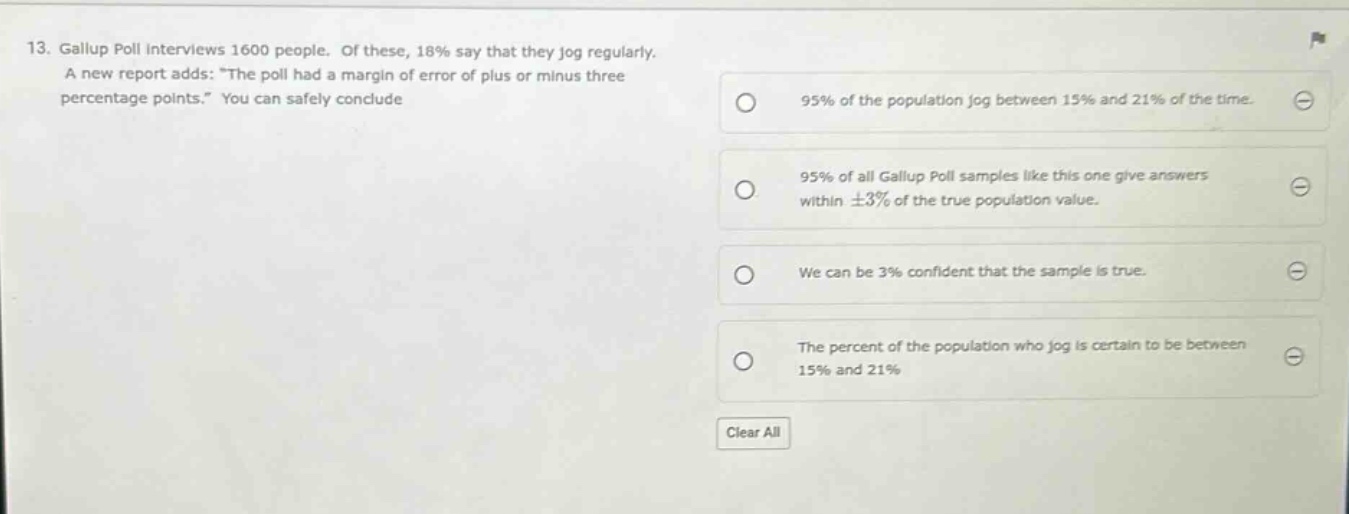
13. gallup poll interviews 1600 people. of these, 18% say that they jog regularly. a new report adds: “the poll had a margin of error of plus or minus three percentage points.” you can safely conclude\n95% of the population jog between 15% and 21% of the time.\n95% of all gallup poll samples like this one give answers within ±3% of the true population value.\nwe can be 3% confident that the sample is true.\nthe percent of the population who jog is certain to be between 15% and 21%
Answer
Explanation:
Step1: Understand margin - of - error concept
Margin of error gives a range around the sample statistic within which the true population parameter is likely to lie. A 95% confidence level is commonly associated with a margin - of - error statement in polling. Here, the sample proportion of people who jog is 18% and the margin of error is ±3%.
Step2: Analyze each option
- Option 1: Saying 95% of the population jog between 15% and 21% of the time is incorrect. The margin of error is about the estimate of the proportion of joggers in the population, not about the time they jog.
- Option 2: A margin of error of ±3% at a 95% confidence level means that 95% of all Gallup Poll samples like this one give answers within ±3% of the true population value. This is the correct interpretation of margin of error.
- Option 3: We are not 3% confident that the sample is true. The confidence level is usually 95% (not 3%) when margin of error is reported in this context.
- Option 4: We are not certain that the percent of the population who jog is between 15% and 21%. The margin of error gives a confidence interval, not a certainty interval.
Answer:
95% of all Gallup Poll samples like this one give answers within ±3% of the true population value.