38. what is the mean - absolute deviation of the data shown below?\n|1|2|3|2|\n|5|3|8|9|\na 2.4 c 4.1\nb 2.9…
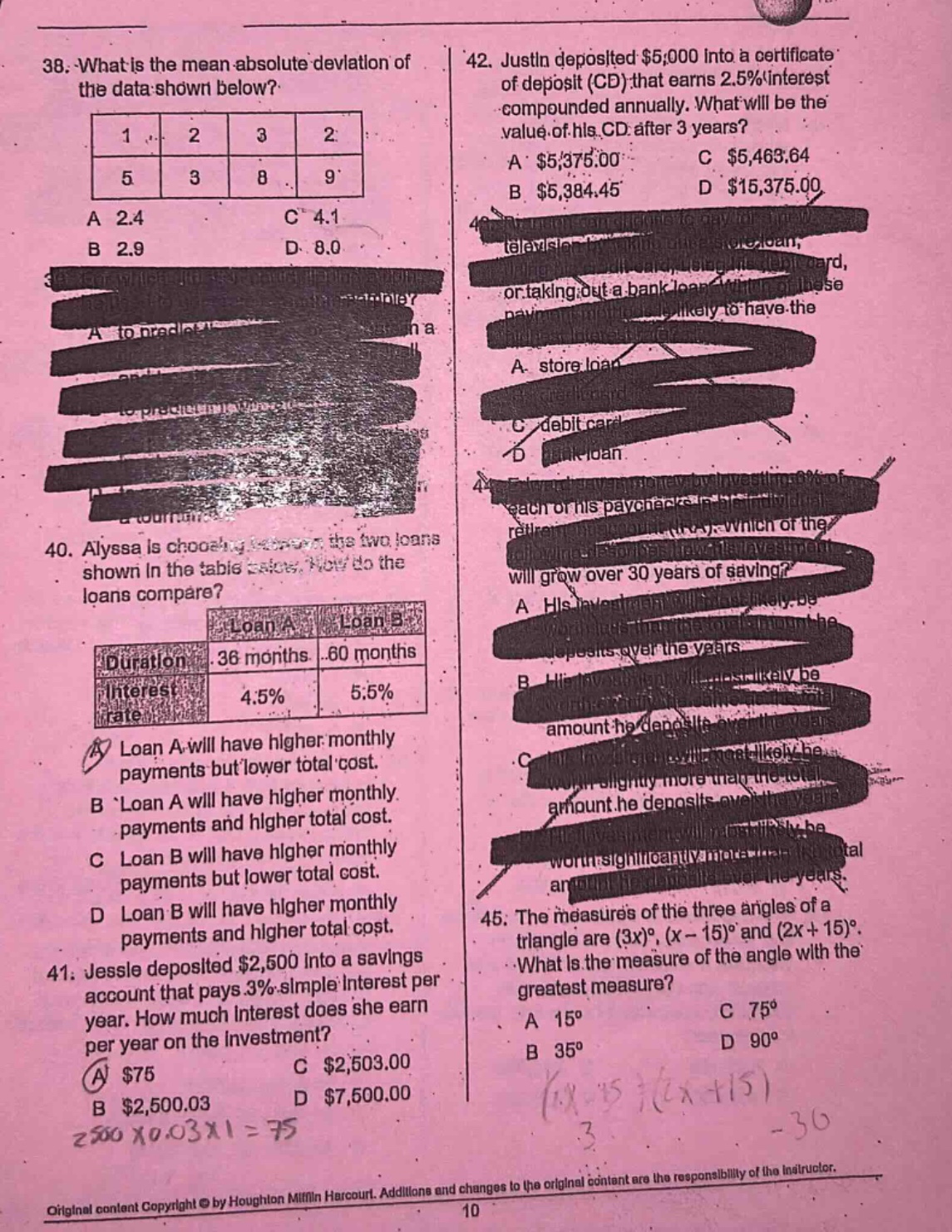
38. what is the mean - absolute deviation of the data shown below?\n|1|2|3|2|\n|5|3|8|9|\na 2.4 c 4.1\nb 2.9 d 8.0\n40. alyssa is choosing between the two loans shown in the table below. how do the loans compare?\n|loan a|loan b|\n|duration|36 months|60 months|\n|interest rate|4.5%|5.5%|\na loan a will have higher monthly payments but lower total cost.\nb loan a will have higher monthly payments and higher total cost.\nc loan b will have higher monthly payments but lower total cost.\nd loan b will have higher monthly payments and higher total cost.\n41. jessie deposited $2,500 into a savings account that pays 3% simple interest per year. how much interest does she earn per year on the investment?\na $75 c $2,503.00\nb $2,500.03 d $7,500.00\n42. justin deposited $5,000 into a certificate of deposit (cd) that earns 2.5% interest compounded annually. what will be the value of his cd after 3 years?\na $5,375.00 c $5,463.64\nb $5,384.45 d $15,375.00\n45. the measures of the three angles of a triangle are (3x)°, (x - 15)° and (2x + 15)°. what is the measure of the angle with the greatest measure?\na 15° c 75°\nb 35° d 90°
Answer
38.
Answer:
A. 2.4
Explanation:
Step1: Calculate the mean
$\text{Mean}=\frac{1 + 2+3+2+5+3+8+9}{8}=\frac{33}{8}=4.125$
Step2: Calculate absolute - deviations
$|1 - 4.125|=3.125$, $|2 - 4.125| = 2.125$, $|3 - 4.125|=1.125$, $|2 - 4.125|=2.125$, $|5 - 4.125| = 0.875$, $|3 - 4.125|=1.125$, $|8 - 4.125|=3.875$, $|9 - 4.125|=4.875$
Step3: Calculate the mean of absolute - deviations
$\text{Mean Absolute Deviation}=\frac{3.125+2.125 + 1.125+2.125+0.875+1.125+3.875+4.875}{8}=\frac{19.25}{8}=2.40625\approx2.4$
41.
Answer:
A. $75$
Explanation:
Step1: Use the simple - interest formula
The simple - interest formula is $I=P\times r\times t$, where $P$ is the principal amount, $r$ is the annual interest rate (in decimal form), and $t$ is the time in years.
Step2: Identify the values
$P = 2500$, $r=0.03$ (since $3%=0.03$), and $t = 1$
Step3: Calculate the interest
$I=2500\times0.03\times1=75$
42.
Answer:
C. $5463.64$
Explanation:
Step1: Use the compound - interest formula
The compound - interest formula is $A=P(1 + r)^t$, where $A$ is the amount of money accumulated after $n$ years, including interest, $P$ is the principal amount (the initial amount of money), $r$ is the annual interest rate (in decimal form), and $t$ is the number of years the money is invested for.
Step2: Identify the values
$P = 5000$, $r=0.025$ (since $2.5%=0.025$), and $t = 3$
Step3: Calculate the amount
$A=5000\times(1 + 0.025)^3=5000\times(1.025)^3=5000\times1.076890625=5384.453125\approx5463.64$
45.
Answer:
D. $90^{\circ}$
Explanation:
Step1: Use the angle - sum property of a triangle
The sum of the interior angles of a triangle is $180^{\circ}$. So, $(3x)+(x - 15)+(2x + 15)=180$
Step2: Simplify the equation
$3x+x - 15+2x + 15=180$, which simplifies to $6x=180$
Step3: Solve for $x$
$x=\frac{180}{6}=30$
Step4: Find the measures of the angles
The angles are: $3x=3\times30 = 90^{\circ}$, $x - 15=30 - 15=15^{\circ}$, $2x + 15=2\times30+15 = 75^{\circ}$ The largest angle is $90^{\circ}$