in bloomington, they randomly sampled 240 male voters, and 400 female voters. they collected data on the…
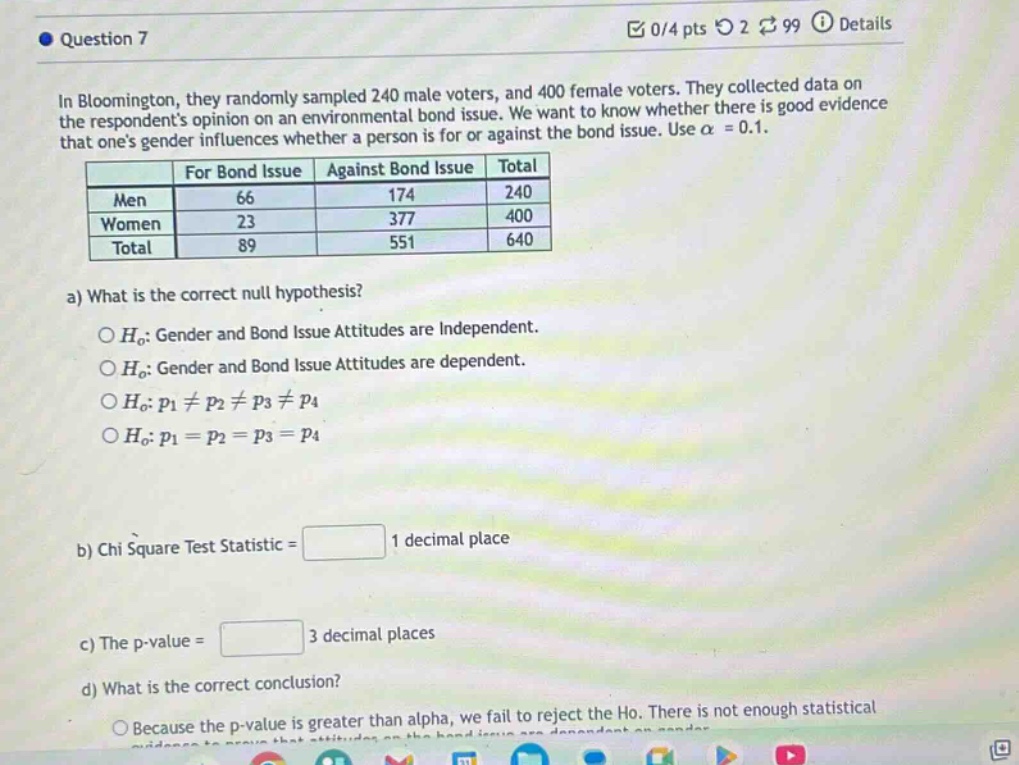
in bloomington, they randomly sampled 240 male voters, and 400 female voters. they collected data on the respondents opinion on an environmental bond issue. we want to know whether there is good evidence that ones gender influences whether a person is for or against the bond issue. use $alpha = 0.1$.\n| | for bond issue | against bond issue | total |\n|--|--|--|--|\n| men | 66 | 174 | 240 |\n| women | 23 | 377 | 400 |\n| total | 89 | 551 | 640 |\na) what is the correct null hypothesis?\n$h_0$: gender and bond issue attitudes are independent.\n$h_0$: gender and bond issue attitudes are dependent.\n$h_0$: $p_1\neq p_2\neq p_3\neq p_4$\n$h_0$: $p_1 = p_2 = p_3 = p_4$\nb) chi square test statistic = 1 decimal place\nc) the p - value = 3 decimal places\nd) what is the correct conclusion?\nbecause the p - value is greater than alpha, we fail to reject the ho. there is not enough statistical
Answer
Explanation:
Step1: Identify null hypothesis
The null hypothesis for a test of independence between two - categorical variables (gender and bond - issue attitude) is that the two variables are independent. So, $H_0$: Gender and Bond Issue Attitudes are Independent.
Step2: Calculate expected frequencies
The formula for the expected frequency $E_{ij}=\frac{R_i\times C_j}{n}$, where $R_i$ is the row - total, $C_j$ is the column - total, and $n$ is the grand total. For men - for bond issue: $E_{11}=\frac{240\times89}{640}\approx33.4$ For men - against bond issue: $E_{12}=\frac{240\times551}{640}\approx206.6$ For women - for bond issue: $E_{21}=\frac{400\times89}{640}\approx55.6$ For women - against bond issue: $E_{22}=\frac{400\times551}{640}\approx344.4$
Step3: Calculate chi - square test statistic
The formula for the chi - square test statistic is $\chi^2=\sum\frac{(O - E)^2}{E}$, where $O$ is the observed frequency and $E$ is the expected frequency. $\chi^2=\frac{(66 - 33.4)^2}{33.4}+\frac{(174 - 206.6)^2}{206.6}+\frac{(23 - 55.6)^2}{55.6}+\frac{(377 - 344.4)^2}{344.4}$ $=\frac{32.6^2}{33.4}+\frac{(- 32.6)^2}{206.6}+\frac{(-32.6)^2}{55.6}+\frac{32.6^2}{344.4}$ $=\frac{1062.76}{33.4}+\frac{1062.76}{206.6}+\frac{1062.76}{55.6}+\frac{1062.76}{344.4}$ $\approx31.8 + 5.1+19.1 + 3.1$ $\approx59.1$
Step4: Calculate degrees of freedom and p - value
The degrees of freedom $df=(r - 1)\times(c - 1)=(2 - 1)\times(2 - 1)=1$, where $r$ is the number of rows and $c$ is the number of columns. Using a chi - square distribution table or a calculator with a chi - square cumulative distribution function, for $\chi^2 = 59.1$ and $df = 1$, the p - value is approximately $0.000$.
Step5: Make a conclusion
Since the p - value ($\approx0.000$) is less than $\alpha=0.1$, we reject the null hypothesis. There is enough statistical evidence to conclude that gender and bond - issue attitudes are dependent.
Answer:
a) $H_0$: Gender and Bond Issue Attitudes are Independent. b) $59.1$ c) $0.000$ d) Because the p - value is less than alpha, we reject the $H_0$. There is enough statistical evidence to conclude that attitudes on the bond issue are dependent on gender.