1. to determine what people think about the construction of a new school, the school board asks citizens to…
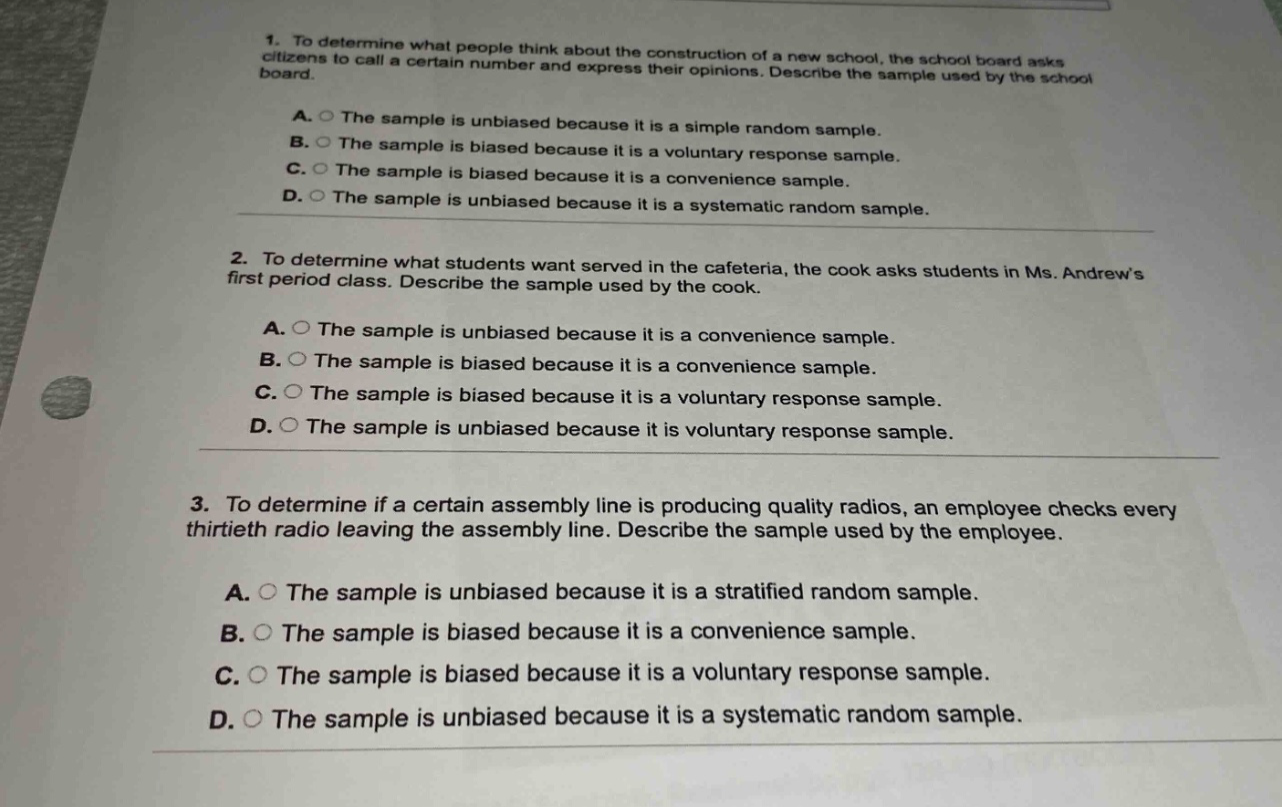
1. to determine what people think about the construction of a new school, the school board asks citizens to call a certain number and express their opinions. describe the sample used by the school board.\na. the sample is unbiased because it is a simple random sample.\nb. the sample is biased because it is a voluntary response sample.\nc. the sample is biased because it is a convenience sample.\nd. the sample is unbiased because it is a systematic random sample.\n\n2. to determine what students want served in the cafeteria, the cook asks students in ms. andrews first period class. describe the sample used by the cook.\na. the sample is unbiased because it is a convenience sample.\nb. the sample is biased because it is a convenience sample.\nc. the sample is biased because it is a voluntary response sample.\nd. the sample is unbiased because it is voluntary response sample.\n\n3. to determine if a certain assembly line is producing quality radios, an employee checks every thirtieth radio leaving the assembly line. describe the sample used by the employee.\na. the sample is unbiased because it is a stratified random sample.\nb. the sample is biased because it is a convenience sample.\nc. the sample is biased because it is a voluntary response sample.\nd. the sample is unbiased because it is a systematic random sample.
Answer
Brief Explanations:
- When citizens are asked to call a number to express opinions, it's a voluntary - response sample as only those who choose to call will be in the sample, which is likely to be biased.
- Asking only students in Ms. Andrew's first - period class is a convenience sample since it's easy for the cook to access this group, and it's likely to be biased as it doesn't represent all students.
- Checking every thirtieth radio is a systematic random sample as there is a fixed sampling interval, and it is an unbiased way to sample from the population of radios on the assembly line.
Answer:
- B. The sample is biased because it is a voluntary response sample.
- B. The sample is biased because it is a convenience sample.
- D. The sample is unbiased because it is a systematic random sample.