determine the probability of each event.\n1. a tray has 16 doughnuts, 9 of which contain raspberry jam and 7…
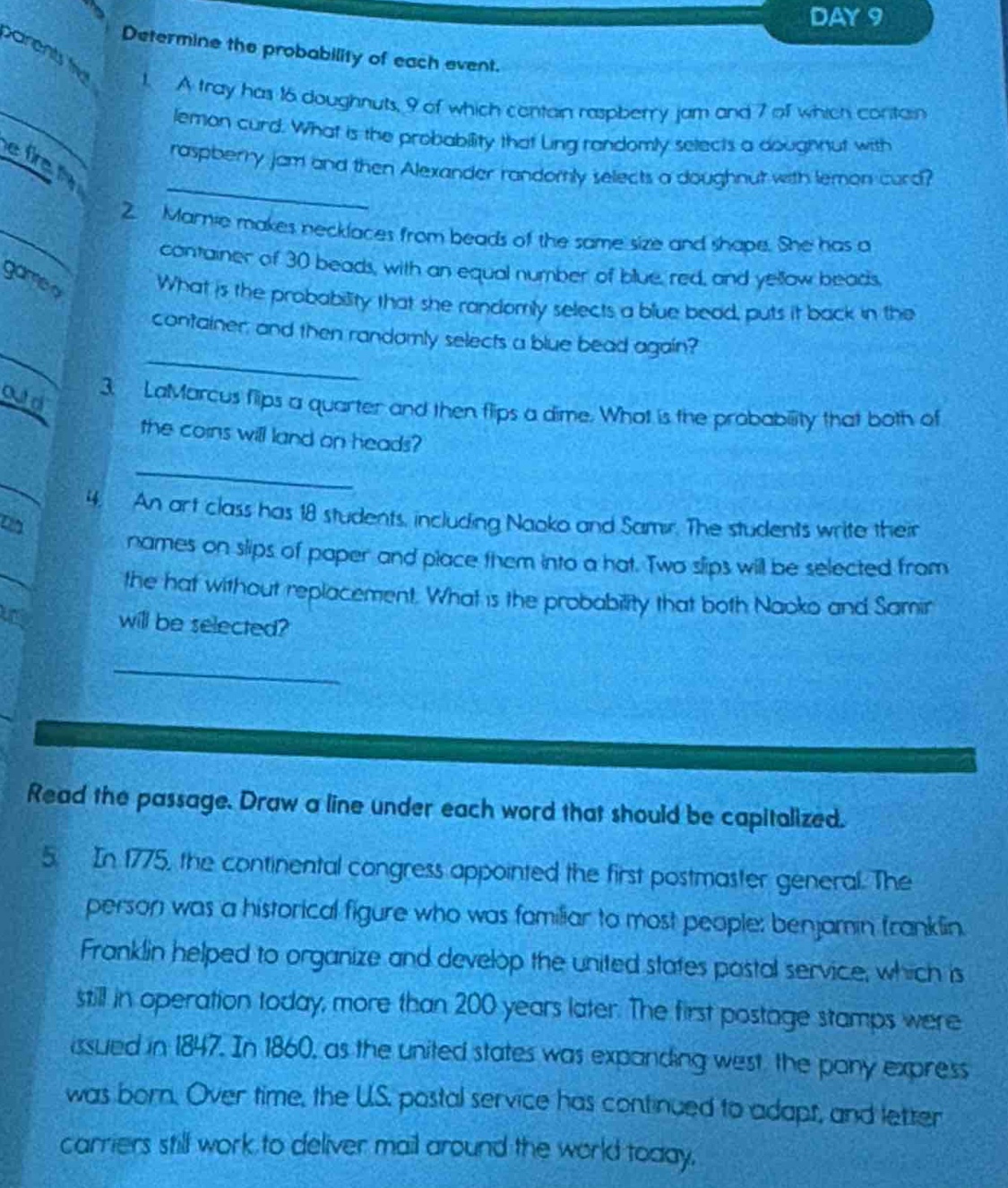
determine the probability of each event.\n1. a tray has 16 doughnuts, 9 of which contain raspberry jam and 7 of which contain lemon curd. what is the probability that ling randomly selects a doughnut with raspberry jam and then alexander randomly selects a doughnut with lemon curd?\n2. marnie makes necklaces from beads of the same size and shape. she has a container of 30 beads, with an equal number of blue, red, and yellow beads. what is the probability that she randomly selects a blue bead, puts it back in the container, and then randomly selects a blue bead again?\n3. lamarcus flips a quarter and then flips a dime. what is the probability that both of the coins will land on heads?\n4. an art class has 18 students, including naoko and samir. the students write their names on slips of paper and place them into a hat. two slips will be selected from the hat without replacement. what is the probability that both naoko and samir will be selected?\n\nread the passage. draw a line under each word that should be capitalized.\n5. in 1775, the continental congress appointed the first postmaster general. the person was a historical figure who was familiar to most people: benjamin franklin. franklin helped to organize and develop the united states postal service, which is still in operation today, more than 200 years later. the first postage stamps were issued in 1847. in 1860, as the united states was expanding west, the pony express was born. over time, the u.s. postal service has continued to adapt, and letter carriers still work to deliver mail around the world today.
Answer
1.
Explanation:
Step1: Calculate probability of first - event
The probability that Ling selects a doughnut with raspberry jam is the number of raspberry - jam doughnuts divided by the total number of doughnuts. There are 9 raspberry - jam doughnuts and 16 total doughnuts, so (P(\text{Ling's selection})=\frac{9}{16}).
Step2: Calculate probability of second - event
After Ling selects a doughnut, there are 15 doughnuts left. There are 7 lemon - curd doughnuts, so (P(\text{Alexander's selection})=\frac{7}{15}).
Step3: Calculate joint probability
Since these are independent events (the first selection affects the second selection in terms of the number of remaining items), the probability of both events occurring is the product of their probabilities. (P = \frac{9}{16}\times\frac{7}{15}=\frac{9\times7}{16\times15}=\frac{63}{240}=\frac{21}{80}).
Answer:
(\frac{21}{80})
2.
Explanation:
Step1: Calculate probability of first - event
There are 30 beads in total, and an equal number of blue, red, and yellow beads. So the number of blue beads is (\frac{30}{3}=10). The probability of selecting a blue bead on the first draw is (P_1=\frac{10}{30}=\frac{1}{3}).
Step2: Calculate probability of second - event
Since the bead is put back, the total number of beads and the number of blue beads remain the same. So the probability of selecting a blue bead on the second draw is (P_2 = \frac{10}{30}=\frac{1}{3}).
Step3: Calculate joint probability
Since the two draws are independent events (because of replacement), the probability of both events occurring is (P=P_1\times P_2=\frac{1}{3}\times\frac{1}{3}=\frac{1}{9}).
Answer:
(\frac{1}{9})
3.
Explanation:
Step1: Calculate probability of first - coin landing on heads
The probability of a quarter landing on heads is (P_1=\frac{1}{2}) since a coin has 2 possible outcomes (heads or tails).
Step2: Calculate probability of second - coin landing on heads
The probability of a dime landing on heads is (P_2=\frac{1}{2}) for the same reason.
Step3: Calculate joint probability
Since the flips of the two coins are independent events, the probability that both coins land on heads is (P = P_1\times P_2=\frac{1}{2}\times\frac{1}{2}=\frac{1}{4}).
Answer:
(\frac{1}{4})
4.
Explanation:
Step1: Calculate probability of first selection
The probability that the first slip selected is either Naoko or Sam is (\frac{2}{18}) since there are 2 favorable outcomes (Naoko or Sam) out of 18 total students.
Step2: Calculate probability of second selection
After the first selection (without replacement), there are 17 students left. If the first - selected student was one of Naoko or Sam, then the probability that the second - selected student is the other one is (\frac{1}{17}).
Step3: Calculate joint probability
The probability that both Naoko and Sam are selected is (P=\frac{2}{18}\times\frac{1}{17}=\frac{2}{306}=\frac{1}{153}).
Answer:
(\frac{1}{153})
5.
Brief Explanations:
Proper nouns, the first word of a sentence, and names of historical events and organizations should be capitalized. In the passage, "In" (first word of the sentence), "1775" (date), "Continental Congress" (historical organization), "Postmaster General" (title), "Benjamin Franklin" (name), "United States" (country), "1847" (date), "1860" (date), "United States" (country), "Pony Express" (historical service), "U.S." (abbreviation of a country), "Postal Service" (organization) should be capitalized.
Answer:
In 1775, the Continental Congress appointed the first Postmaster General. The person was a historical figure who was familiar to most people: Benjamin Franklin. Franklin helped to organize and develop the United States Postal Service, which is still in operation today, more than 200 years later. The first postage stamps were issued in 1847. In 1860, as the United States was expanding west, the Pony Express was born. Over time, the U.S. Postal Service has continued to adapt, and letter carriers still work to deliver mail around the world today.