exercises\nbuilding concepts and skills\n6. true/false: a pilot study is a good way to test the wording of a…
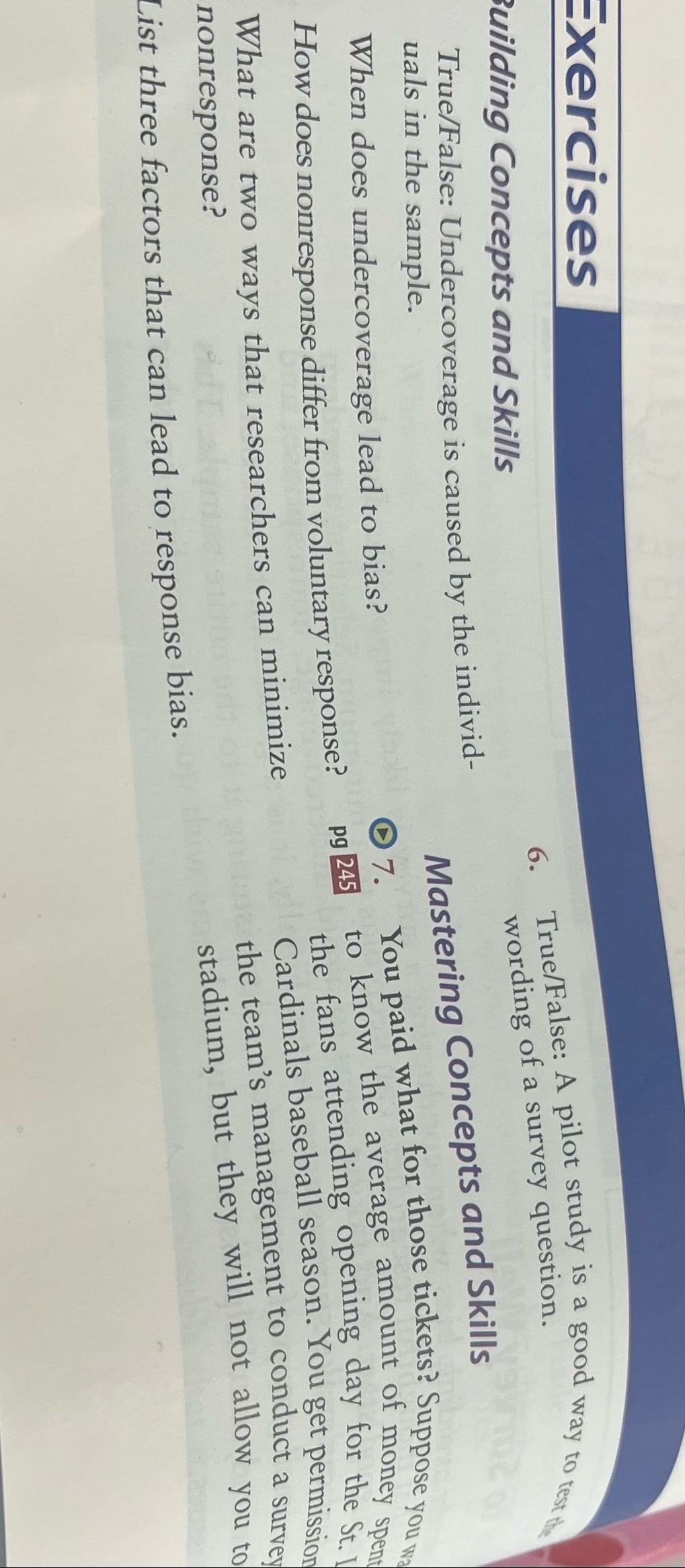
exercises\nbuilding concepts and skills\n6. true/false: a pilot study is a good way to test the wording of a survey question.\n7. you paid what for those tickets? suppose you want to know the average amount of money spent by the fans attending opening day for the st. louis cardinals baseball season. you get permission from the teams management to conduct a survey in the stadium, but they will not allow you to\ntrue/false: undercoverage is caused by the individuals in the sample.\nwhen does undercoverage lead to bias?\nhow does nonresponse differ from voluntary response?\nwhat are two ways that researchers can minimize nonresponse?\nlist three factors that can lead to response bias.
Answer
Brief Explanations:
- Undercoverage bias: Occurs when some members of the population are left out of the sampling frame. For example, if a survey about internet - usage is conducted only among land - line phone users, mobile - only users are undercovered, leading to bias as their views are not represented.
- Non - response bias: Happens when individuals selected for the sample do not respond. Reasons can include lack of interest, time constraints, or difficulty in contacting them. This can skew results if non - respondents have different opinions from respondents.
- Response bias: Arises when respondents do not answer truthfully. For instance, in a survey about healthy eating habits, respondents may overstate their consumption of fruits and vegetables due to social desirability.
To minimize non - response bias, researchers can:
- Send follow - up reminders to non - respondents to increase the response rate.
- Offer incentives such as gift cards or vouchers to encourage participation.
Non - response differs from voluntary response as in non - response, individuals are selected for the sample but do not respond, while in voluntary response, individuals choose on their own to participate in a survey (e.g., online polls where anyone can respond), often leading to a self - selected and potentially biased sample.
A pilot study is indeed a good way to test the wording of a survey question as it allows researchers to identify any confusing or ambiguous language, and make necessary adjustments before the full - scale survey.
Answer:
- Three factors for response bias: Social desirability, lack of knowledge, and memory recall issues.
- Two ways to minimize non - response bias: Send follow - up reminders, offer incentives.
- Non - response is when selected individuals don't answer; voluntary response is self - selected participation.
- True. Undercoverage is caused by individuals in the sample not being part of the population of interest.
- True. A pilot study helps test survey question wording.
- To find the average amount of money spent, divide the total money spent by the number of fans attending. However, without data on total money spent and number of fans, we can't calculate it.