(a) a facilities supervisor at a sports stadium wants to rate the condition of the seats at the stadium…
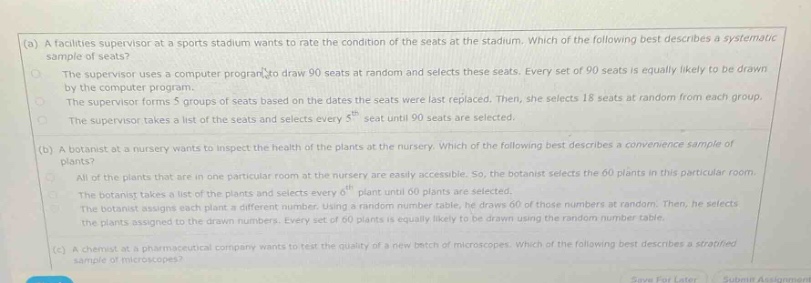
(a) a facilities supervisor at a sports stadium wants to rate the condition of the seats at the stadium. which of the following best describes a systematic sample of seats? the supervisor uses a computer program to draw 90 seats at random and selects these seats. every set of 90 seats is equally likely to be drawn by the computer program. the supervisor forms 5 groups of seats based on the dates the seats were last replaced. then, she selects 18 seats at random from each group. the supervisor takes a list of the seats and selects every 5th seat until 90 seats are selected. (b) a botanist at a nursery wants to inspect the health of the plants at the nursery. which of the following best describes a convenience sample of plants? all of the plants that are in one particular room at the nursery are easily accessible. so, the botanist selects the 60 plants in this particular room. the botanist takes a list of the plants and selects every 6th plant until 60 plants are selected. the botanist assigns each plant a different number. using a random - number table, he draws 60 of those numbers at random. then, he selects the plants assigned to the drawn numbers. every set of 60 plants is equally likely to be drawn using the random - number table. (c) a chemist at a pharmaceutical company wants to test the quality of a new batch of microscopes. which of the following best describes a stratified sample of microscopes?
Answer
(a)
Explanation:
Step1: Define systematic sampling
Systematic sampling involves selecting elements at regular intervals from an ordered population.
Step2: Analyze each option
- Option 1 is simple - random sampling as seats are drawn randomly by a computer program.
- Option 2 is stratified sampling as groups are formed based on a characteristic (date of last - replacement).
- Option 3: The supervisor takes a list of seats and selects every (5^{th}) seat until 90 seats are selected. This is systematic sampling as there is a fixed sampling interval ((5^{th}) seat).
Answer:
The supervisor takes a list of the seats and selects every (5^{th}) seat until 90 seats are selected.
(b)
Explanation:
Step1: Define convenience sampling
Convenience sampling is selecting elements that are easily accessible.
Step2: Analyze each option
- Option 1: Selecting the 60 plants in a particular room because they are easily accessible is convenience sampling.
- Option 2 is simple - random sampling as plants are selected using a random - number table.
- Option 3 is also simple - random sampling as plants are randomly selected from a list using a random - number table.
Answer:
All of the plants that are in one particular room at the nursery are easily accessible. So, the botanist selects the 60 plants in this particular room.
(c)
Explanation:
Step1: Define stratified sampling
Stratified sampling divides the population into non - overlapping subgroups (strata) and then samples from each stratum.
Step2: Assume a possible scenario
Suppose the microscopes can be divided into subgroups based on some characteristic (e.g., production line, batch within the new batch). Then, sampling from each of these subgroups would be stratified sampling. For example, if the new batch of microscopes is produced on 3 different production lines, and the chemist samples some microscopes from each production line.
Answer:
The chemist divides the new batch of microscopes into subgroups (strata) based on some characteristic (such as production line) and then selects a sample of microscopes from each subgroup.