the graph shows the results of a survey of adults in country a, ages 33 to 51, who were asked if they…
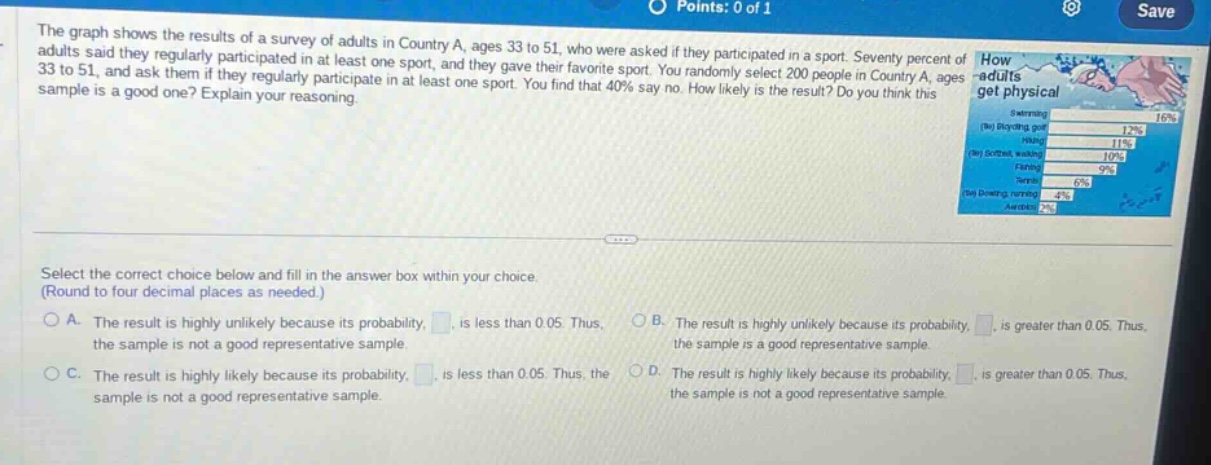
the graph shows the results of a survey of adults in country a, ages 33 to 51, who were asked if they participated in a sport. seventy percent of adults said they regularly participated in at least one sport, and they gave their favorite sport. you randomly select 200 people in country a, ages 33 to 51, and ask them if they regularly participate in at least one sport. you find that 40% say no. how likely is the result? do you think this sample is a good one? explain your reasoning.\nselect the correct choice below and fill in the answer box within your choice. (round to four decimal places as needed)\na. the result is highly unlikely because its probability, , is less than 0.05. thus, the sample is not a good representative sample.\nb. the result is highly unlikely because its probability, , is greater than 0.05. thus, the sample is a good representative sample.\nc. the result is highly likely because its probability, , is less than 0.05. thus, the sample is not a good representative sample.\nd. the result is highly likely because its probability, , is greater than 0.05. thus, the sample is not a good representative sample.
Answer
Explanation:
Step1: Identify the population proportion
The proportion of adults who regularly participate in at least one sport in the population is $p = 0.70$. So the proportion of those who do not participate is $q=1 - p=1 - 0.70 = 0.30$. The sample size is $n = 200$.
Step2: Calculate the mean and standard - deviation of the sampling distribution of the sample proportion
The mean of the sampling distribution of the sample proportion $\hat{p}$ is $\mu_{\hat{p}}=p = 0.70$. The standard - deviation is $\sigma_{\hat{p}}=\sqrt{\frac{pq}{n}}=\sqrt{\frac{0.70\times0.30}{200}}=\sqrt{\frac{0.21}{200}}\approx\sqrt{0.00105}\approx0.0324$.
Step3: Standardize the sample proportion
The sample proportion of those who say no is $\hat{p}=0.40$. First, we note that if we are interested in non - participants, we standardize using the formula $z=\frac{\hat{p}-p}{\sigma_{\hat{p}}}$. Here, $z=\frac{0.40 - 0.30}{0.0324}=\frac{0.10}{0.0324}\approx3.09$. We can also use the normal approximation to find the probability $P(\hat{p}=0.40)$. Using the normal distribution, we find the $z$ - score and then the probability. The probability of getting a sample proportion of non - participants as extreme as 0.40 (assuming a normal distribution of the sample proportion) is very low. We can use the binomial approximation to the normal. The probability of getting $x = 0.40\times200 = 80$ non - participants out of $n = 200$ when $p = 0.30$ can be calculated using the normal approximation to the binomial $X\sim N(np,npq)$ where $np=200\times0.30 = 60$ and $npq=200\times0.30\times0.70 = 42$. We standardize $x = 80$ using $z=\frac{x - np}{\sqrt{npq}}=\frac{80 - 60}{\sqrt{42}}\approx\frac{20}{6.48}\approx3.09$. The probability $P(Z\geq3.09)$ (or a two - tailed probability if we consider extreme values in both directions) is $P(Z\geq3.09)=1 - P(Z < 3.09)$. From the standard normal table, $P(Z < 3.09)=0.9990$, so $P(Z\geq3.09)=1 - 0.9990 = 0.0010$.
Answer:
A. The result is highly unlikely because its probability, $0.0010$, is less than 0.05. Thus, the sample is not a good representative sample.