highest earned educational degree\npolitical party high - school some college college graduate postgraduate…
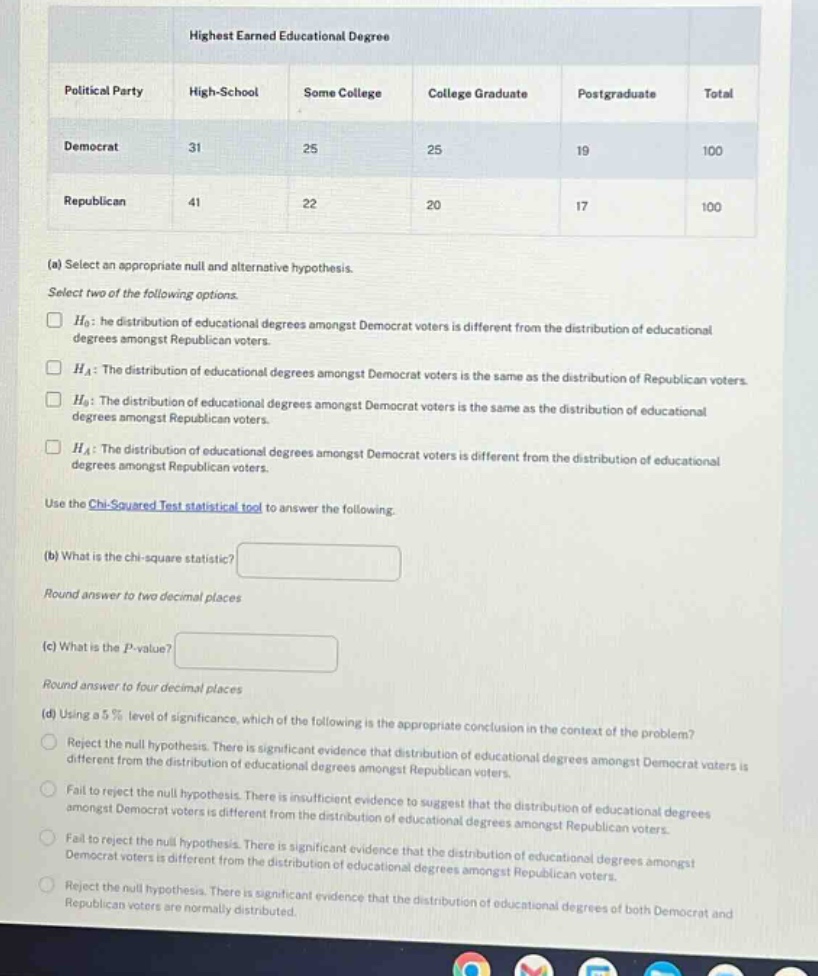
highest earned educational degree\npolitical party high - school some college college graduate postgraduate total\ndemocrat 31 25 25 19 100\nrepublican 41 22 20 17 100\n(a) select an appropriate null and alternative hypothesis.\nselect two of the following options.\n□ (h_0): he distribution of educational degrees amongst democrat voters is different from the distribution of educational degrees amongst republican voters.\n□ (h_a): the distribution of educational degrees amongst democrat voters is the same as the distribution of republican voters.\n□ (h_0): the distribution of educational degrees amongst democrat voters is the same as the distribution of educational degrees amongst republican voters.\n□ (h_a): the distribution of educational degrees amongst democrat voters is different from the distribution of educational degrees amongst republican voters.\nuse the chi - squared test statistical tool to answer the following.\n(b) what is the chi - square statistic?\nround answer to two decimal places\n(c) what is the (p) - value?\nround answer to four decimal places\n(d) using a 5% level of significance, which of the following is the appropriate conclusion in the context of the problem?\nreject the null hypothesis. there is significant evidence that distribution of educational degrees amongst democrat voters is different from the distribution of educational degrees amongst republican voters.\nfail to reject the null hypothesis. there is insufficient evidence to suggest that the distribution of educational degrees amongst democrat voters is different from the distribution of educational degrees amongst republican voters.\nfail to reject the null hypothesis. there is significant evidence that the distribution of educational degrees amongst democrat voters is different from the distribution of educational degrees amongst republican voters.\nreject the null hypothesis. there is significant evidence that the distribution of educational degrees of both democrat and republican voters are normally distributed.
Answer
Explanation:
Step1: Define null and alternative hypotheses
The null hypothesis $H_0$ is that the distribution of educational - degrees amongst Democrat voters is the same as the distribution of educational degrees amongst Republican voters. The alternative hypothesis $H_A$ is that the distribution of educational degrees amongst Democrat voters is different from the distribution of educational degrees amongst Republican voters. So, $H_0$: The distribution of educational degrees amongst Democrat voters is the same as the distribution of educational degrees amongst Republican voters; $H_A$: The distribution of educational degrees amongst Democrat voters is different from the distribution of educational degrees amongst Republican voters.
Step2: Calculate expected frequencies
The total number of Democrat voters $n_1 = 100$ and the total number of Republican voters $n_2=100$, and the total number of observations $N=n_1 + n_2=200$. For the cell of High - School and Democrat: The row total for High - School is $31 + 41=72$, the column total for Democrat is $100$, so the expected frequency $E_{11}=\frac{(31 + 41)\times100}{200}=36$. For the cell of High - School and Republican: $E_{12}=\frac{(31 + 41)\times100}{200}=36$. For the cell of Some College and Democrat: The row total for Some College is $25+22 = 47$, so $E_{21}=\frac{(25 + 22)\times100}{200}=23.5$. For the cell of Some College and Republican: $E_{22}=\frac{(25 + 22)\times100}{200}=23.5$. For the cell of College Graduate and Democrat: The row total for College Graduate is $25 + 20=45$, so $E_{31}=\frac{(25 + 20)\times100}{200}=22.5$. For the cell of College Graduate and Republican: $E_{32}=\frac{(25 + 20)\times100}{200}=22.5$. For the cell of Postgraduate and Democrat: The row total for Postgraduate is $19+17 = 36$, so $E_{41}=\frac{(19 + 17)\times100}{200}=18$. For the cell of Postgraduate and Republican: $E_{42}=\frac{(19 + 17)\times100}{200}=18$.
Step3: Calculate chi - square statistic
The chi - square statistic $\chi^2=\sum\frac{(O - E)^2}{E}$, where $O$ is the observed frequency and $E$ is the expected frequency. $\chi^2=\frac{(31 - 36)^2}{36}+\frac{(41 - 36)^2}{36}+\frac{(25 - 23.5)^2}{23.5}+\frac{(22 - 23.5)^2}{23.5}+\frac{(25 - 22.5)^2}{22.5}+\frac{(20 - 22.5)^2}{22.5}+\frac{(19 - 18)^2}{18}+\frac{(17 - 18)^2}{18}$ $=\frac{(- 5)^2}{36}+\frac{5^2}{36}+\frac{1.5^2}{23.5}+\frac{(-1.5)^2}{23.5}+\frac{2.5^2}{22.5}+\frac{(-2.5)^2}{22.5}+\frac{1^2}{18}+\frac{(-1)^2}{18}$ $=\frac{25}{36}+\frac{25}{36}+\frac{2.25}{23.5}+\frac{2.25}{23.5}+\frac{6.25}{22.5}+\frac{6.25}{22.5}+\frac{1}{18}+\frac{1}{18}$ $\approx0.6944+0.6944 + 0.0957+0.0957+0.2778+0.2778+0.0556+0.0556$ $\approx2.25$
Step4: Calculate degrees of freedom and p - value
The degrees of freedom $df=(r - 1)(c - 1)=(4 - 1)(2 - 1)=3$. Using a chi - square distribution table or a calculator (e.g., in R: 1 - pchisq(2.25,3)), the p - value is approximately $0.5221$.
Step5: Make a decision
Since the p - value ($0.5221$) is greater than the significance level $\alpha = 0.05$, we fail to reject the null hypothesis.
Answer:
(a) $H_0$: The distribution of educational degrees amongst Democrat voters is the same as the distribution of educational degrees amongst Republican voters; $H_A$: The distribution of educational degrees amongst Democrat voters is different from the distribution of educational degrees amongst Republican voters. (b) $2.25$ (c) $0.5221$ (d) Fail to reject the null hypothesis. There is insufficient evidence to suggest that the distribution of educational degrees amongst Democrat voters is different from the distribution of educational degrees amongst Republican voters.