7. to investigate a possible association between cholesterol - concentration and diet, a researcher had 50…
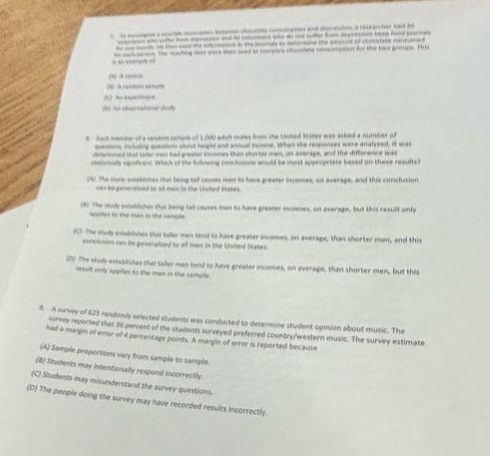
7. to investigate a possible association between cholesterol - concentration and diet, a researcher had 50 vegetarians and 50 non - vegetarians have their cholesterol measured. she also noted from three - day food diaries whether each person ate an average of more than 30 grams of fat per day or not. she then used the information to calculate the average cholesterol concentration for the two groups. this is an example of: (a) a review (b) an experiment (c) an observational study. 8. each member of a random sample of 1,000 adult males from the united states was asked a number of questions, including questions about height and annual income. when the responses were analyzed, it was found that taller men had higher incomes, on average, than shorter men. which of the following conclusions would be most appropriate based on these results? (a) the study establishes that tallness causes men to have greater incomes, on average, and this conclusion can be generalized to all men in the united states. (b) the study establishes that tallness causes men to have greater incomes, on average, but this result only applies to the men in the sample. (c) the study establishes that taller men tend to have greater incomes, on average, than shorter men, and this conclusion can be generalized to all men in the united states. (d) the study establishes that taller men tend to have greater incomes, on average, than shorter men, but this result only applies to the men in the sample. 9. a survey of 625 randomly selected students was conducted to determine student opinion about music. the survey reported that 36% of the students surveyed preferred country - western music. the survey estimate had a margin of error of 4 percentage points. the margin of error is reported because: (a) sample proportions vary from sample to sample. (b) students may intentionally respond incorrectly. (c) the people doing the survey may have recorded results incorrectly.
Answer
- Question 7:
- Explanation:
- Step 1: Understand the study types
- In an experiment, the researcher manipulates one or more variables. In an observational study, the researcher only observes and measures without manipulation. Here, the researcher is just observing the relationship between church - attendance and depression without manipulating any variables. So it is an observational study.
- Step 2: Analyze the options
- Option (A) is incorrect as it is not an experiment. Option (B) is correct as it is an observational study. Option (C) is incorrect as it is not a census (a census involves collecting data from every member of a population). Option (D) is incorrect as it is not a sample survey in the traditional sense of randomly sampling to estimate population parameters.
- Step 1: Understand the study types
- Answer: B. An observational study
- Explanation:
- Question 8:
- Explanation:
- Step 1: Analyze the sample and population
- The sample is 1,000 adult males from the United States. The study found that taller men in this sample tend to have greater incomes on average. Since the sample is from the United States, the conclusion can only be generalized to men in the United States.
- Step 2: Evaluate each option
- Option (A) is incorrect because we cannot generalize to all men in the United States based on this sample. Option (B) is incorrect as we cannot say it applies to all men in the world. Option (C) is correct as it correctly states that taller men in the United States tend to have greater incomes on average based on the sample. Option (D) is incorrect as it is too restrictive to say it only applies to the men in the sample when we can make a general statement about the population (men in the US) from which the sample is drawn.
- Step 1: Analyze the sample and population
- Answer: C. The study establishes that taller men tend to have greater incomes, on average, than shorter men, and this conclusion can be generalized to all men in the United States.
- Explanation:
- Question 9:
- Explanation:
- Step 1: Identify the source of error
- A margin of error is reported in a sample survey when the sample is used to estimate a population parameter. Here, the survey of 625 randomly - selected students is a sample survey. The margin of error is due to the fact that the sample is only a part of the population of all students, and there is sampling variability.
- Step 2: Analyze the options
- Option (A) is correct as the margin of error is due to sampling variability. Option (B) is incorrect as there is no indication of students intentionally responding incorrectly. Option (C) is incorrect as there is no evidence that students misread the questions. Option (D) is incorrect as there is no sign that the people doing the survey recorded results incorrectly.
- Step 1: Identify the source of error
- Answer: A. A sample proportion was used to estimate a population proportion.
- Explanation: