lesson 22.1 homework\n□ complete problems 1 - 5 for independent practice.\nwhen you are finished, check the…
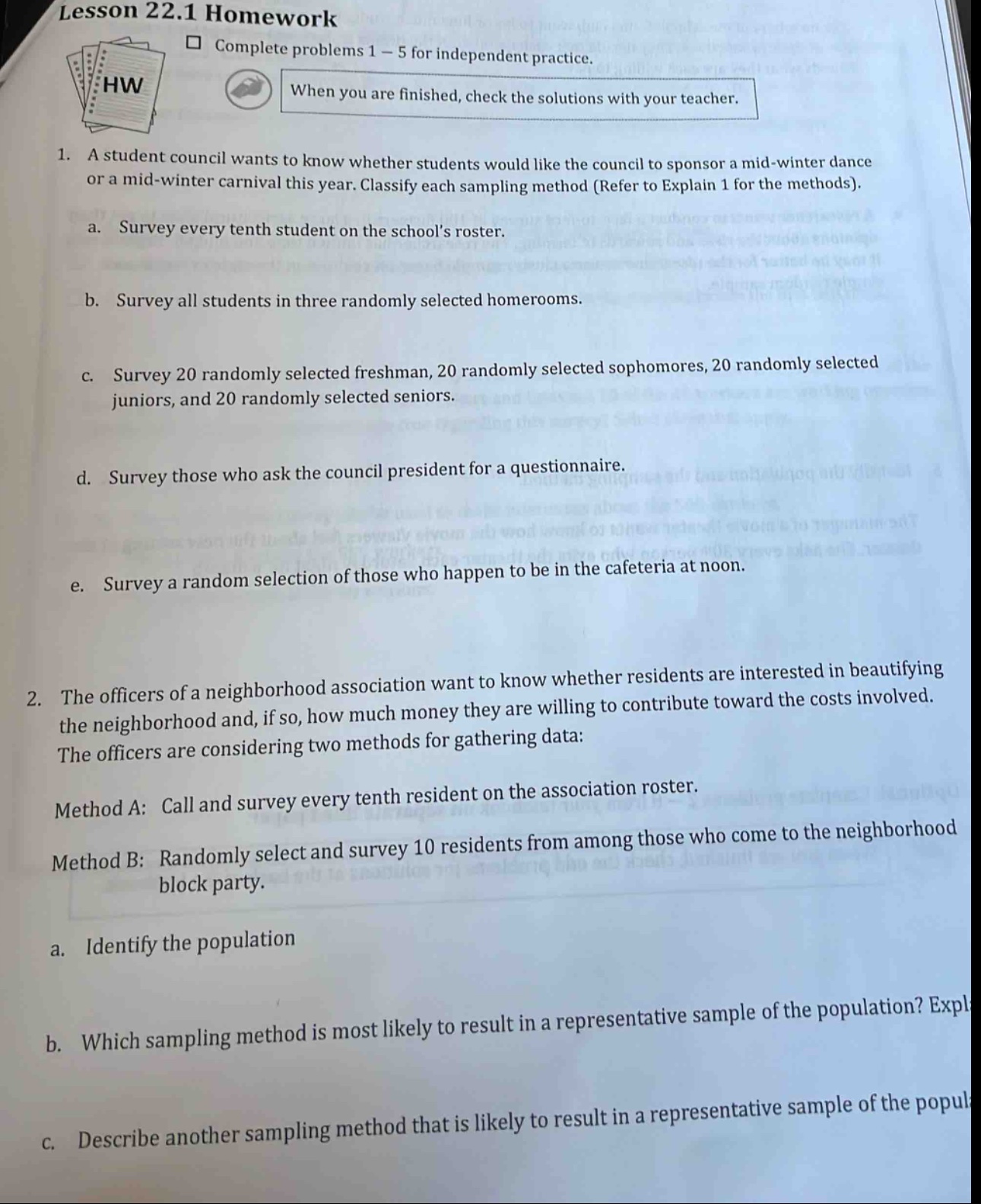
lesson 22.1 homework\n□ complete problems 1 - 5 for independent practice.\nwhen you are finished, check the solutions with your teacher.\n1. a student council wants to know whether students would like the council to sponsor a mid - winter dance or a mid - winter carnival this year. classify each sampling method (refer to explain 1 for the methods).\na. survey every tenth student on the schools roster.\nb. survey all students in three randomly selected homerooms.\nc. survey 20 randomly selected freshmen, 20 randomly selected sophomores, 20 randomly selected juniors, and 20 randomly selected seniors.\nd. survey those who ask the council president for a questionnaire.\ne. survey a random selection of those who happen to be in the cafeteria at noon.\n2. the officers of a neighborhood association want to know whether residents are interested in beautifying the neighborhood and, if so, how much money they are willing to contribute toward the costs involved. the officers are considering two methods for gathering data:\nmethod a: call and survey every tenth resident on the association roster.\nmethod b: randomly select and survey 10 residents from among those who come to the neighborhood block party.\na. identify the population\nb. which sampling method is most likely to result in a representative sample of the population? explain\nc. describe another sampling method that is likely to result in a representative sample of the population.
Answer
Brief Explanations:
- a. Systematic sampling as it selects every tenth student.
- b. Cluster sampling since it samples entire homerooms (clusters).
- c. Stratified sampling as it divides students by grade - level (strata) and samples from each.
- d. Voluntary - response sampling as students self - select by asking for a questionnaire.
- e. Convenience sampling as it samples from students in the cafeteria (a convenient location).
- a. The population is all residents of the neighborhood.
- b. Method A (systematic sampling from the roster) is more likely to be representative as it samples from the entire population list. Method B samples only from those at the block party, which may be a non - representative group.
- c. Randomly select a sample from a list of all neighborhood addresses. This would give every resident an equal chance of being selected and is likely to result in a representative sample.
Answer:
- a. Systematic sampling
- b. Cluster sampling
- c. Stratified sampling
- d. Voluntary - response sampling
- e. Convenience sampling
- a. All residents of the neighborhood
- b. Method A; it samples from the entire population list while Method B samples from a non - representative subset (block party attendees).
- c. Randomly select a sample from a list of all neighborhood addresses.