name:______ hour:______ date:______\nlesson 3.5: what is wrong with these surveys?\nidentify what is wrong…
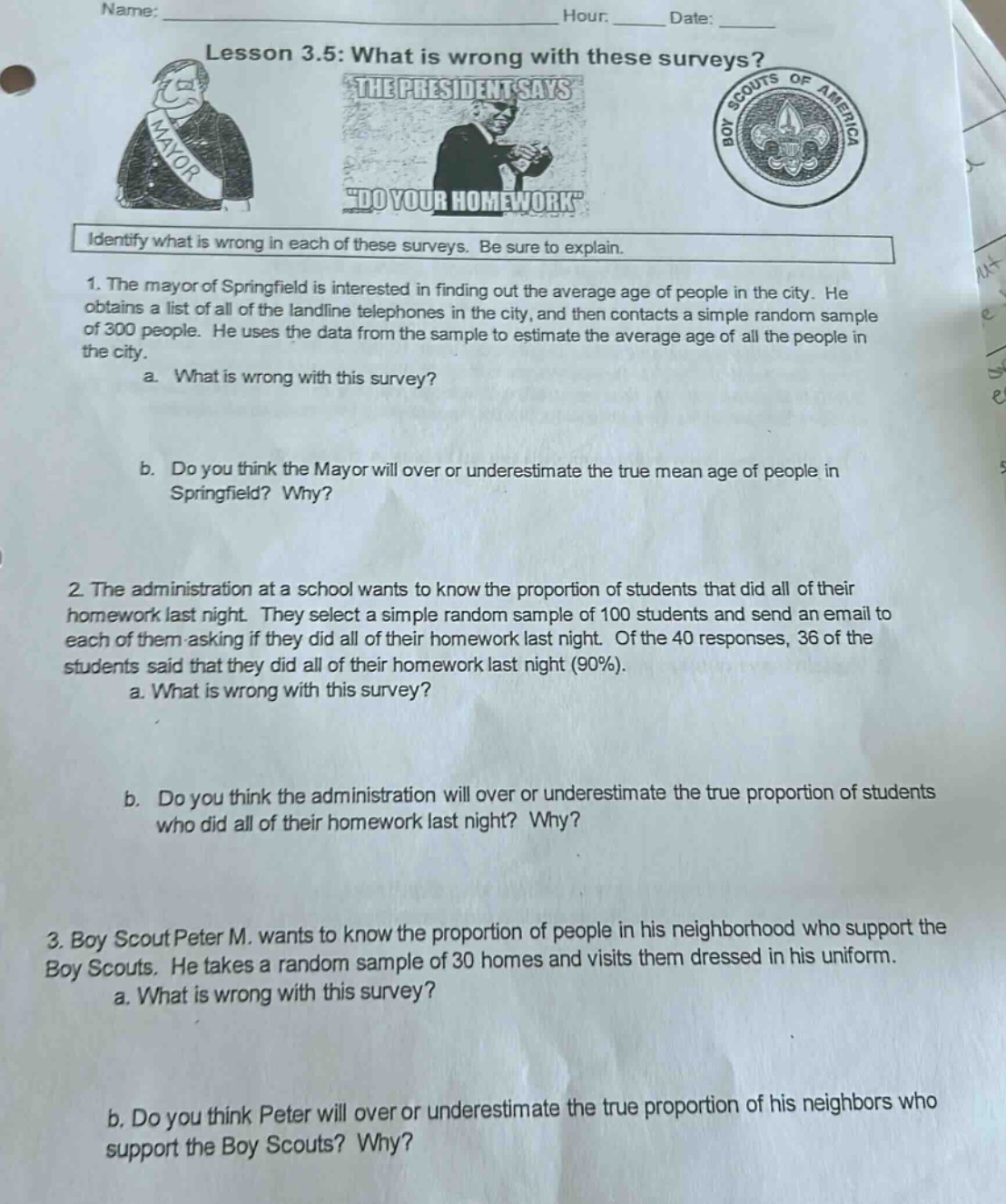
name:______ hour:______ date:______\nlesson 3.5: what is wrong with these surveys?\nidentify what is wrong in each of these surveys. be sure to explain.\n1. the mayor of springfield is interested in finding out the average age of people in the city. he obtains a list of all of the land - line telephones in the city, and then contacts a simple random sample of 300 people. he uses the data from the sample to estimate the average age of all the people in the city.\n a. what is wrong with this survey?\n b. do you think the mayor will over or underestimate the true mean age of people in springfield? why?\n2. the administration at a school wants to know the proportion of students that did all of their homework last night. they select a simple random sample of 100 students and send an email to each of them asking if they did all of their homework last night. of the 40 responses, 36 of the students said that they did all of their homework last night (90%).\n a. what is wrong with this survey?\n b. do you think the administration will over or underestimate the true proportion of students who did all of their homework last night? why?\n3. boy scout peter m. wants to know the proportion of people in his neighborhood who support the boy scouts. he takes a random sample of 30 homes and visits them dressed in his uniform.\n a. what is wrong with this survey?\n b. do you think peter will over or underestimate the true proportion of his neighbors who support the boy scouts? why?
Answer
Brief Explanations:
1.
a.
The sample is not representative. Using land - line telephone lists excludes people without land - lines, such as young people who may rely only on cell phones.
b.
The mayor may underestimate the true mean age. Younger people, who are more likely to not have land - lines and have a lower average age, are under - represented in the sample.
2.
a.
There is non - response bias. Only 40 out of 100 students responded, and those who responded may have different homework - completion habits than those who did not.
b.
The administration may overestimate the true proportion. Students who did their homework may be more likely to respond, inflating the reported proportion.
3.
a.
There is response bias. Peter's uniform may influence the responses of the neighbors, making them more likely to say they support the Boy Scouts.
b.
Peter may overestimate the true proportion. The presence of his uniform may lead neighbors to give positive responses even if they don't truly support the Boy Scouts.
Answer:
a. Sample is not representative as it excludes non - landline users. b. Underestimate, as younger non - landline users are under - represented. 2. a. Non - response bias due to low response rate. b. Overestimate, as homework - doers may be more likely to respond. 3. a. Response bias due to Peter's uniform influence. b. Overestimate, as the uniform may prompt positive responses.