when the null hypothesis in the chi square test for independence is true, there should be little difference…
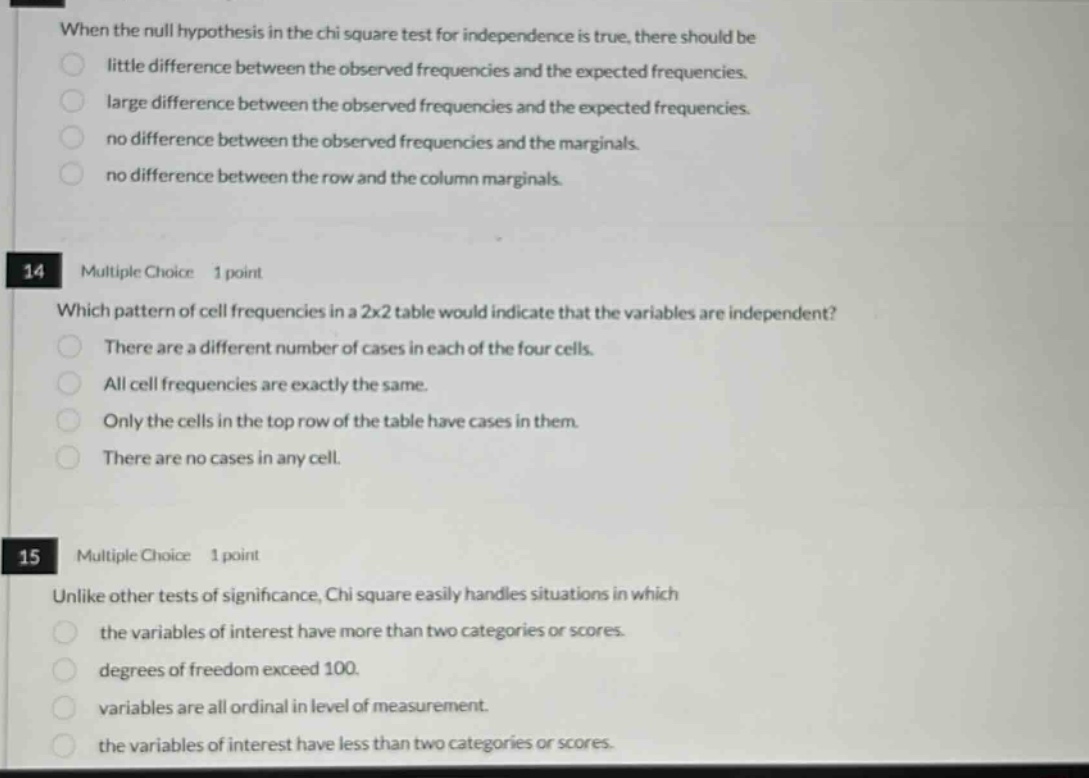
when the null hypothesis in the chi square test for independence is true, there should be little difference between the observed frequencies and the expected frequencies. large difference between the observed frequencies and the expected frequencies. no difference between the observed frequencies and the marginals. no difference between the row and the column marginals. 14 multiple choice 1 point which pattern of cell frequencies in a 2x2 table would indicate that the variables are independent? there are a different number of cases in each of the four cells. all cell frequencies are exactly the same. only the cells in the top row of the table have cases in them. there are no cases in any cell. 15 multiple choice 1 point unlike other tests of significance, chi square easily handles situations in which the variables of interest have more than two categories or scores. degrees of freedom exceed 100. variables are all ordinal in level of measurement. the variables of interest have less than two categories or scores.
Answer
Brief Explanations:
- In a chi - square test for independence, when the null hypothesis is true, the observed and expected frequencies should be similar. So, for the first question, little difference between observed and expected frequencies is correct.
- For a 2x2 table, if variables are independent, there is no specific pattern like all frequencies being the same or other given options. Independence means the distribution of one variable is not related to the other, and a different number of cases in each cell can occur under independence.
- Chi - square is useful when variables of interest have more than two categories or scores as it can handle multi - category situations well compared to some other significance tests.
Answer:
- little difference between the observed frequencies and the expected frequencies.
- There are a different number of cases in each of the four cells.
- the variables of interest have more than two categories or scores.