if the probability of raining tomorrow is 0.25, what is the probability that it will not rain? a. 1/2 b. 1/2…
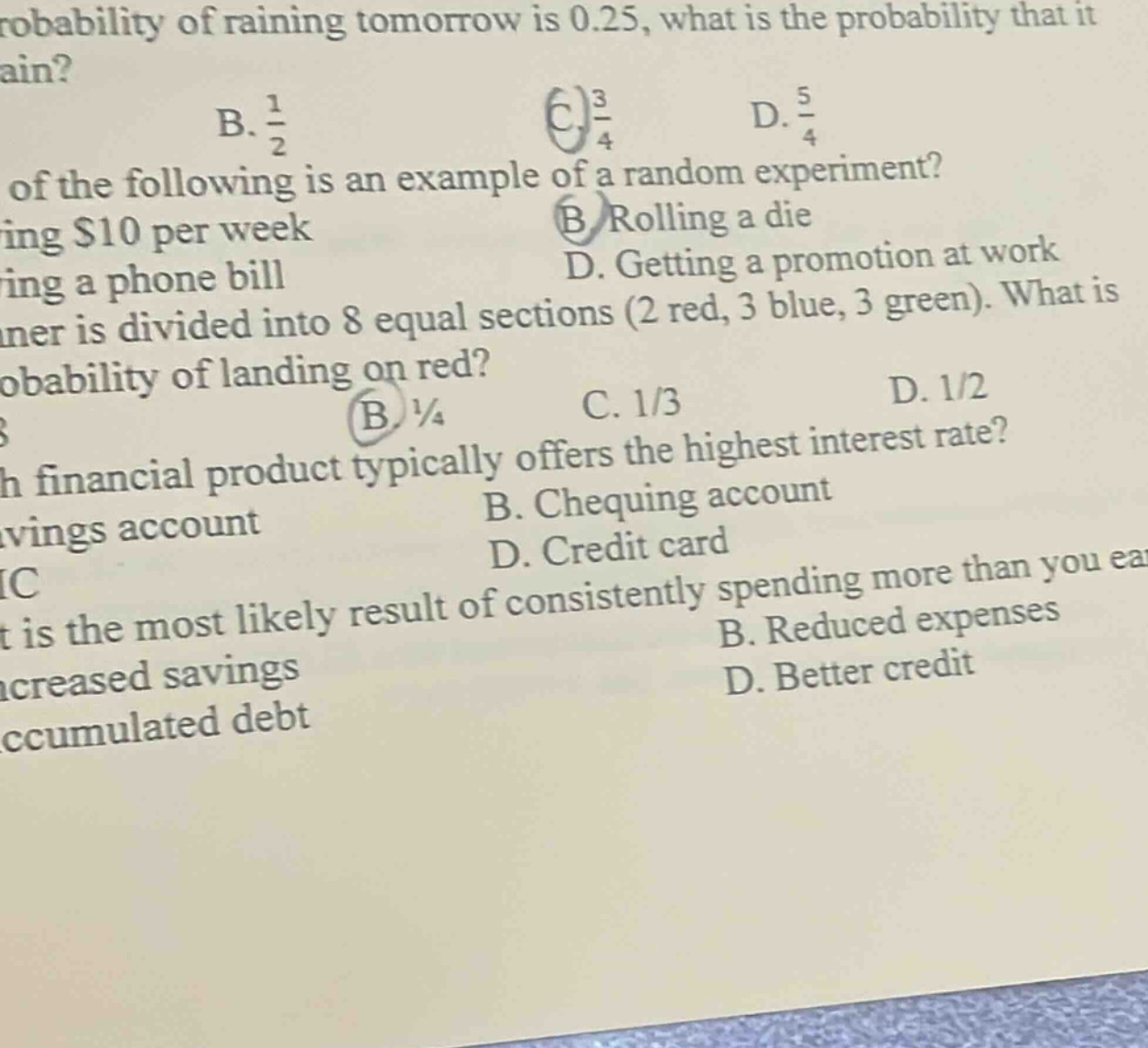
if the probability of raining tomorrow is 0.25, what is the probability that it will not rain? a. 1/2 b. 1/2 c. 3/4 d. 5/4\nwhich of the following is an example of a random experiment? a. saving $10 per week b. rolling a die c. paying a phone bill d. getting a promotion at work\na spinner is divided into 8 equal - sections (2 red, 3 blue, 3 green). what is the probability of landing on red? a. 1/4 b. 1/4 c. 1/3 d. 1/2\nwhich financial product typically offers the highest interest rate? a. savings account b. chequing account c. illegible d. credit card\nwhat is the most likely result of consistently spending more than you earn? a. increased savings b. reduced expenses c. accumulated debt d. better credit
Answer
- First probability - rain tomorrow:
-
Explanation:
-
Step1: Recall probability of complementary event
- The probability of an event (A) and its complement (\overline{A}) satisfy (P(A)+P(\overline{A}) = 1). Let (A) be the event of raining tomorrow with (P(A)=0.25).
- We want to find the probability of not - raining tomorrow, which is the complement of the event of raining tomorrow.
- Using the formula (P(\overline{A})=1 - P(A)).
-
Step2: Calculate the probability
- Substitute (P(A) = 0.25=\frac{1}{4}) into the formula. So (P(\overline{A})=1-\frac{1}{4}=\frac{3}{4}).
-
-
Answer: C. (\frac{3}{4})
-
- Random experiment:
-
Brief Explanations:
- A random experiment is an experiment whose outcome cannot be predicted with certainty before it is performed. Saving a fixed amount per week and paying a phone bill are deterministic. Getting a promotion at work has many non - random factors involved. Rolling a die has an uncertain outcome among 1, 2, 3, 4, 5, 6.
-
Answer: B. Rolling a die
-
- Spinner probability:
-
Explanation:
-
Step1: Use the probability formula
- The probability formula for an event (E) in a sample space (S) is (P(E)=\frac{n(E)}{n(S)}), where (n(E)) is the number of elements in the event (E) and (n(S)) is the number of elements in the sample space.
- Here, the sample space (n(S) = 8) (total number of sections on the spinner), and the number of red sections (n(E)=2) (number of red sections).
-
Step2: Calculate the probability
- Substitute (n(E) = 2) and (n(S)=8) into the formula (P(E)=\frac{n(E)}{n(S)}=\frac{2}{8}=\frac{1}{4}).
-
-
Answer: B. (\frac{1}{4})
-
- Financial product with highest interest rate:
-
Brief Explanations:
- Savings accounts typically offer a low but positive interest rate. Chequing accounts usually have very low or no interest rates. Credit cards are for borrowing money and have high interest rates for borrowing, but they don't offer interest on deposits. Certificates of deposit (not in the options but for context) and some high - yield savings accounts can offer relatively higher interest rates compared to regular savings accounts, but among the given options, savings accounts are more likely to offer some interest compared to chequing accounts.
-
Answer: A. Savings account
-
- Result of over - spending:
-
Brief Explanations:
- If you consistently spend more than you earn, you are using credit or borrowing money to cover the short - fall. This leads to accumulated debt over time. Reduced expenses would be the opposite of over - spending, increased savings is not possible when over - spending, and better credit is not a result of over - spending.
-
Answer: C. Accumulated debt
-