question 12 of 24\nthe rails to trails program refers to the conversion of old rail corridors into…
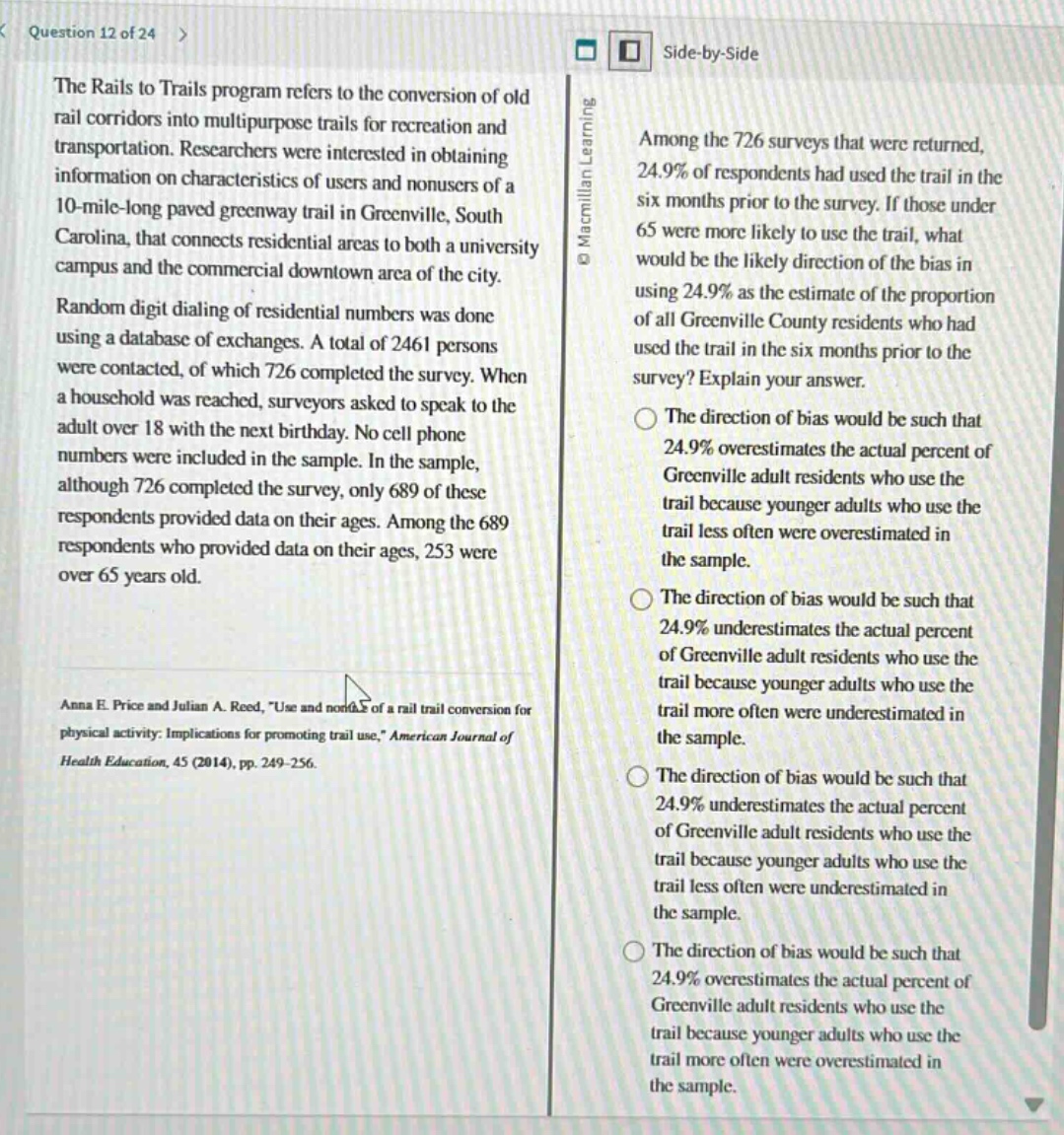
question 12 of 24\nthe rails to trails program refers to the conversion of old rail corridors into multipurpose trails for recreation and transportation. researchers were interested in obtaining information on characteristics of users and non - users of a 10 - mile - long paved greenway trail in greenville, south carolina, that connects residential areas to both a university campus and the commercial downtown area of the city. random digit dialing of residential numbers was done using a database of exchanges. a total of 2461 persons were contacted, of which 726 completed the survey. when a household was reached, surveyors asked to speak to the adult over 18 with the next birthday. no cell phone numbers were included in the sample. in the sample, although 726 completed the survey, only 689 of these respondents provided data on their ages. among the 689 respondents who provided data on their ages, 253 were over 65 years old.\namong the 726 surveys that were returned, 24.9% of respondents had used the trail in the six months prior to the survey. if those under 65 were more likely to use the trail, what would be the likely direction of the bias in using 24.9% as the estimate of the proportion of all greenville county residents who had used the trail in the six months prior to the survey? explain your answer.\nthe direction of bias would be such that 24.9% overestimates the actual percent of greenville adult residents who use the trail because younger adults who use the trail less often were overestimated in the sample.\nthe direction of bias would be such that 24.9% underestimates the actual percent of greenville adult residents who use the trail because younger adults who use the trail more often were underestimated in the sample.\nthe direction of bias would be such that 24.9% underestimates the actual percent of greenville adult residents who use the trail because younger adults who use the trail less often were underestimated in the sample.\nthe direction of bias would be such that 24.9% overestimates the actual percent of greenville adult residents who use the trail because younger adults who use the trail more often were overestimated in the sample.\nanna e. price and julian a. reed, \use and nonuse of a rail trail conversion for physical activity: implications for promoting trail use,\ american journal of health education, 45 (2014), pp. 249 - 256.
Answer
Brief Explanations:
Since those under 65 are more likely to use the trail and younger adults who use the trail more often were underestimated in the sample, the 24.9% estimate based on the sample will be lower than the actual proportion of all Greenville County residents who used the trail. So the 24.9% underestimates the actual percent of Greenville adult residents who use the trail.
Answer:
The direction of bias would be such that 24.9% underestimates the actual percent of Greenville adult residents who use the trail because younger adults who use the trail more often were underestimated in the sample.