question 41\nthe following spreadsheet shows results of a commute - time survey at a company for 17 randomly…
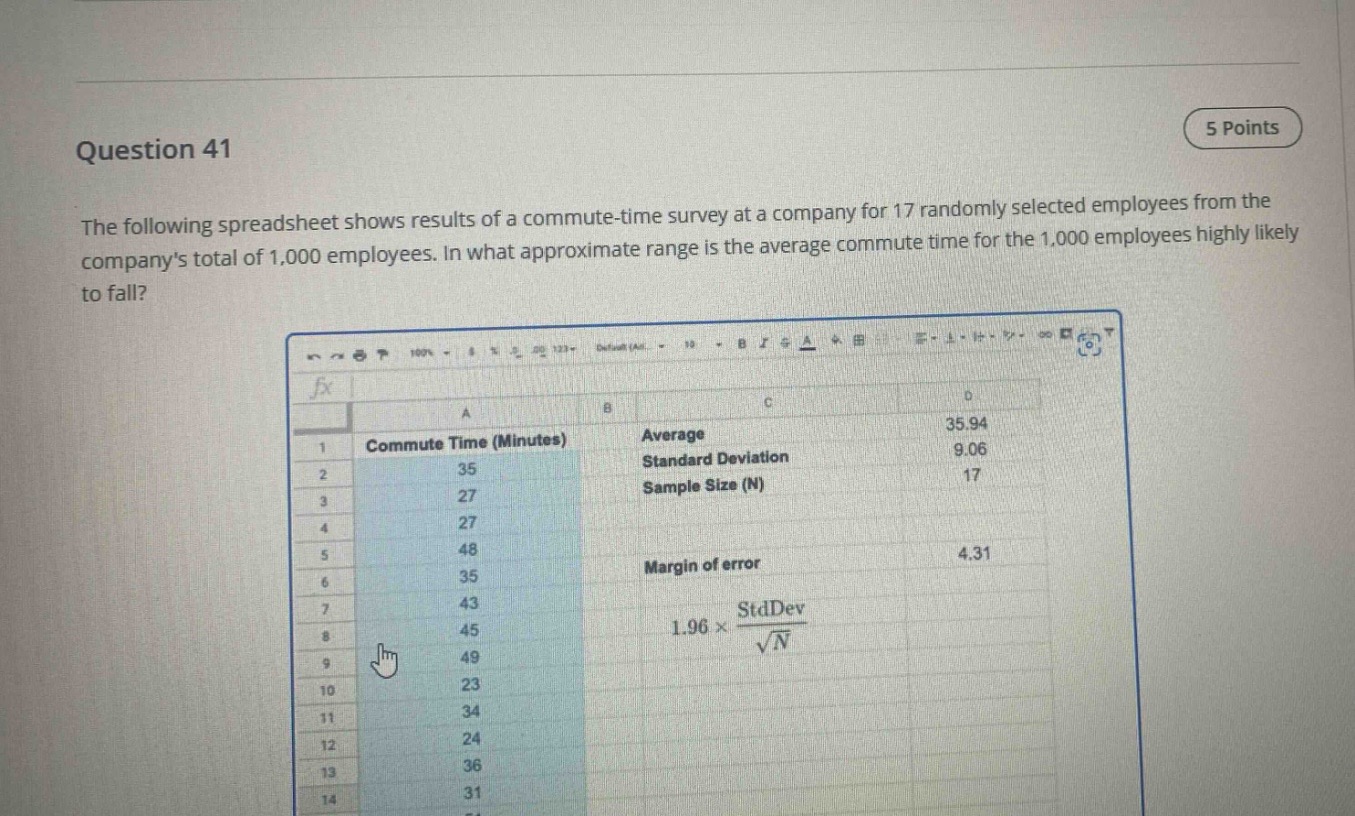
question 41\nthe following spreadsheet shows results of a commute - time survey at a company for 17 randomly selected employees from the companys total of 1,000 employees. in what approximate range is the average commute time for the 1,000 employees highly likely to fall?\n\n| | a | b | c | d |\n|--|--|--|--|--|\n| 1 | commute time (minutes) | average | 35.94 |\n| 2 | | standard deviation | 9.06 |\n| 3 | 35 | sample size (n) | 17 |\n| 4 | 27 | | |\n| 5 | 27 | | |\n| 6 | 48 | | |\n| 7 | 35 | | |\n| 8 | 43 | | |\n| 9 | 45 | | |\n| 10 | 49 | | |\n| 11 | 23 | | |\n| 12 | 34 | | |\n| 13 | 24 | | |\n| 14 | 36 | | |\n| 15 | 31 | | |\n| 16 | | margin of error | 4.31 |\n| 17 | | $1.96\times\frac{stddev}{sqrt{n}}$ | |
Answer
Answer:
The average commute - time for the 1000 employees is highly likely to fall in the range (35.94 - 4.31, 35.94 + 4.31), i.e., (31.63, 40.25) minutes.
Explanation:
Step1: Recall confidence - interval formula
For a large - sample or normal - distributed population, the confidence interval for the population mean is given by $\bar{x}\pm z\times\frac{s}{\sqrt{n}}$, where $\bar{x}$ is the sample mean, $z$ is the z - score, $s$ is the sample standard deviation, and $n$ is the sample size. Here, a 95% confidence level is assumed (since $z = 1.96$ is used), $\bar{x}=35.94$, $s = 9.06$, and $n = 17$.
Step2: Calculate the lower bound
Lower bound=$\bar{x}-z\times\frac{s}{\sqrt{n}}=35.94 - 4.31=31.63$.
Step3: Calculate the upper bound
Upper bound=$\bar{x}+z\times\frac{s}{\sqrt{n}}=35.94 + 4.31=40.25$.