j) a researcher is conducting a study of qcc students with a sample size of n = 100. which of the following…
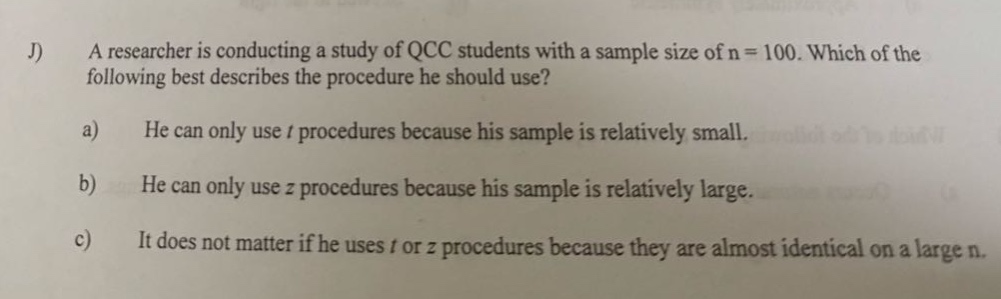
j) a researcher is conducting a study of qcc students with a sample size of n = 100. which of the following best describes the procedure he should use? a) he can only use t procedures because his sample is relatively small. b) he can only use z procedures because his sample is relatively large. c) it does not matter if he uses t or z procedures because they are almost identical on a large n.
Answer
Explanation:
Step1: Define sample - size criteria
In general, a sample size of (n = 100) is considered relatively large. When the sample size (n) is large ((n\geq30) is a common rule - of - thumb), the sampling distribution of the sample mean is approximately normal.
Step2: Analyze (t) and (z) procedures
For large samples, the (z) - procedures are appropriate when the population standard deviation (\sigma) is known. The (t) - procedures are used when the population standard deviation (\sigma) is unknown and is estimated by the sample standard deviation (s). However, as the sample size (n) gets large, the (t) - distribution approaches the standard normal ((z)) distribution. But the key here is that for a relatively large sample size like (n = 100), the (z) - procedures are more appropriate when the population standard deviation is known.
Answer:
b) He can only use (z) procedures because his sample is relatively large.