a researcher studied iron - deficiency anemia in women in each of two developing countries. differences in…
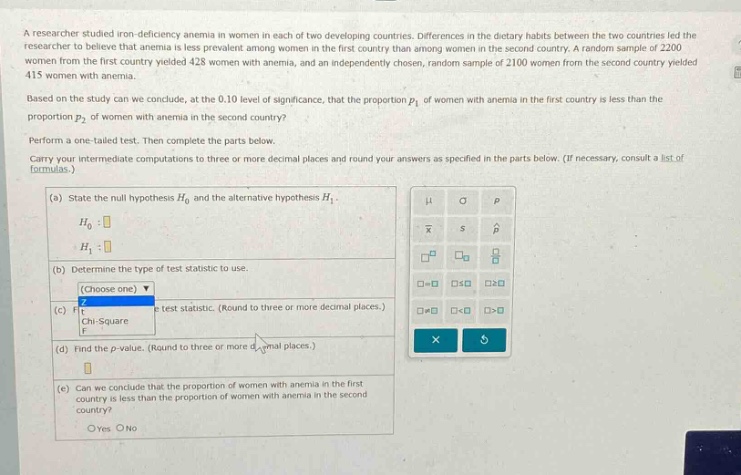
a researcher studied iron - deficiency anemia in women in each of two developing countries. differences in the dietary habits between the two countries led the researcher to believe that anemia is less prevalent among women in the first country than among women in the second country. a random sample of 2200 women from the first country yielded 428 women with anemia, and an independently chosen, random sample of 2100 women from the second country yielded 415 women with anemia. based on the study, can we conclude, at the 0.10 level of significance, that the proportion (p_1) of women with anemia in the first country is less than the proportion (p_2) of women with anemia in the second country? perform a one - tailed test. then complete the parts below. carry your intermediate computations to three or more decimal places and round your answers as specified in the parts below. (if necessary, consult a list of formulas.) (a) state the null hypothesis (h_0) and the alternative hypothesis (h_1). (h_0:) (h_1:) (b) determine the type of test statistic to use. (choose one) (c) find the value of the test statistic. (round to three or more decimal places.) (d) find the p - value. (round to three or more decimal places.) (e) can we conclude that the proportion of women with anemia in the first country is less than the proportion of women with anemia in the second country? oyes ono
Answer
Explanation:
Step1: State hypotheses
The null hypothesis (H_0:p_1 - p_2\geq0) (the proportion of women with anemia in the first country is greater than or equal to the proportion in the second country). The alternative hypothesis (H_1:p_1 - p_2<0) (the proportion of women with anemia in the first country is less than the proportion in the second country).
Step2: Determine test - statistic
We use the two - proportion z - test statistic since we are comparing two proportions. The formula for the two - proportion z - test statistic is (z=\frac{(\hat{p}_1-\hat{p}_2)- (p_1 - p_2)}{\sqrt{\hat{p}(1 - \hat{p})(\frac{1}{n_1}+\frac{1}{n_2})}}), where (\hat{p}_1=\frac{x_1}{n_1}), (\hat{p}_2=\frac{x_2}{n_2}), and (\hat{p}=\frac{x_1 + x_2}{n_1 + n_2}). Here, (n_1 = 2200), (x_1=428), (n_2 = 2100), (x_2 = 415). First, calculate (\hat{p}_1=\frac{428}{2200}\approx0.1945), (\hat{p}_2=\frac{415}{2100}\approx0.1976), and (\hat{p}=\frac{428 + 415}{2200+2100}=\frac{843}{4300}\approx0.1960). Then, (z=\frac{(0.1945 - 0.1976)-0}{\sqrt{0.1960\times(1 - 0.1960)\times(\frac{1}{2200}+\frac{1}{2100})}}) [=\frac{- 0.0031}{\sqrt{0.1960\times0.8040\times(\frac{2100 + 2200}{2200\times2100})}}] [=\frac{-0.0031}{\sqrt{0.1576\times\frac{4300}{4620000}}}] [=\frac{-0.0031}{\sqrt{0.1576\times0.000931}}] [=\frac{-0.0031}{\sqrt{0.0001467}}] [=\frac{-0.0031}{0.0121}\approx - 0.256]
Step3: Find p - value
Since this is a one - tailed test ((H_1:p_1 - p_2<0)), the p - value is (P(Z < - 0.256)). Using the standard normal distribution table, (P(Z < - 0.256)=0.399) (rounded to three decimal places).
Step4: Make a decision
The significance level (\alpha = 0.10). Since the p - value (0.399>0.10), we fail to reject the null hypothesis.
Answer:
(a) (H_0:p_1 - p_2\geq0), (H_1:p_1 - p_2<0) (b) Two - proportion z - test (c) (z\approx - 0.256) (d) (p - value\approx0.399) (e) No