a sample of 298 people is surveyed. the people are classified according to political affiliation…
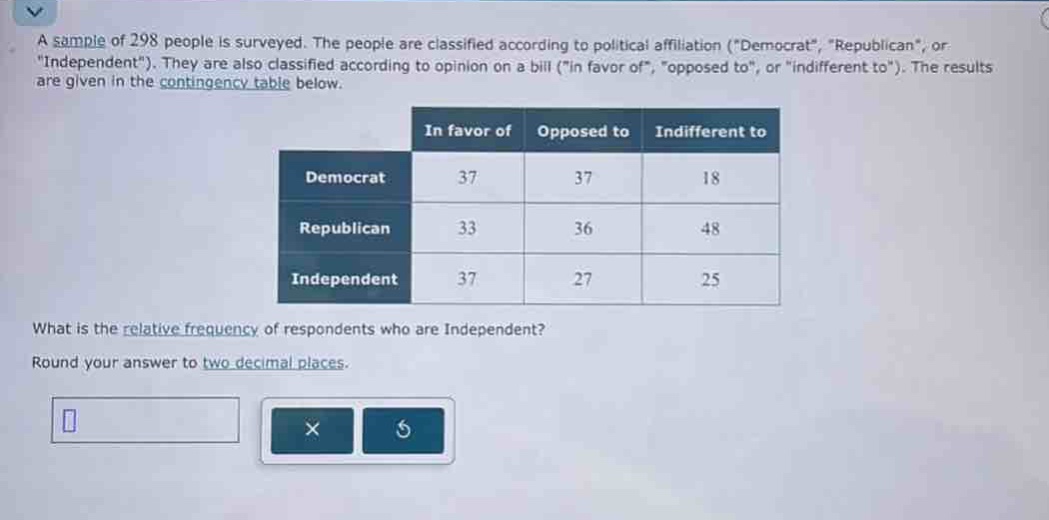
a sample of 298 people is surveyed. the people are classified according to political affiliation (\democrat\, \republican\, or \independent\). they are also classified according to opinion on a bill (\in favor of\, \opposed to\, or \indifferent to\). the results are given in the contingency table below.\n| |in favor of|opposed to|indifferent to|\n|--|--|--|--|\n|democrat|37|37|18|\n|republican|33|36|48|\n|independent|37|27|25|\nwhat is the relative frequency of respondents who are independent?\nround your answer to two decimal places.
Answer
Explanation:
Step1: Calculate total number of Independents
Add the number of Independents in each opinion - category: $37 + 27+25=89$.
Step2: Calculate relative - frequency
The relative frequency is the number of Independents divided by the total number of people surveyed. The total number of people surveyed is 298. So the relative frequency $r=\frac{89}{298}\approx0.30$.
Answer:
$0.30$