a social scientist collects information about study time for a random sample of 40 students with the…
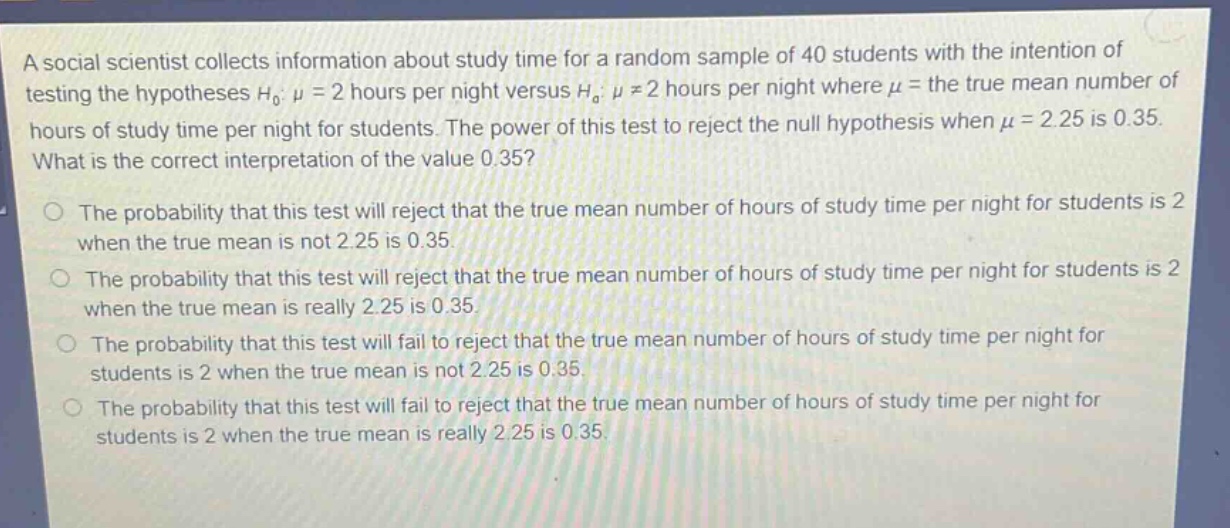
a social scientist collects information about study time for a random sample of 40 students with the intention of testing the hypotheses h0: μ = 2 hours per night versus ha: μ ≠ 2 hours per night where μ = the true mean number of hours of study time per night for students. the power of this test to reject the null hypothesis when μ = 2.25 is 0.35. what is the correct interpretation of the value 0.35? the probability that this test will reject that the true mean number of hours of study time per night for students is 2 when the true mean is not 2.25 is 0.35. the probability that this test will reject that the true mean number of hours of study time per night for students is 2 when the true mean is really 2.25 is 0.35. the probability that this test will fail to reject that the true mean number of hours of study time per night for students is 2 when the true mean is not 2.25 is 0.35. the probability that this test will fail to reject that the true mean number of hours of study time per night for students is 2 when the true mean is really 2.25 is 0.35.
Answer
Brief Explanations:
The power of a hypothesis - test is the probability of correctly rejecting the null hypothesis ($H_0$) when the alternative hypothesis ($H_a$) is true. Here, $H_0:\mu = 2$ and $H_a:\mu\neq2$, and we are considering the case when the true - mean $\mu = 2.25$. So, the power of 0.35 is the probability of rejecting $H_0$ (that the true mean number of hours of study time per night for students is 2) when the true mean is really 2.25.
Answer:
The probability that this test will reject that the true mean number of hours of study time per night for students is 2 when the true mean is really 2.25 is 0.35.