a study was conducted to determine how many undergraduates at a university are familiar with a new financial…
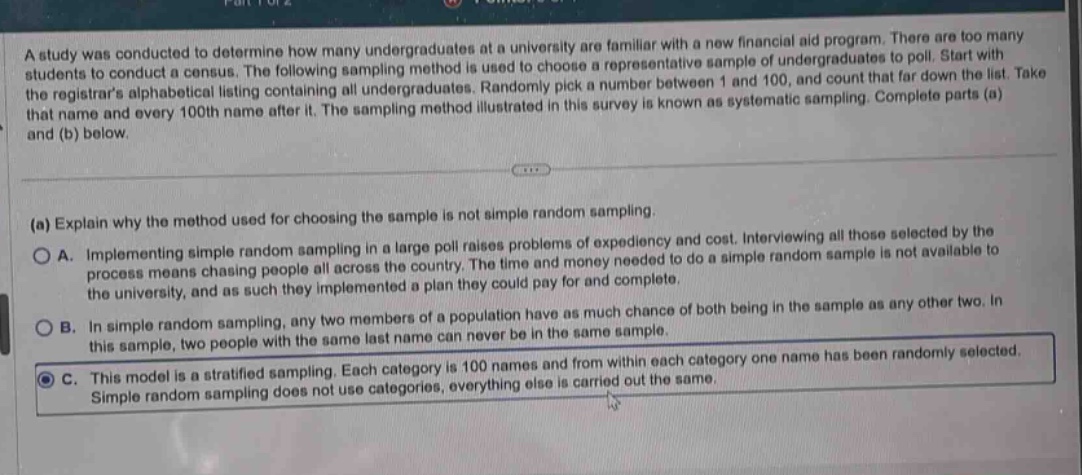
a study was conducted to determine how many undergraduates at a university are familiar with a new financial aid program. there are too many students to conduct a census. the following sampling method is used to choose a representative sample of undergraduates to poll. start with the registrars alphabetical listing containing all undergraduates. randomly pick a number between 1 and 100, and count that far down the list. take that name and every 100th name after it. the sampling method illustrated in this survey is known as systematic sampling. complete parts (a) and (b) below.\n\n(a) explain why the method used for choosing the sample is not simple random sampling.\n\na. implementing simple random sampling in a large poll raises problems of expediency and cost. interviewing all those selected by the process means chasing people all across the country. the time and money needed to do a simple random sample is not available to the university, and as such they implemented a plan they could pay for and complete.\n\nb. in simple random sampling, any two members of a population have as much chance of both being in the sample as any other two. in this sample, two people with the same last name can never be in the same sample.\n\nc. this model is a stratified sampling. each category is 100 names and from within each category one name has been randomly selected. simple random sampling does not use categories, everything else is carried out the same.
Answer
Brief Explanations:
In simple random sampling, every possible sample of the given size has an equal chance of being selected. In systematic sampling (the method used here), once the first - element is chosen, the rest of the sample is determined by a fixed interval (in this case, every 100th name). So, not all possible samples have an equal chance of being selected. Option B correctly states that in simple random sampling, any two members of a population have as much chance of both being in the sample as any other two, which is not the case in the given systematic sampling method. Option A is about the practicality of simple random sampling in a large - scale poll, not about the difference in sampling methods. Option C is incorrect as the method is systematic sampling, not stratified sampling.
Answer:
B. In simple random sampling, any two members of a population have as much chance of both being in the sample as any other two. In this sample, two people with the same last name can never be in the same sample.