a study of seat belt users and nonusers yielded the randomly selected sample data summarized in the…
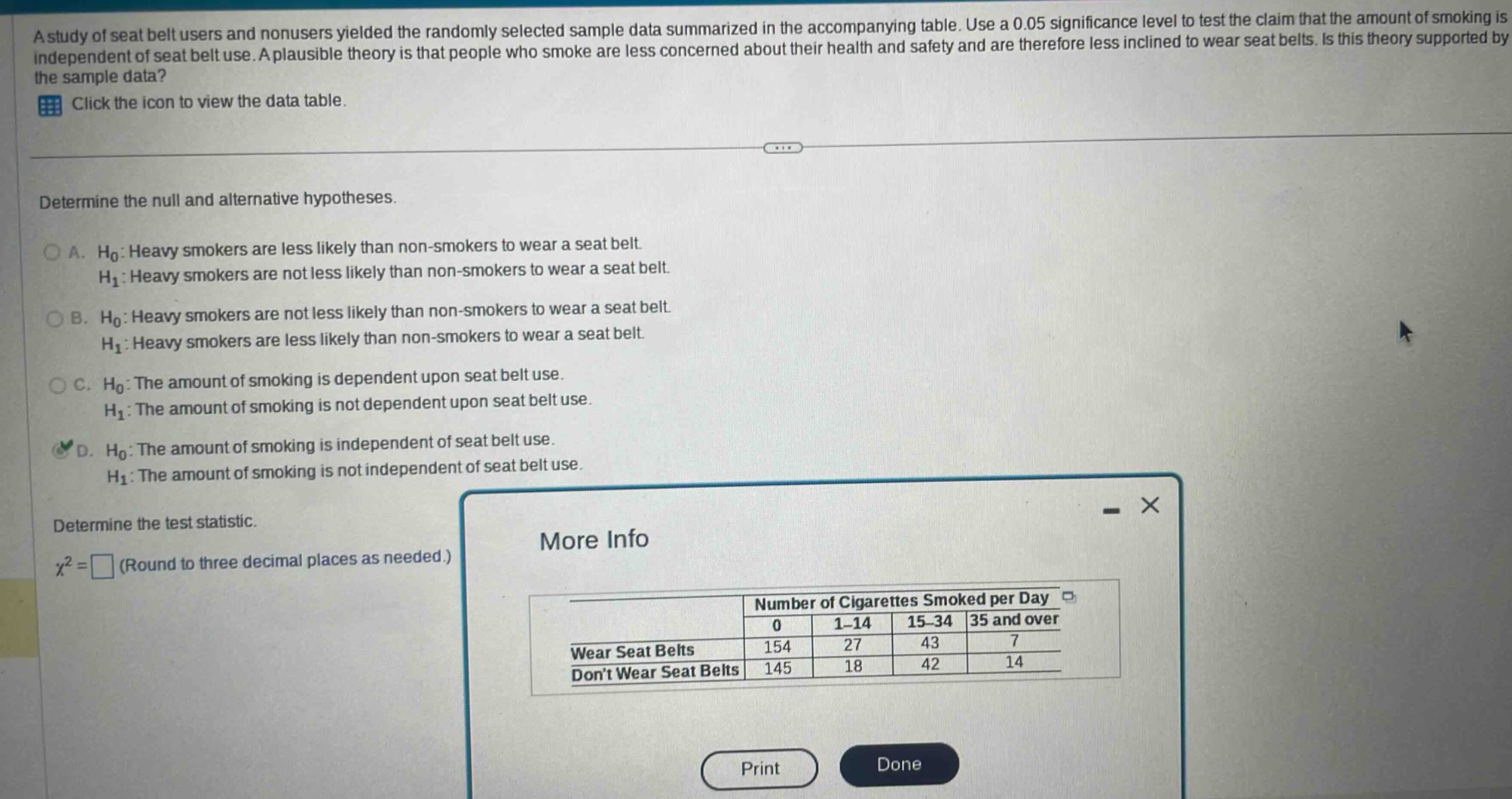
a study of seat belt users and nonusers yielded the randomly selected sample data summarized in the accompanying table. use a 0.05 significance level to test the claim that the amount of smoking is independent of seat belt use. a plausible theory is that people who smoke are less concerned about their health and safety and are therefore less inclined to wear seat belts. is this theory supported by the sample data? click the icon to view the data table. determine the null and alternative hypotheses. a. $h_0$: heavy smokers are less likely than non - smokers to wear a seat belt. $h_1$: heavy smokers are not less likely than non - smokers to wear a seat belt. b. $h_0$: heavy smokers are not less likely than non - smokers to wear a seat belt. $h_1$: heavy smokers are less likely than non - smokers to wear a seat belt. c. $h_0$: the amount of smoking is dependent upon seat belt use. $h_1$: the amount of smoking is not dependent upon seat belt use. d. $h_0$: the amount of smoking is independent of seat belt use. $h_1$: the amount of smoking is not independent of seat belt use. determine the test statistic. $chi^{2}=square$ (round to three decimal places as needed.) more info number of cigarettes smoked per day 0 1 - 14 15 - 34 35 and over wear seat belts 154 27 43 7 dont wear seat belts 145 18 42 14
Answer
Explanation:
Step1: Identify hypotheses
The null hypothesis $H_0$ for a test of independence is that the two variables (amount of smoking and seat - belt use) are independent. The alternative hypothesis $H_1$ is that they are not independent. So $H_0$: The amount of smoking is independent of seat belt use; $H_1$: The amount of smoking is not independent of seat belt use.
Step2: Calculate expected frequencies
First, find the row totals, column totals and grand total. Row 1 total ($R_1$): $154 + 27+43 + 7=231$ Row 2 total ($R_2$): $145 + 18+42 + 14=219$ Column 1 total ($C_1$): $154+145 = 299$ Column 2 total ($C_2$): $27 + 18=45$ Column 3 total ($C_3$): $43+42 = 85$ Column 4 total ($C_4$): $7+14 = 21$ Grand total ($N$): $231+219=450$ The expected frequency formula for a cell in a contingency - table is $E_{ij}=\frac{R_i\times C_j}{N}$. For example, for the cell of "Wear Seat Belts" and "0 cigarettes smoked per day": $E_{11}=\frac{231\times299}{450}\approx153.98$ Calculate all expected frequencies:
| 0 | 1 - 14 | 15 - 34 | 35 and over | |
|---|---|---|---|---|
| Wear Seat Belts | $E_{11}\approx153.98$ | $E_{12}=\frac{231\times45}{450}=23.1$ | $E_{13}=\frac{231\times85}{450}\approx43.83$ | $E_{14}=\frac{231\times21}{450}\approx10.78$ |
| Don't Wear Seat Belts | $E_{21}=\frac{219\times299}{450}\approx145.02$ | $E_{22}=\frac{219\times45}{450}=21.9$ | $E_{23}=\frac{219\times85}{450}\approx41.17$ | $E_{24}=\frac{219\times21}{450}\approx10.22$ |
Step3: Calculate the chi - square test statistic
The chi - square test statistic formula is $\chi^{2}=\sum\frac{(O - E)^{2}}{E}$, where $O$ is the observed frequency and $E$ is the expected frequency. For the cell of "Wear Seat Belts" and "0 cigarettes smoked per day": $\frac{(154 - 153.98)^{2}}{153.98}\approx0.0000026$ Sum up for all cells: [ \begin{align*} \chi^{2}&=\frac{(154 - 153.98)^{2}}{153.98}+\frac{(27 - 23.1)^{2}}{23.1}+\frac{(43 - 43.83)^{2}}{43.83}+\frac{(7 - 10.78)^{2}}{10.78}+\frac{(145 - 145.02)^{2}}{145.02}+\frac{(18 - 21.9)^{2}}{21.9}+\frac{(42 - 41.17)^{2}}{41.17}+\frac{(14 - 10.22)^{2}}{10.22}\ &\approx0.0000026+\frac{15.21}{23.1}+\frac{0.6889}{43.83}+\frac{14.2884}{10.78}+\frac{0.0004}{145.02}+\frac{15.21}{21.9}+\frac{0.6889}{41.17}+\frac{14.2884}{10.22}\ &\approx0.0000026 + 0.66 + 0.016+1.33+0.0000027+0.69+0.017+1.4\ &\approx4.130 \end{align*} ]
Answer:
D. $H_0$: The amount of smoking is independent of seat belt use; $H_1$: The amount of smoking is not independent of seat belt use $\chi^{2}=4.130$