a survey asks respondents to rate their political views on a seven - point scale, where 1 = extremely…
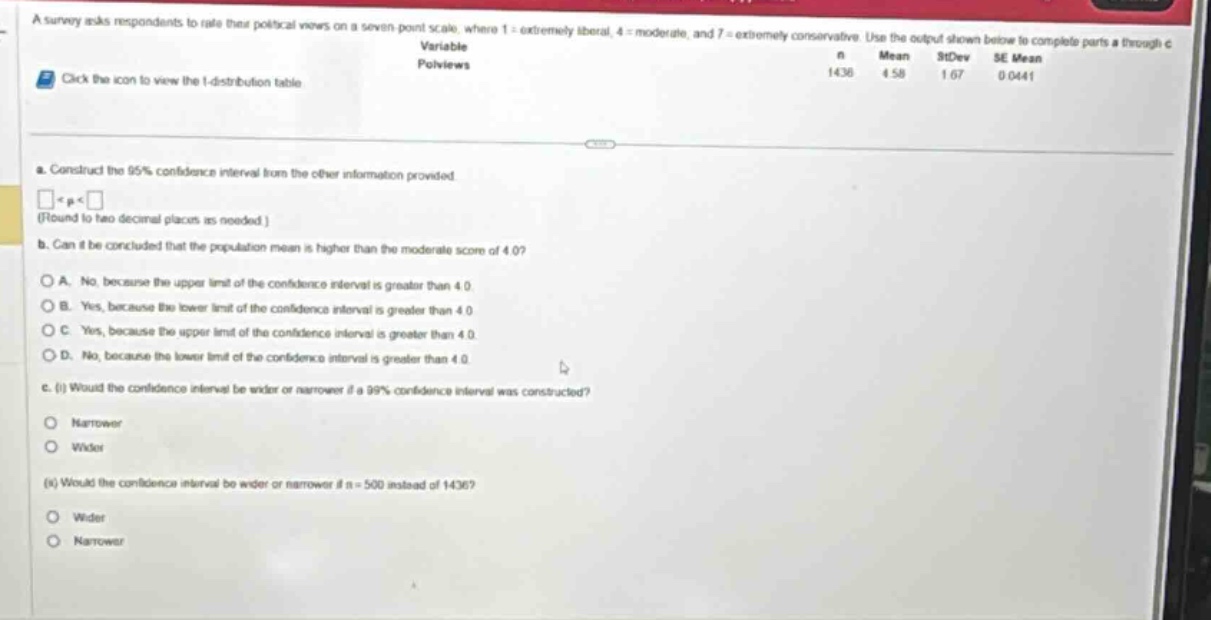
a survey asks respondents to rate their political views on a seven - point scale, where 1 = extremely liberal, 4 = moderate, and 7 = extremely conservative. use the output shown below to complete parts a through c. variable polviews n mean stdev se mean 1436 4.58 1.67 0.0441 click the icon to view the t - distribution table. a. construct the 95% confidence interval from the other information provided. □<μ<□ (round to two decimal places as needed.) b. can it be concluded that the population mean is higher than the moderate score of 4.0? a. no, because the upper limit of the confidence interval is greater than 4.0 b. yes, because the lower limit of the confidence interval is greater than 4.0 c. yes, because the upper limit of the confidence interval is greater than 4.0 d. no, because the lower limit of the confidence interval is greater than 4.0 c. (i) would the confidence interval be wider or narrower if a 99% confidence interval was constructed? narrower wider (ii) would the confidence interval be wider or narrower if n = 500 instead of 1436? wider narrower
Answer
Explanation:
Step1: Identify the formula for confidence - interval
For a large - sample (since (n = 1436) is large), the confidence interval for the population mean (\mu) is given by (\bar{x}\pm z_{\alpha/2}\times SE), where (\bar{x}) is the sample mean, (SE) is the standard error of the mean, and (z_{\alpha/2}) is the z - value corresponding to the level of confidence. For a 95% confidence interval, (\alpha=1 - 0.95 = 0.05), so (\alpha/2=0.025) and (z_{\alpha/2}=1.96). Given (\bar{x}=4.58) and (SE = 0.0441).
Step2: Calculate the lower limit of the confidence interval
The lower limit (L=\bar{x}-z_{\alpha/2}\times SE=4.58-1.96\times0.0441). [L = 4.58-1.96\times0.0441=4.58 - 0.086436\approx4.49]
Step3: Calculate the upper limit of the confidence interval
The upper limit (U=\bar{x}+z_{\alpha/2}\times SE=4.58 + 1.96\times0.0441). [U=4.58+1.96\times0.0441=4.58 + 0.086436\approx4.67]
Step4: Answer part b
Since the lower limit of the 95% confidence interval ((4.49)) is greater than (4.0), we can conclude that the population mean is higher than the moderate score of (4.0).
Step5: Answer part c(i)
A 99% confidence interval has a larger (z_{\alpha/2}) value. For a 99% confidence interval, (\alpha = 1-0.99 = 0.01), (\alpha/2=0.005), and (z_{\alpha/2}=2.576). Since the margin of error (E = z_{\alpha/2}\times SE) and (z_{\alpha/2}) is larger for a 99% confidence interval, the confidence interval will be wider.
Step6: Answer part c(ii)
The standard error (SE=\frac{\sigma}{\sqrt{n}}). When (n) increases, (SE) decreases. If (n) changes from (n_1 = 1436) to (n_2 = 500), and the margin of error (E = z_{\alpha/2}\times SE), since (SE) is inversely proportional to (\sqrt{n}), a smaller (n) (from 1436 to 500) will result in a larger (SE) and thus a wider confidence interval.
Answer:
a. (4.49<\mu<4.67) b. B. Yes, because the lower limit of the confidence interval is greater than 4.0 c. (i) Wider (ii) Wider