5. which task is not a component of an observational study? 1) the researcher decides who will make up the…
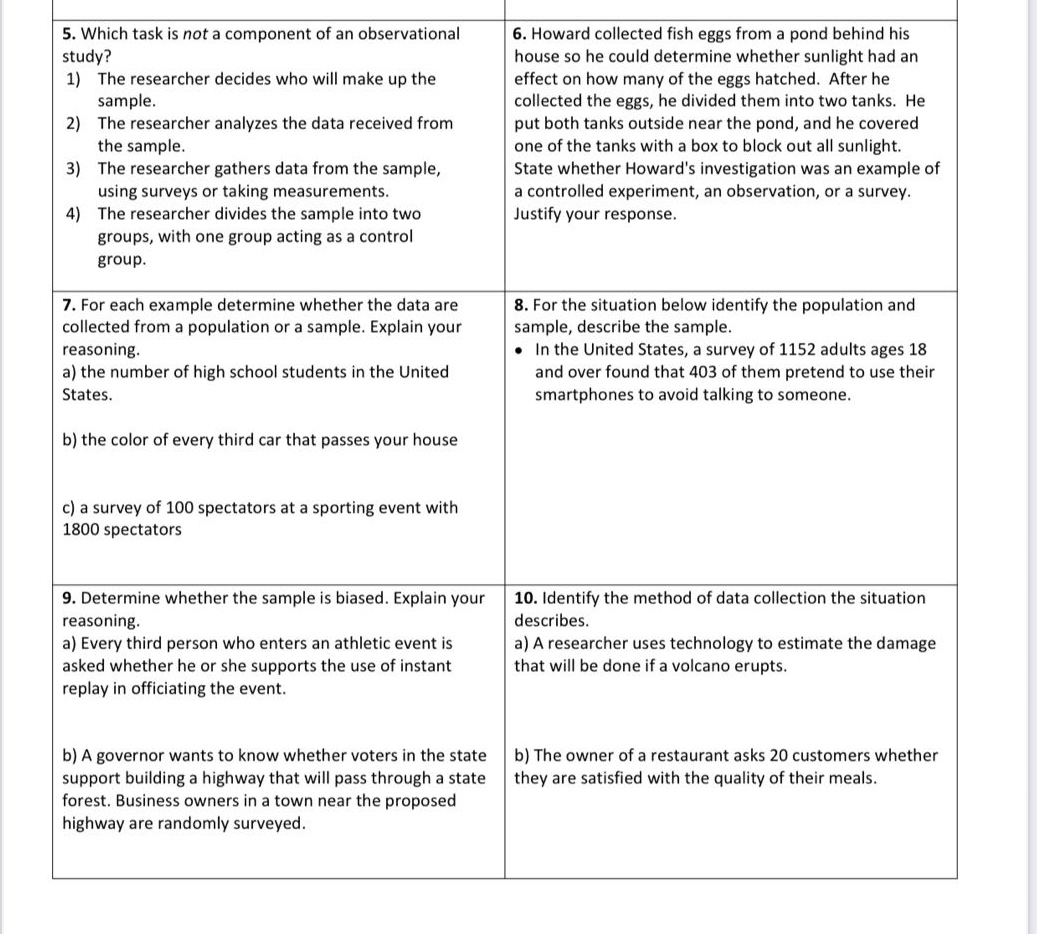
5. which task is not a component of an observational study? 1) the researcher decides who will make up the sample. 2) the researcher analyzes the data received from the sample. 3) the researcher gathers data from the sample, using surveys or taking measurements. 4) the researcher divides the sample into two groups, with one group acting as a control group. 6. howard collected fish eggs from a pond behind his house so he could determine whether sunlight had an effect on how many of the eggs hatched. after he collected the eggs, he divided them into two tanks. he put both tanks outside near the pond, and he covered one of the tanks with a box to block out all sunlight. state whether howards investigation was an example of a controlled experiment, an observation, or a survey. justify your response. 7. for each example determine whether the data are collected from a population or a sample. explain your reasoning. a) the number of high school students in the united states. b) the color of every third car that passes your house c) a survey of 100 spectators at a sporting event with 1800 spectators 8. for the situation below identify the population and sample, describe the sample. • in the united states, a survey of 1152 adults ages 18 and over found that 403 of them pretend to use their smartphones to avoid talking to someone. 9. determine whether the sample is biased. explain your reasoning. a) every third person who enters an athletic event is asked whether he or she supports the use of instant replay in officiating the event. b) a governor wants to know whether voters in the state support building a highway that will pass through a state forest. business owners in a town near the proposed highway are randomly surveyed. 10. identify the method of data collection the situation describes. a) a researcher uses technology to estimate the damage that will be done if a volcano erupts. b) the owner of a restaurant asks 20 customers whether they are satisfied with the quality of their meals.
Answer
5.
Brief Explanations:
In an observational study, the researcher does not manipulate variables like dividing into control - experimental groups. This is more of an experimental study action.
Answer:
- The researcher divides the sample into two groups, with one group acting as a control group.
6.
Brief Explanations:
Howard has a control group (tank with no sunlight) and an experimental group (tank with sunlight), and he manipulates the sunlight variable to observe the effect on egg - hatching. This is the characteristic of a controlled experiment.
Answer:
It was a controlled experiment. He had a control group (tank covered to block sunlight) and an experimental group (tank with sunlight) to observe the effect of sunlight on egg - hatching.
7.
Brief Explanations:
a) The number of high - school students in the US is the entire population as it refers to all high - school students in the country. b) The color of every third car is a sample as it is a subset of all cars passing the house. c) The survey of 100 spectators out of 1800 is a sample since it is a part of the total 1800 spectators.
Answer:
a) Population. It represents all high - school students in the US. b) Sample. It is a subset of all cars passing the house. c) Sample. It is a part of the 1800 spectators.
8.
Brief Explanations:
The population is all adults 18 and over in the United States. The sample is the 1152 adults surveyed. The sample is a group of 1152 adults ages 18 and over who were surveyed about pretending to use smartphones to avoid talking to someone.
Answer:
Population: All adults 18 and over in the United States. Sample: 1152 adults ages 18 and over. The sample consists of 1152 adults surveyed about smartphone - related behavior.
9.
Brief Explanations:
a) This may be unbiased as it is a systematic random selection. Every third person has an equal chance of being selected. b) This is biased. Business owners near the proposed highway may have a different opinion than the general voting population due to self - interest related to the highway's impact on their businesses.
Answer:
a) Unbiased. Systematic random selection gives each person an equal chance of being selected. b) Biased. Business owners near the highway may have self - interest that affects their opinions.
10.
Brief Explanations:
a) The researcher is using a simulation (using technology to estimate volcanic damage) as a data - collection method. b) The restaurant owner is using a survey, asking 20 customers about their satisfaction.
Answer:
a) Simulation. Using technology to estimate volcanic damage is a form of simulation. b) Survey. Asking customers about meal quality is a survey.