the f - test statistic is formed by taking the of two separate estimates of , where the estimate in the…
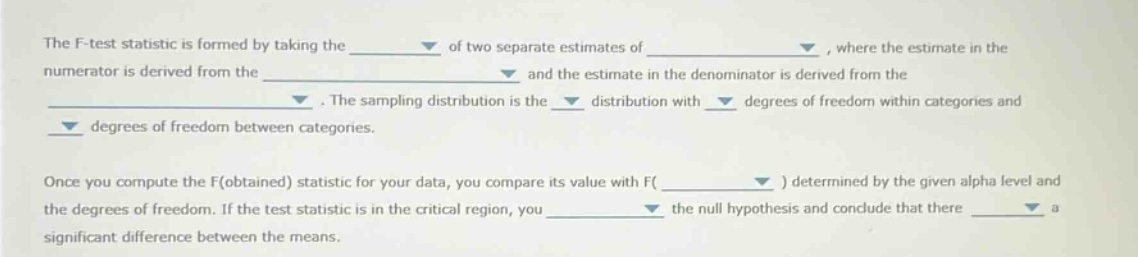
the f - test statistic is formed by taking the of two separate estimates of , where the estimate in the numerator is derived from the and the estimate in the denominator is derived from the . the sampling distribution is the distribution with degrees of freedom within categories and degrees of freedom between categories. once you compute the f(obtained) statistic for your data, you compare its value with f( ) determined by the given alpha level and the degrees of freedom. if the test statistic is in the critical region, you the null hypothesis and conclude that there a significant difference between the means.
Answer
Brief Explanations:
The F - test statistic is the ratio of two variance estimates. The numerator variance estimate comes from between - groups variance and the denominator from within - groups variance. The sampling distribution is F - distribution with degrees of freedom within and between categories. We compare the obtained F - statistic with the critical F - value at a given alpha level. If in the critical region, we reject the null hypothesis and conclude there is a significant difference between means.
Answer:
The F - test statistic is formed by taking the ratio of two separate estimates of variance, where the estimate in the numerator is derived from the between - groups variance and the estimate in the denominator is derived from the within - groups variance. The sampling distribution is the F distribution with degrees of freedom within categories and degrees of freedom between categories. Once you compute the F(obtained) statistic for your data, you compare its value with F(critical) determined by the given alpha level and the degrees of freedom. If the test statistic is in the critical region, you reject the null hypothesis and conclude that there is a significant difference between the means.