2. for the three - part question that follows, provide your answer to each part in the given workspace…
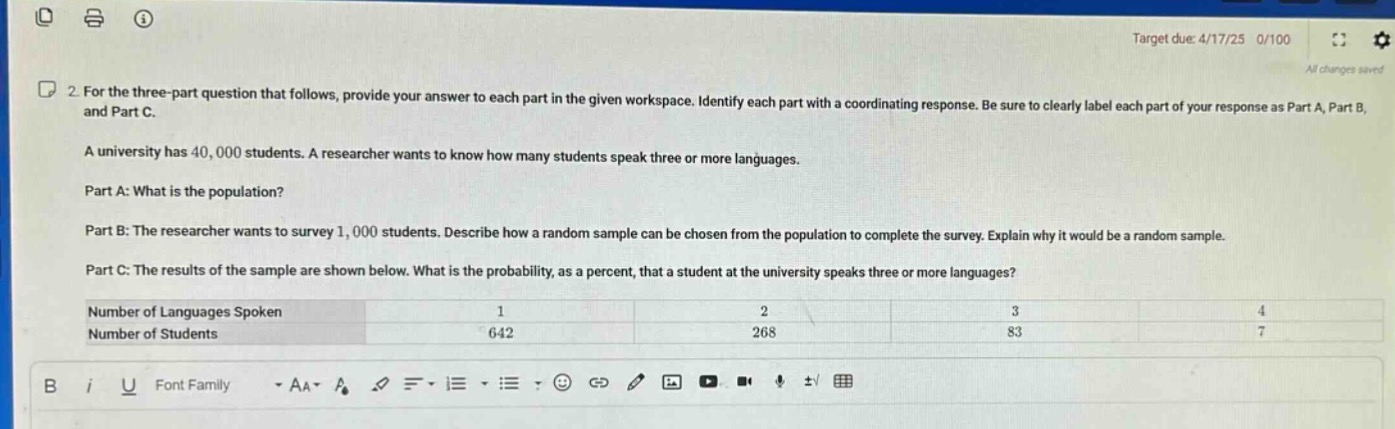
2. for the three - part question that follows, provide your answer to each part in the given workspace. identify each part with a coordinating response. be sure to clearly label each part of your response as part a, part b, and part c.\na university has 40,000 students. a researcher wants to know how many students speak three or more languages.\npart a: what is the population?\npart b: the researcher wants to survey 1,000 students. describe how a random sample can be chosen from the population to complete the survey. explain why it would be a random sample.\npart c: the results of the sample are shown below. what is the probability, as a percent, that a student at the university speaks three or more languages?\n|number of languages spoken|1|2|3|4|\n|----|----|----|----|----|\n|number of students|642|268|83|7|
Answer
Explanation:
Part A:
The population is the entire group of interest. Here, the group of interest is all students at the university. The population is 40,000 students.
Part B:
One way to choose a random sample is to assign each of the 40,000 students a unique number from 1 - 40,000. Then use a random - number generator to select 1,000 distinct numbers. The students corresponding to those numbers will form the sample. It is a random sample because every student in the population has an equal chance of being selected.
Part C:
First, find the number of students in the sample who speak 3 or more languages. The number of students who speak 3 languages is 83 and who speak 4 languages is 7. So the number of students who speak 3 or more languages is $83 + 7=90$. The probability $P$ that a student in the sample speaks 3 or more languages is the number of students who speak 3 or more languages divided by the total number of students in the sample. The total number of students in the sample is $642+268 + 83+7=1000$. $P=\frac{90}{1000}=0.09$. To convert to a percentage, multiply by 100. So the probability as a percent is $0.09\times100 = 9%$.
Answer:
Part A: 40,000 students Part B: Assign each student a number from 1 - 40,000 and use a random - number generator to select 1,000 distinct numbers. Every student has an equal chance of being selected. Part C: 9%