(b) the variable town where the participant lives is not a possible confounder in this study. choose the…
(b) the variable town where the participant lives is not a possible confounder in this study. choose the best reason why.\na variable is a confounder if its effect on the outcome cannot be distinguished from the effect on the outcome from different treatments. (in our context, the outcome is bone density, and the treatments are has/had cancer and never had cancer.) in this study, both treatment groups (hc and nhc) were similarly comprised of only participants who lived in the same town as the researcher. thus, the researcher designed the study so that the town a participant lives in would not be a confounder.\na variable is a confounder if, based on its value, it prohibits some members of the sample from participating in the study. for this study, all of the participants in the sample lived in the same town. so, each person in the sample could participate since they could be placed into one of the two groups.
Answer
Brief Explanations:
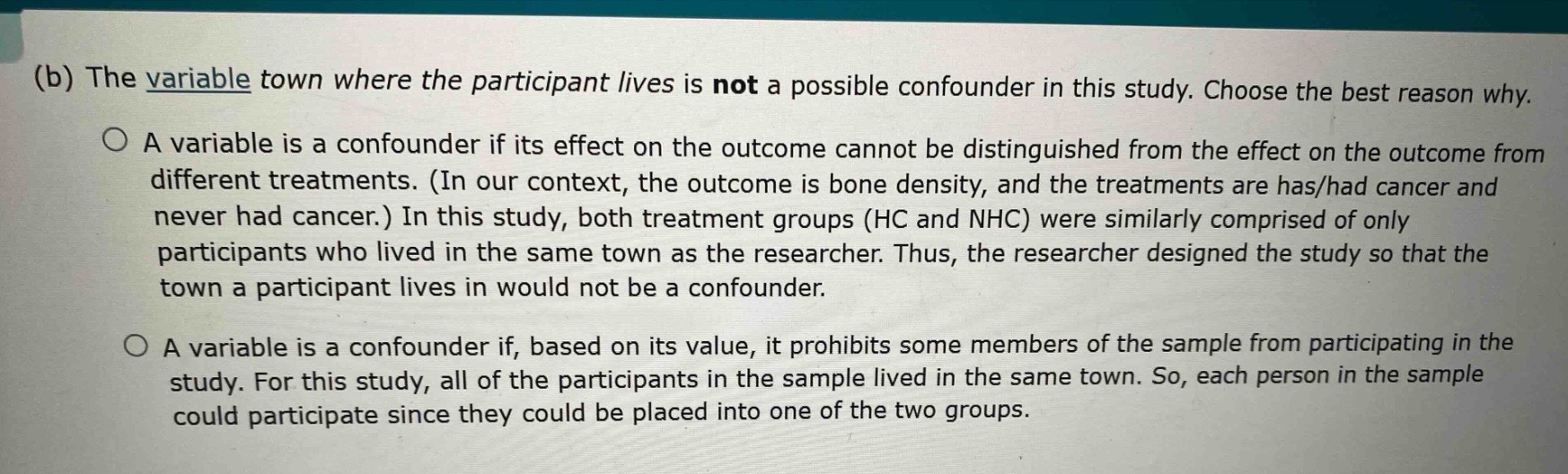
A confounder is a variable whose effect on the outcome can't be separated from the treatment - effect. In this study, both treatment groups have participants from the same town, so the effect of the town - variable on bone density (the outcome) can be distinguished from the effect of having/ not having cancer (the treatments). The second option's definition of a confounder is incorrect.
Answer:
A variable is a confounder if its effect on the outcome cannot be distinguished from the effect on the outcome from different treatments. (In our context, the outcome is bone density, and the treatments are has/had cancer and never had cancer.) In this study, both treatment groups (HC and NHC) were similarly comprised of only participants who lived in the same town as the researcher. Thus, the researcher designed the study so that the town a participant lives in would not be a confounder.