watching tv: the 2012 general social survey asked a large number of people how much time they spent watching…
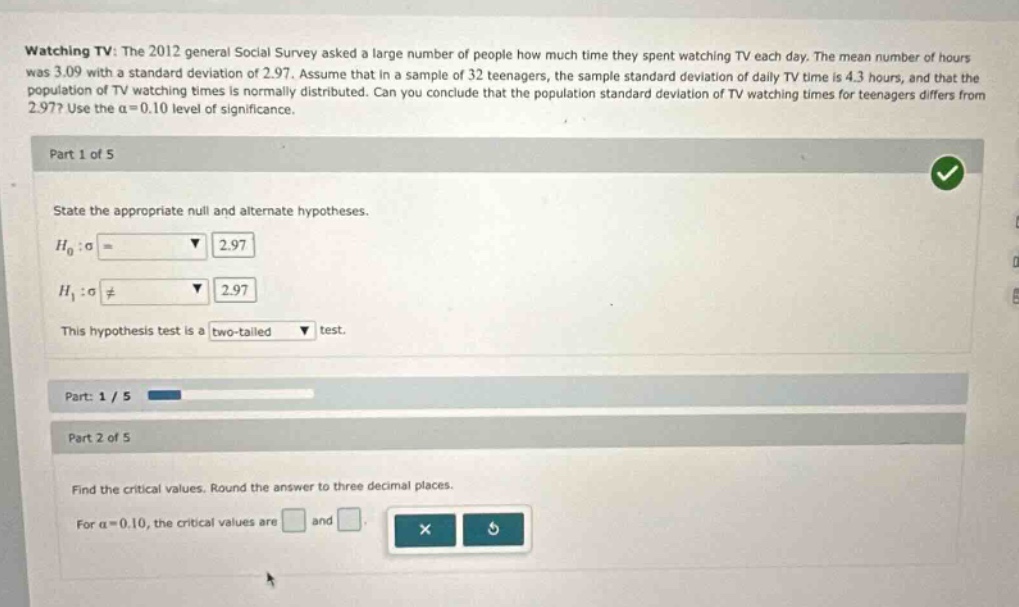
watching tv: the 2012 general social survey asked a large number of people how much time they spent watching tv each day. the mean number of hours was 3.09 with a standard deviation of 2.97. assume that in a sample of 32 teenagers, the sample standard deviation of daily tv time is 4.3 hours, and that the population of tv watching times is normally distributed. can you conclude that the population standard deviation of tv watching times for teenagers differs from 2.97? use the $alpha = 0.10$ level of significance.\npart 1 of 5\nstate the appropriate null and alternate hypotheses.\n$h_0:sigma = 2.97$\n$h_1:sigma\neq 2.97$\nthis hypothesis test is a two - tailed test.\npart: 1 / 5\npart 2 of 5\nfind the critical values. round the answer to three decimal places.\nfor $alpha = 0.10$, the critical values are and
Answer
Explanation:
Step1: Identify the degrees of freedom
The degrees of freedom $df=n - 1$, where $n = 32$. So $df=32-1 = 31$.
Step2: Determine the critical - value for a two - tailed test
Since $\alpha=0.10$ for a two - tailed test, we divide $\alpha$ by 2, so $\alpha/2=0.05$. We use the chi - square distribution $\chi^{2}$. Looking up the values in the chi - square distribution table or using a statistical software, the lower critical value $\chi_{1-\alpha/2,df}^{2}=\chi_{0.95,31}^{2}$ and the upper critical value $\chi_{\alpha/2,df}^{2}=\chi_{0.05,31}^{2}$. Using a chi - square table or software, $\chi_{0.95,31}^{2}\approx19.281$ and $\chi_{0.05,31}^{2}\approx43.773$.
Answer:
19.281 and 43.773