the following passage is a draft.\n(1) while many people are familiar with the dewey decimal system of…
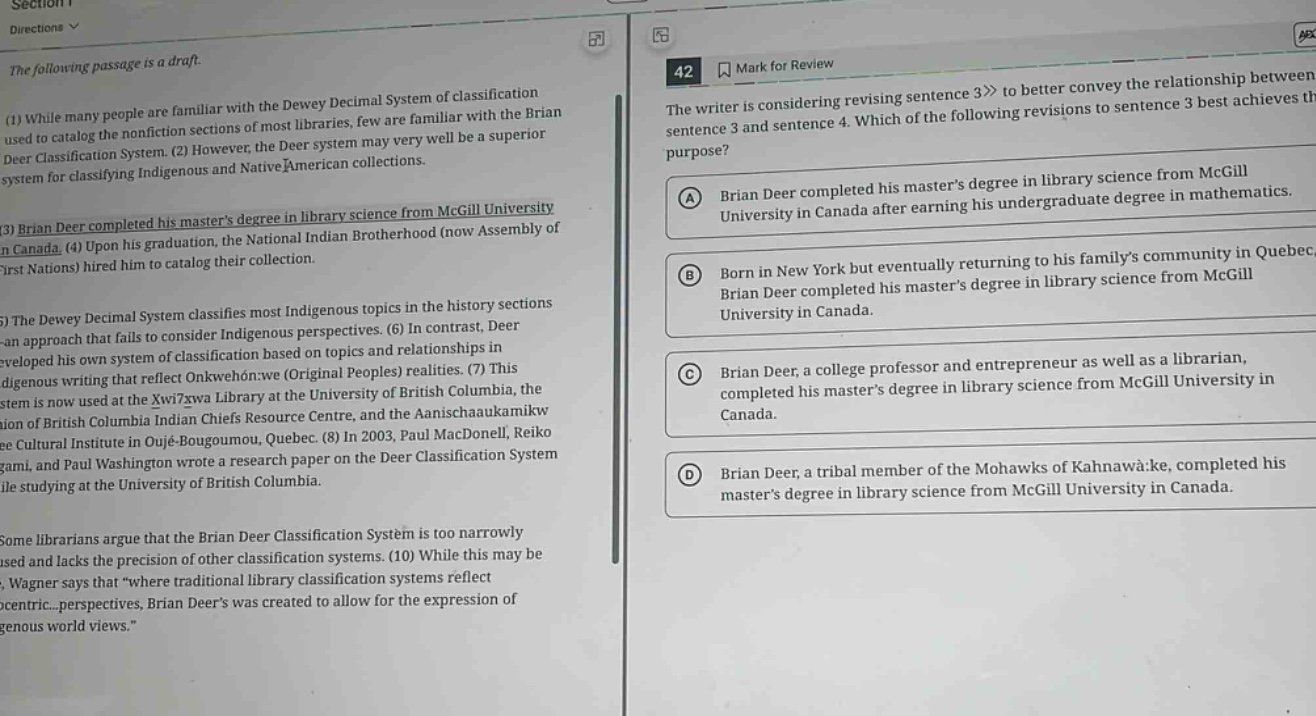
the following passage is a draft.\n(1) while many people are familiar with the dewey decimal system of classification used to catalog the nonfiction sections of most libraries, few are familiar with the brian deer classification system. (2) however, the deer system may very well be a superior system for classifying indigenous and native american collections.\n(3) brian deer completed his masters degree in library science from mcgill university in canada. (4) upon his graduation, the national indian brotherhood (now assembly of first nations) hired him to catalog their collection.\n(5) the dewey decimal system classifies most indigenous topics in the history sections - an approach that fails to consider indigenous perspectives. (6) in contrast, deer developed his own system of classification based on topics and relationships in indigenous writing that reflect onkwéhon:we (original peoples) realities. (7) this system is now used at the xwi7xwa library at the university of british columbia, the union of british columbia indian chiefs resource centre, and the aanischaaukamikw cree cultural institute in oujé - bougoumou, quebec. (8) in 2003, paul macdonell, reiko yamagami, and paul washington wrote a research paper on the deer classification system while studying at the university of british columbia.\nsome librarians argue that the brian deer classification system is too narrowly used and lacks the precision of other classification systems. (10) while this may be true, wagner says that “where traditional library classification systems reflect euro - centric... perspectives, brian deer’s was created to allow for the expression of indigenous world views.”\n42 mark for review\nthe writer is considering revising sentence 3 to better convey the relationship between sentence 3 and sentence 4. which of the following revisions to sentence 3 best achieves this purpose?\na brian deer completed his masters degree in library science from mcgill university in canada after earning his undergraduate degree in mathematics.\nb born in new york but eventually returning to his familys community in quebec, brian deer completed his masters degree in library science from mcgill university in canada.\nc brian deer, a college professor and entrepreneur as well as a librarian, completed his masters degree in library science from mcgill university in canada.\nd brian deer, a tribal member of the mohawks of kahnawà:ke, completed his masters degree in library science from mcgill university in canada.
Answer
Brief Explanations:
The passage focuses on Brian Deer's classification system for Indigenous collections. Sentence 3 should introduce Brian Deer in a way that connects to his work with Indigenous - related classification. Option D mentions that he is a tribal member of the Mohawks of Kahnawà:ke, which ties him to the Indigenous context and better sets up the connection to his work in classifying Indigenous collections compared to other options that just mention his academic degree without the Indigenous - related identity.
Answer:
D. Brian Deer, a tribal member of the Mohawks of Kahnawà:ke, completed his master's degree in library science from McGill University in Canada.