a paint - by - numbers kit hides the combination to a locker containing valuables in three of its 36 colors…
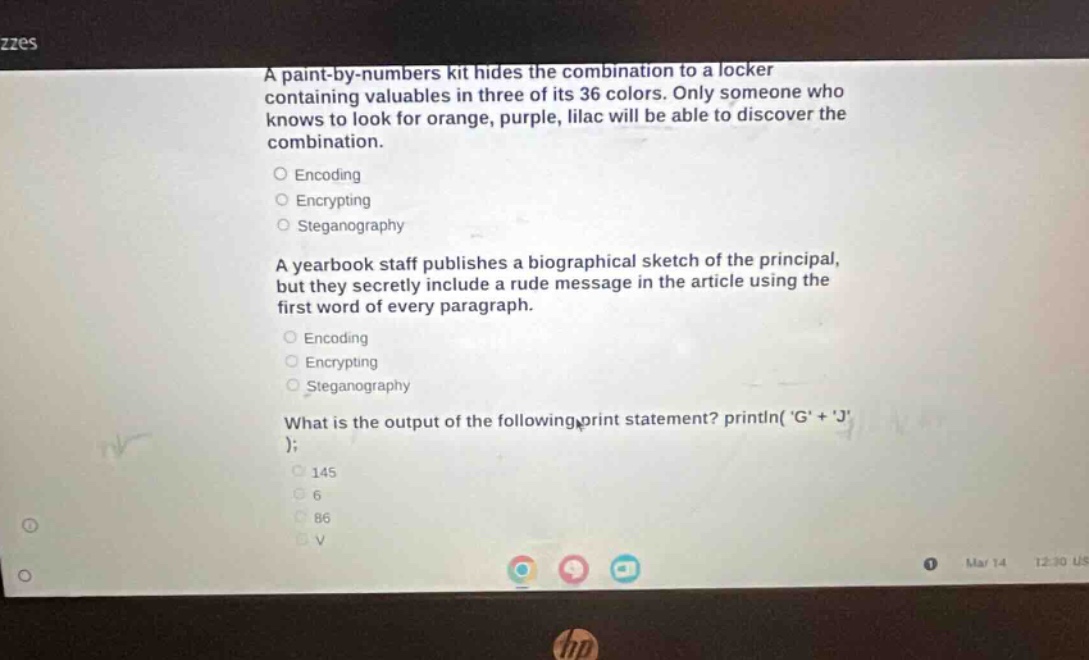
a paint - by - numbers kit hides the combination to a locker containing valuables in three of its 36 colors. only someone who knows to look for orange, purple, lilac will be able to discover the combination. encoding encrypting steganography a yearbook staff publishes a biographical sketch of the principal, but they secretly include a rude message in the article using the first word of every paragraph. encoding encrypting steganography what is the output of the following print statement? println(g + j); 145 6 86 v
Answer
Brief Explanations:
- In the first case, the combination is hidden within the colors of a paint - by - numbers kit. Steganography is the practice of hiding information within other non - secret data. Here, the combination is hidden in the colors, so it's steganography. Encoding is a more general process of representing information in a different format, and encrypting is about transforming data into an unreadable form for security.
- In the second case, a rude message is hidden in the first word of every paragraph of a biographical sketch. This is also an example of steganography as information is hidden within a seemingly normal text.
- In Java, when you use the
+operator with two characters in aprintlnstatement likeprintln('G' + 'J');, the characters are converted to their ASCII values and added. The ASCII value of 'G' is 71 and of 'J' is 74. 71+74 = 145.
Answer:
- C. Steganography
- C. Steganography
- A. 145