part a how does paragraph 3 contribute to the structure of the article? a it explains why sedimentary rocks…
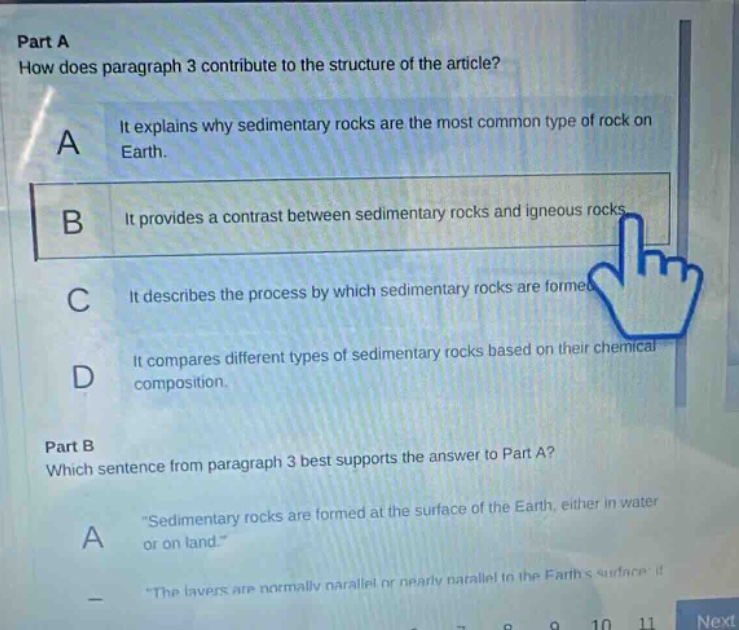
part a how does paragraph 3 contribute to the structure of the article? a it explains why sedimentary rocks are the most common type of rock on earth. b it provides a contrast between sedimentary rocks and igneous rocks. c it describes the process by which sedimentary rocks are formed. d it compares different types of sedimentary rocks based on their chemical composition. part b which sentence from paragraph 3 best supports the answer to part a? a \sedimentary rocks are formed at the surface of the earth, either in water or on land.\ - \the layers are normally parallel or nearly parallel to the earths surface.\
Answer
Brief Explanations:
For Part A, we need to analyze the function of paragraph 3 in the article's structure. Option A is incorrect as the paragraph doesn't focus on why sedimentary rocks are most common. Option B is wrong since there's no contrast with igneous rocks. Option D is incorrect as chemical - composition comparison isn't the main point. Option C is correct as it describes sedimentary - rock formation. For Part B, the sentence that supports the idea of describing the formation process is "Sedimentary rocks are formed at the surface of the Earth, either in water or on land."
Answer:
Part A: C. It describes the process by which sedimentary rocks are formed. Part B: A. "Sedimentary rocks are formed at the surface of the Earth, either in water or on land."