question 13 (essay worth 10 points)\n(05.01 hc)\nan unlabeled hierarchical diagram of some astronomical…
question 13 (essay worth 10 points)\n(05.01 hc)\nan unlabeled hierarchical diagram of some astronomical bodies is shown. the labels a, b, c, and d can be used to represent galaxies, solar system, clusters, universe, and planets.\npart 1: which four astronomical bodies would you choose to represent the four labels in the diagram?\npart 2: justify your choice based on the hierarchical relationships in astronomical bodies.
Answer
Brief Explanations:
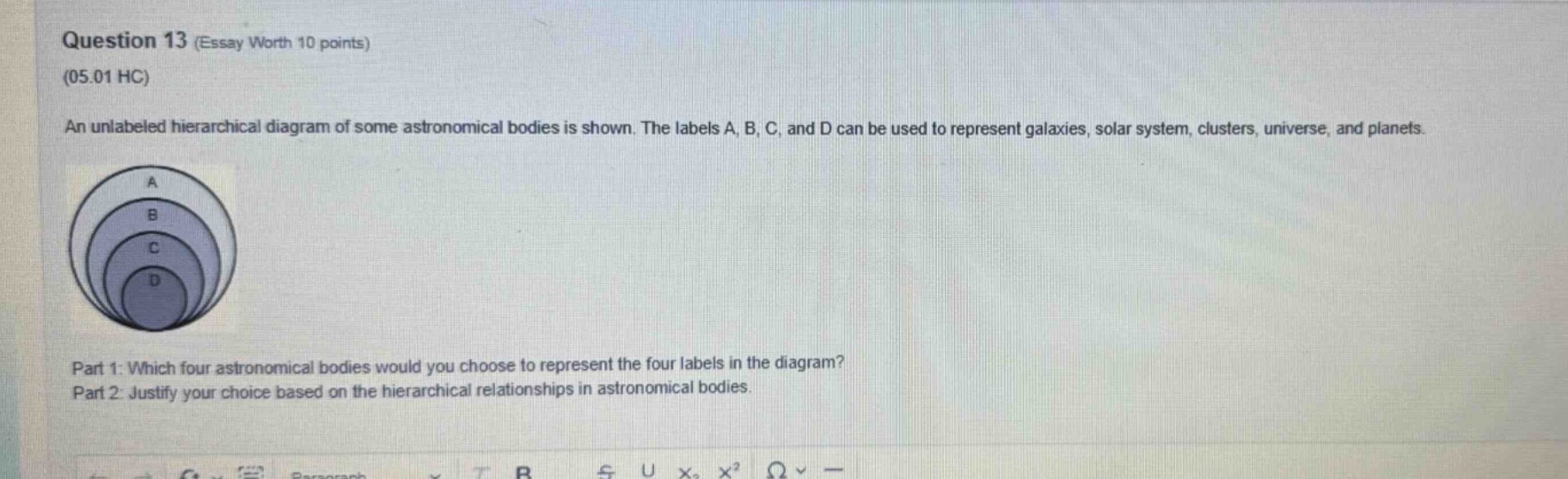
The hierarchical diagram shows four nested levels, with A being the largest and D the smallest. From the given list of astronomical bodies (galaxies, solar system, clusters, universe, planets), we need to select four that fit this hierarchy and justify the selection.
Part 1: Choice of Astronomical Bodies The four astronomical bodies selected to represent the labels in the diagram are:
- A: Universe
- B: Cluster (specifically, a cluster of galaxies)
- C: Galaxy
- D: Solar System
Part 2: Justification of Choice This selection is based on the established cosmological hierarchy where astronomical structures are nested within each other based on their scale and gravitational relationships:
- The Universe (A) is the largest and most encompassing known astronomical entity. It contains all space, time, matter, and energy. Therefore, it is appropriately assigned to the outermost and largest layer, A.
- Within the Universe, matter is organized into large-scale structures. Clusters of galaxies (B) are significant congregations of many galaxies bound together by gravity. A cluster is contained within the Universe and is smaller than it, making it suitable for label B.
- Each cluster is composed of numerous individual Galaxies (C). A galaxy is a massive, gravitationally bound system typically consisting of stars, stellar remnants, interstellar gas, dust, and dark matter. Thus, a galaxy is contained within a cluster and is assigned to label C.
- Within each galaxy, there are many Solar Systems (D) (or stellar systems). A solar system generally consists of a central star (or stars) and the celestial objects orbiting it, such as planets, moons, asteroids, and comets. A solar system is contained within a galaxy and represents the innermost labeled layer in this chosen hierarchy, fitting label D.
This assignment (A: Universe ⊃ B: Cluster ⊃ C: Galaxy ⊃ D: Solar System) accurately reflects the nested hierarchical structure depicted in the diagram, where A contains B, B contains C, and C contains D. The fifth astronomical body provided in the list, "planets," would be components found within D (Solar System). This selection provides a comprehensive representation of cosmic organization across a vast range of scales.
Answer:
Part 1: The four astronomical bodies chosen to represent the labels in the diagram are: A: Universe B: Cluster C: Galaxy D: Solar System
Part 2: This choice is justified by the hierarchical organization of astronomical bodies by scale. The Universe (A) is the largest entity and contains Clusters of galaxies (B). Clusters (B) are collections of individual Galaxies (C). Galaxies (C), in turn, contain numerous Solar Systems (D). This creates a clear nested structure (A contains B, B contains C, and C contains D) that is consistent with the provided diagram. The fifth option, planets, are components found within Solar Systems (D).