read the passage about a labrador retriever. about 10 years ago, i was training my new yellow labrador…
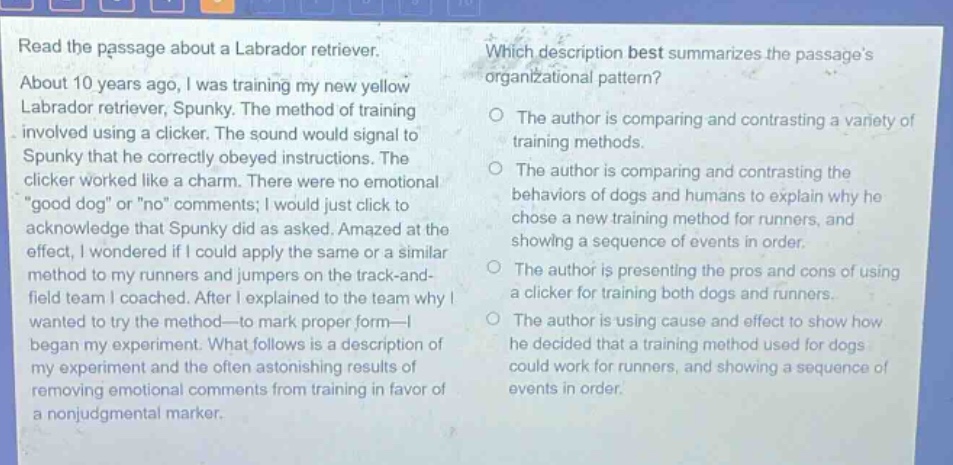
read the passage about a labrador retriever. about 10 years ago, i was training my new yellow labrador retriever, spunky. the method of training involved using a clicker. the sound would signal to spunky that he correctly obeyed instructions. the clicker worked like a charm. there were no emotional \good dog\ or \no\ comments; i would just click to acknowledge that spunky did as asked. amazed at the effect, i wondered if i could apply the same or a similar method to my runners and jumpers on the track - and - field team i coached. after i explained to the team why i wanted to try the method - to mark proper form - i began my experiment. what follows is a description of my experiment and the often astonishing results of removing emotional comments from training in favor of a nonjudgmental marker. which description best summarizes the passages organizational pattern? the author is comparing and contrasting a variety of training methods. the author is comparing and contrasting the behaviors of dogs and humans to explain why he chose a new training method for runners, and showing a sequence of events in order. the author is presenting the pros and cons of using a clicker for training both dogs and runners. the author is using cause and effect to show how he decided that a training method used for dogs could work for runners, and showing a sequence of events in order.
Answer
Brief Explanations:
The passage first describes training a dog with a clicker. Then, it shows the author's thought - to apply a similar method to track - and - field team after explaining the reason. It presents a cause - effect relationship and a sequence of events.
Answer:
The author is using cause and effect to show how he decided that a training method used for dogs could work for runners, and showing a sequence of events in order.