science test - chemistry\nquestions 1 and 2 refer to the following information and bar graph about…
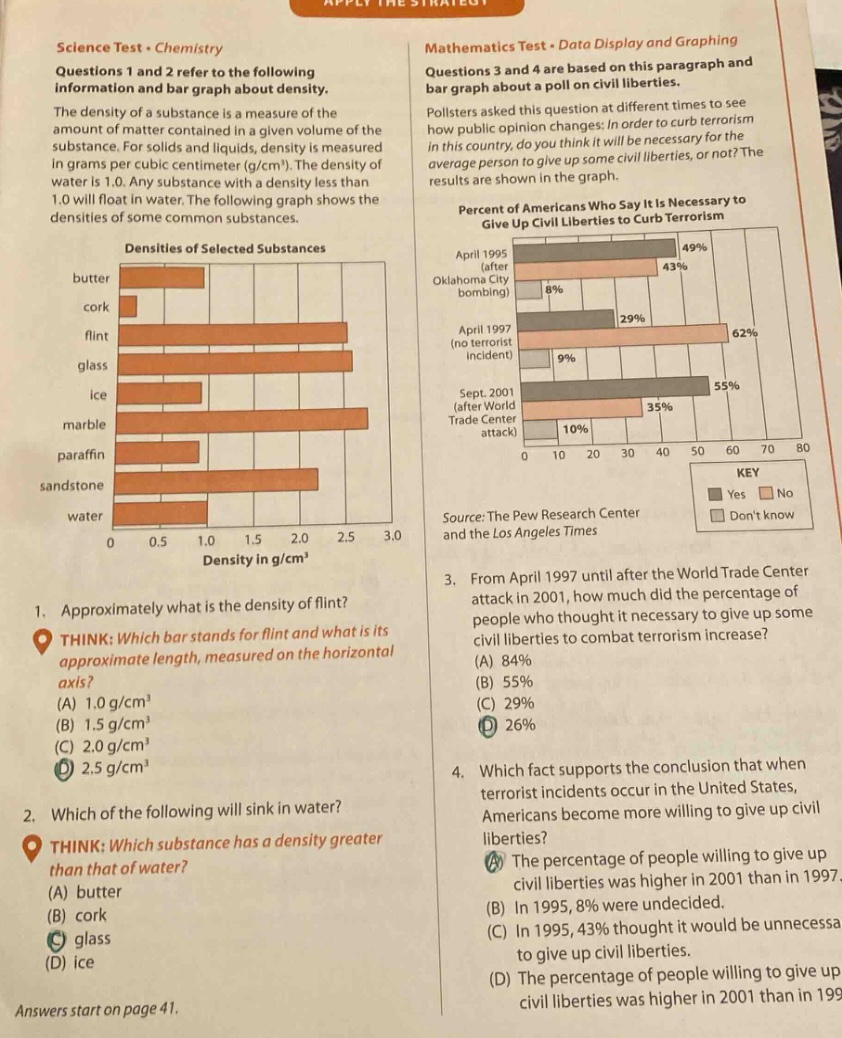
science test - chemistry\nquestions 1 and 2 refer to the following information and bar graph about density.\nthe density of a substance is a measure of the amount of matter contained in a given volume of the substance. for solids and liquids, density is measured in grams per cubic centimeter (g/cm³). the density of water is 1.0. any substance with a density less than 1.0 will float in water. the following graph shows the densities of some common substances.\ndensities of selected substances\nbutter\ncork\nflint\nglass\nice\nmarble\nparaffin\nsandstone\nwater\n0 0.5 1.0 1.5 2.0 2.5 3.0\ndensity in g/cm³\n1. approximately what is the density of flint?\nthink: which bar stands for flint and what is its approximate length, measured on the horizontal axis?\n(a) 1.0 g/cm³\n(b) 1.5 g/cm³\n(c) 2.0 g/cm³\n(d) 2.5 g/cm³\n2. which of the following will sink in water?\nthink: which substance has a density greater than that of water?\n(a) butter\n(b) cork\n(c) glass\n(d) ice\nmathematics test - data display and graphing\nquestions 3 and 4 are based on this paragraph and bar graph about a poll on civil liberties.\npollsters asked this question at different times to see how public opinion changes: in order to curb terrorism in this country, do you think it will be necessary for the average person to give up some civil liberties, or not? the results are shown in the graph.\npercent of americans who say it is necessary to give up civil liberties to curb terrorism\napril 1995 (after oklahoma city bombing)\napril 1997 (no terrorist incident)\nsept. 2001 (after world trade center attack)\n0 10 20 30 40 50 60 70 80\nkey\nyes\nno\ndont know\nsource: the pew research center and the los angeles times\n3. from april 1997 until after the world trade center attack in 2001, how much did the percentage of people who thought it necessary to give up some civil liberties to combat terrorism increase?\n(a) 84%\n(b) 55%\n(c) 29%\n(d) 26%\n4. which fact supports the conclusion that when terrorist incidents occur in the united states, americans become more willing to give up civil liberties?\n(a) the percentage of people willing to give up civil liberties was higher in 2001 than in 1997.\n(b) in 1995, 8% were undecided.\n(c) in 1995, 43% thought it would be unnecessary to give up civil liberties.\n(d) the percentage of people willing to give up civil liberties was higher in 2001 than in 1995.\nanswers start on page 41.
Answer
Explanation:
Step1: Identify flint's bar in density graph
By observing the bar - graph of densities of selected substances, the bar for flint reaches approximately to 2.5 on the horizontal axis (density in g/cm³).
Step2: Determine substance that sinks in water
Water has a density of 1.0 g/cm³. Substances with density greater than 1.0 g/cm³ will sink in water. Among butter (density < 1.0 g/cm³), cork (density < 1.0 g/cm³), glass (density > 1.0 g/cm³), and ice (density < 1.0 g/cm³), glass will sink.
Step3: Calculate change in percentage for civil - liberties question
In April 1997, the percentage of people who thought it necessary to give up some civil liberties to combat terrorism was 29%. After the World - Trade Center attack in 2001, it was 55%. The increase is 55% - 29%=26%.
Step4: Select fact supporting civil - liberties conclusion
The fact that the percentage of people willing to give up civil liberties was higher in 2001 (after a major terrorist incident) than in 1997 (no major terrorist incident) supports the conclusion that when terrorist incidents occur in the United States, Americans become more willing to give up civil liberties.
Answer:
- D. 2.5 g/cm³
- C. glass
- D. 26%
- A. The percentage of people willing to give up civil liberties was higher in 2001 than in 1997.