student name: period: date: 20 multiple - choice questions\n1. how many sentences are in the introduction…
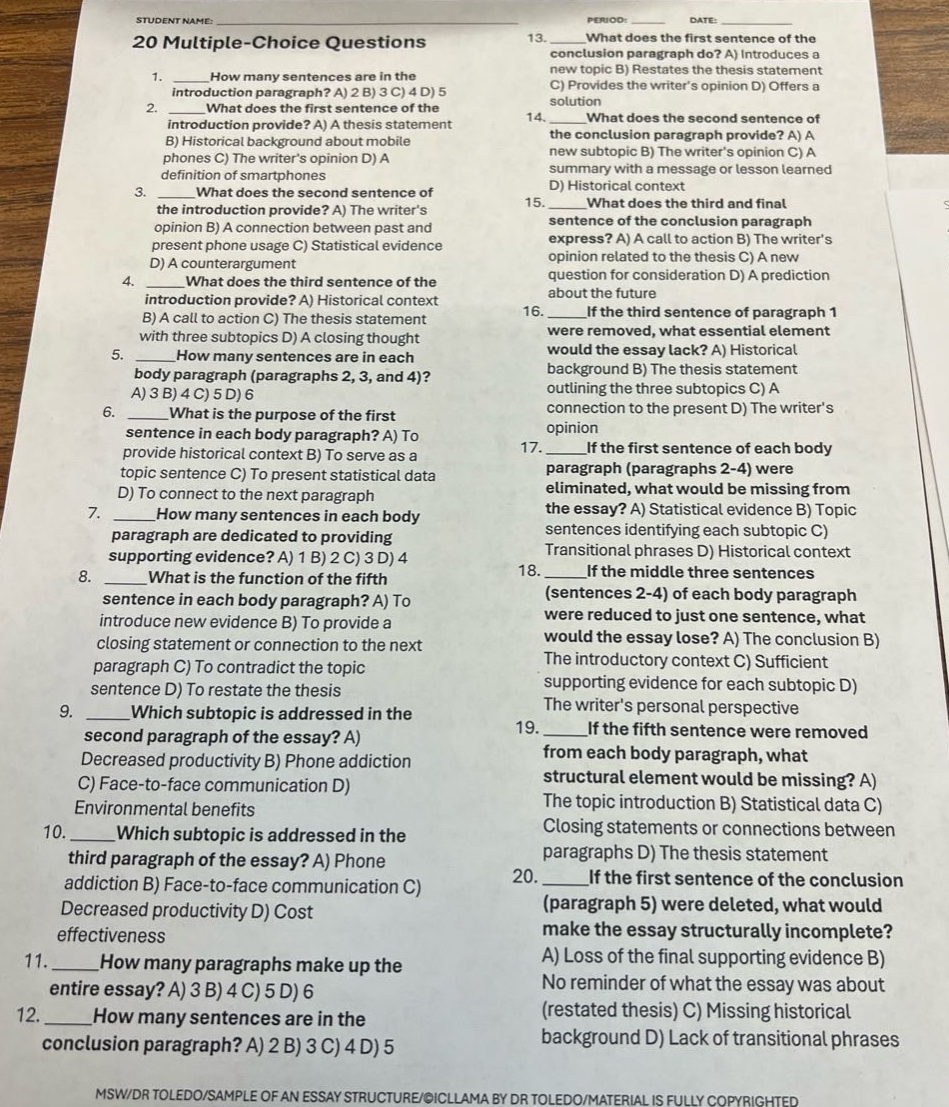
student name: period: date: 20 multiple - choice questions\n1. how many sentences are in the introduction paragraph? a) 2 b) 3 c) 4 d) 5\n2. what does the first sentence of the second introduction provide? a) a thesis statement b) historical background about mobile phones c) the writers opinion d) a definition of smartphones\n3. what does the second sentence of the introduction provide? a) the writers opinion b) a connection between past and present phone usage c) statistical evidence d) a counterargument\n4. what does the third sentence of the introduction provide? a) historical context b) a call to action c) the thesis statement with three subtopics d) a closing thought\n5. how many sentences are in each body paragraph (paragraphs 2, 3, and 4)? a) 3 b) 4 c) 5 d) 6\n6. what is the purpose of the first sentence in each body paragraph? a) to provide historical context b) to serve as a topic sentence c) to present statistical data d) to connect to the next paragraph\n7. how many sentences in each body paragraph are dedicated to providing supporting evidence? a) 1 b) 2 c) 3 d) 4\n8. what is the function of the fifth sentence in each body paragraph? a) to introduce new evidence b) to provide a closing statement or connection to the next paragraph c) to contradict the topic sentence d) to restate the thesis\n9. which subtopic is addressed in the second paragraph of the essay? a) decreased productivity b) phone addiction c) face - to - face communication d) environmental benefits\n10. which subtopic is addressed in the third paragraph of the essay? a) phone addiction b) face - to - face communication c) decreased productivity d) cost effectiveness\n11. how many paragraphs make up the entire essay? a) 3 b) 4 c) 5 d) 6\n12. how many sentences are in the conclusion paragraph? a) 2 b) 3 c) 4 d) 5\n13. what does the first sentence of the conclusion paragraph do? a) introduces a new topic b) restates the thesis statement c) provides the writers opinion d) offers a solution\n14. what does the second sentence of the conclusion paragraph provide? a) a new subtopic b) the writers opinion c) a summary with a message or lesson learned d) historical context\n15. what does the third and final sentence of the conclusion paragraph express? a) a call to action b) the writers opinion c) related to the past d) a new question for consideration d) a prediction about the future\n16. if the third sentence of paragraph 1 were removed, what essential element would the essay lack? a) historical background b) the thesis statement outlining the three subtopics c) a connection to the present d) the writers opinion\n17. if the first sentence of each body paragraph (paragraphs 2 - 4) were eliminated, what would be missing from the essay? a) statistical evidence b) topic sentences identifying each subtopic c) transitional phrases d) historical context\n18. if the middle three sentences (sentences 2 - 4) of each body paragraph were reduced to just one sentence, what would the essay lose? a) the conclusion b) the introductory context c) sufficient supporting evidence for each subtopic d) the writers personal perspective\n19. if the fifth sentence were removed from each body paragraph, what structural element would be missing? a) the topic introduction b) statistical data c) closing statements or connections between paragraphs d) the thesis statement\n20. if the first sentence of the conclusion (paragraph 5) were deleted, what would make the essay structurally incomplete? a) loss of the final supporting evidence b) no reminder of what the essay was about (restated thesis) c) missing historical background d) lack of transitional phrases\nmswdr toledo/sample of an essay structure/©icllama by dr toledo/material is fully copyrighted
Answer
Brief Explanations:
These questions pertain to the structure and function of sentences and paragraphs within an essay. They ask about the number of sentences in different parts of the essay, the purpose of specific sentences (like thesis - statements, topic - sentences, etc.), and what would be lost if certain sentences or parts were removed. This is related to the study of writing, which falls under Arts - Writing.
Answer:
- Without the actual essay, cannot determine.
- Without the actual essay, cannot determine.
- Without the actual essay, cannot determine.
- Without the actual essay, cannot determine.
- Without the actual essay, cannot determine.
- Without the actual essay, cannot determine.
- Without the actual essay, cannot determine.
- Without the actual essay, cannot determine.
- Without the actual essay, cannot determine.
- Without the actual essay, cannot determine.
- Without the actual essay, cannot determine.
- Without the actual essay, cannot determine.
- Without the actual essay, cannot determine.
- Without the actual essay, cannot determine.
- Without the actual essay, cannot determine.
- Without the actual essay, cannot determine.
- Without the actual essay, cannot determine.
- Without the actual essay, cannot determine.
- Without the actual essay, cannot determine.
- Without the actual essay, cannot determine.