QUESTION IMAGE
Question
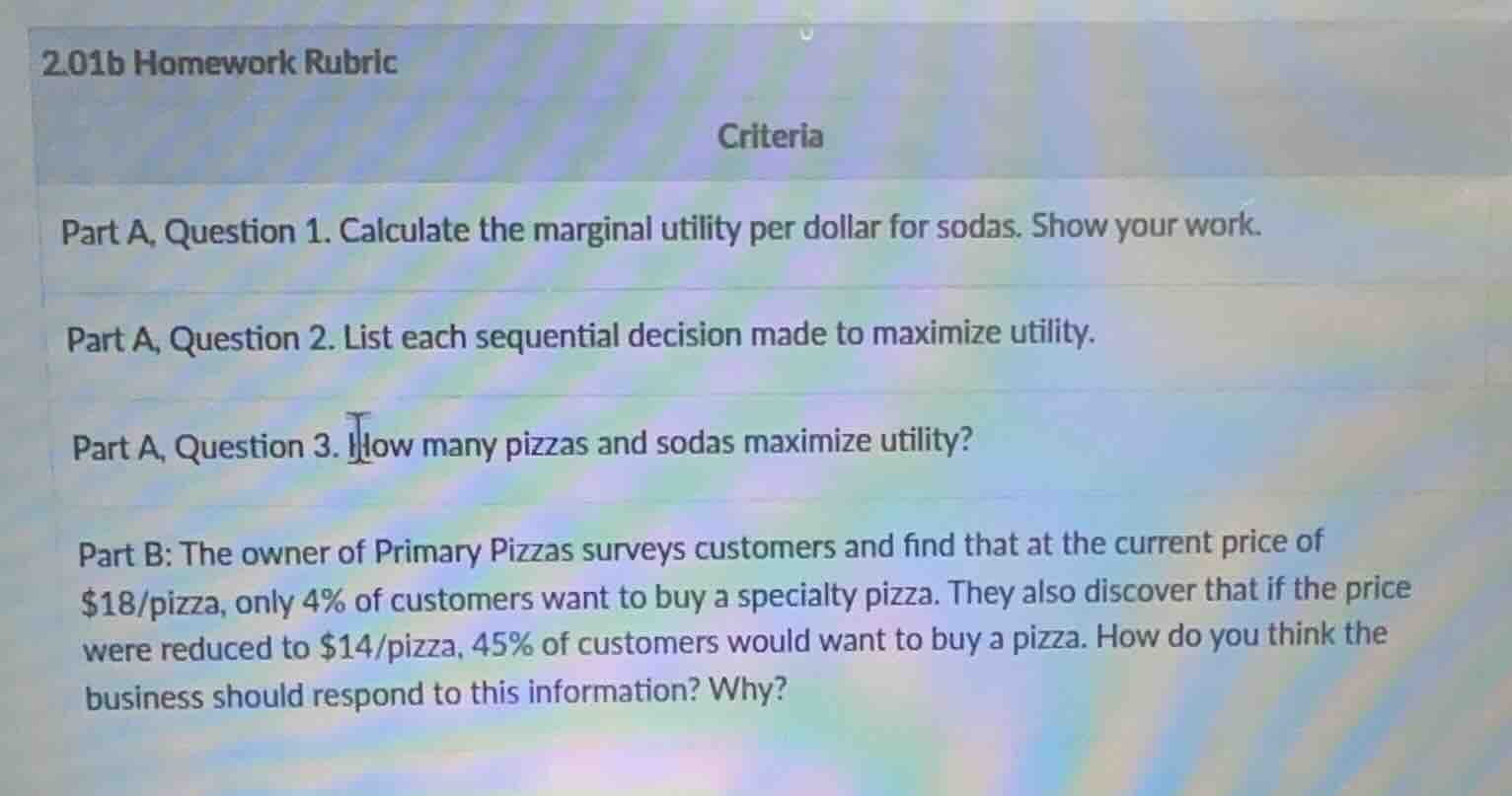
2.01b homework rubric
criteria
part a, question 1. calculate the marginal utility per dollar for sodas. show your work.
part a, question 2. list each sequential decision made to maximize utility.
part a, question 3. how many pizzas and sodas maximize utility?
part b: the owner of primary pizzas surveys customers and find that at the current price of $18/pizza, only 4% of customers want to buy a specialty pizza. they also discover that if the price were reduced to $14/pizza, 45% of customers would want to buy a pizza. how do you think the business should respond to this information? why?
To solve these problems, we'll address each part:
Part A, Question 1: Calculate Marginal Utility per Dollar for Sodas
To calculate marginal utility per dollar (\(MU/\$ \)) for sodas, we use the formula:
\[
\text{Marginal Utility per Dollar} = \frac{\text{Marginal Utility of Soda (}MU_{\text{soda}}\text{)}}{\text{Price of Soda (}P_{\text{soda}}\text{)}}
\]
However, we need the marginal utility values for sodas (e.g., from a table of total utility or marginal utility) and the price of a soda. For example, if:
- \(MU_{\text{soda}} = 10\) (utils)
- \(P_{\text{soda}} = \$2\)
Then:
\[
\frac{10}{2} = 5 \text{ utils per dollar}
\]
Part A, Question 2: Sequential Decisions to Maximize Utility
To maximize utility, consumers follow the marginal utility per dollar rule:
- Calculate \(MU/\$ \) for all goods (pizza, soda, etc.).
- Spend the first dollar on the good with the highest \(MU/\$ \).
- Spend the next dollar on the good with the highest remaining \(MU/\$ \) (after the first purchase).
- Repeat until the budget is exhausted or \(MU/\$ \) across all goods is equal (or no more positive \(MU/\$ \) exists).
Part A, Question 3: Quantity to Maximize Utility
To find the quantity of pizzas and sodas that maximize utility:
- Calculate \(MU/\$ \) for both pizzas and sodas at each quantity.
- Follow the sequential decision process (from Question 2) to allocate dollars.
- Stop when:
- The budget is spent.
- \(MU/\$ \) for the last unit of pizza = \(MU/\$ \) for the last unit of soda (or no more positive \(MU/\$ \) for either good).
Part B: Business Response to Pricing Information
The survey shows:
- At \( \$18/\text{pizza} \), only 4% of customers buy.
- At \( \$14/\text{pizza} \), 45% of customers buy.
This implies elastic demand (a small price decrease leads to a large increase in quantity demanded). By the law of demand, lowering the price to \( \$14 \) will likely increase total revenue (since \( \%\Delta Q > \%\Delta P \) for elastic demand).
Thus, the business should reduce the price to \$14 per pizza because:
- The large increase in customer interest (45% vs. 4%) suggests demand is elastic.
- Lowering the price will increase quantity demanded enough to raise total revenue ( \( \text{Total Revenue} = P \times Q \) ).
Final Answers (Summarized)
- Part A, Q1: Depends on \(MU_{\text{soda}}\) and \(P_{\text{soda}}\); use \( \frac{MU_{\text{soda}}}{P_{\text{soda}}} \).
- Part A, Q2: Spend on the good with the highest \(MU/\$ \) first, then the next highest, etc.
- Part A, Q3: Depends on \(MU/\$ \) calculations and budget.
- Part B: Reduce the price to \$14/pizza (elastic demand implies higher revenue with lower price).

Snap & solve any problem in the app
Get step-by-step solutions on Sovi AI
Photo-based solutions with guided steps
Explore more problems and detailed explanations
To solve these problems, we'll address each part:
Part A, Question 1: Calculate Marginal Utility per Dollar for Sodas
To calculate marginal utility per dollar (\(MU/\$ \)) for sodas, we use the formula:
\[
\text{Marginal Utility per Dollar} = \frac{\text{Marginal Utility of Soda (}MU_{\text{soda}}\text{)}}{\text{Price of Soda (}P_{\text{soda}}\text{)}}
\]
However, we need the marginal utility values for sodas (e.g., from a table of total utility or marginal utility) and the price of a soda. For example, if:
- \(MU_{\text{soda}} = 10\) (utils)
- \(P_{\text{soda}} = \$2\)
Then:
\[
\frac{10}{2} = 5 \text{ utils per dollar}
\]
Part A, Question 2: Sequential Decisions to Maximize Utility
To maximize utility, consumers follow the marginal utility per dollar rule:
- Calculate \(MU/\$ \) for all goods (pizza, soda, etc.).
- Spend the first dollar on the good with the highest \(MU/\$ \).
- Spend the next dollar on the good with the highest remaining \(MU/\$ \) (after the first purchase).
- Repeat until the budget is exhausted or \(MU/\$ \) across all goods is equal (or no more positive \(MU/\$ \) exists).
Part A, Question 3: Quantity to Maximize Utility
To find the quantity of pizzas and sodas that maximize utility:
- Calculate \(MU/\$ \) for both pizzas and sodas at each quantity.
- Follow the sequential decision process (from Question 2) to allocate dollars.
- Stop when:
- The budget is spent.
- \(MU/\$ \) for the last unit of pizza = \(MU/\$ \) for the last unit of soda (or no more positive \(MU/\$ \) for either good).
Part B: Business Response to Pricing Information
The survey shows:
- At \( \$18/\text{pizza} \), only 4% of customers buy.
- At \( \$14/\text{pizza} \), 45% of customers buy.
This implies elastic demand (a small price decrease leads to a large increase in quantity demanded). By the law of demand, lowering the price to \( \$14 \) will likely increase total revenue (since \( \%\Delta Q > \%\Delta P \) for elastic demand).
Thus, the business should reduce the price to \$14 per pizza because:
- The large increase in customer interest (45% vs. 4%) suggests demand is elastic.
- Lowering the price will increase quantity demanded enough to raise total revenue ( \( \text{Total Revenue} = P \times Q \) ).
Final Answers (Summarized)
- Part A, Q1: Depends on \(MU_{\text{soda}}\) and \(P_{\text{soda}}\); use \( \frac{MU_{\text{soda}}}{P_{\text{soda}}} \).
- Part A, Q2: Spend on the good with the highest \(MU/\$ \) first, then the next highest, etc.
- Part A, Q3: Depends on \(MU/\$ \) calculations and budget.
- Part B: Reduce the price to \$14/pizza (elastic demand implies higher revenue with lower price).