QUESTION IMAGE
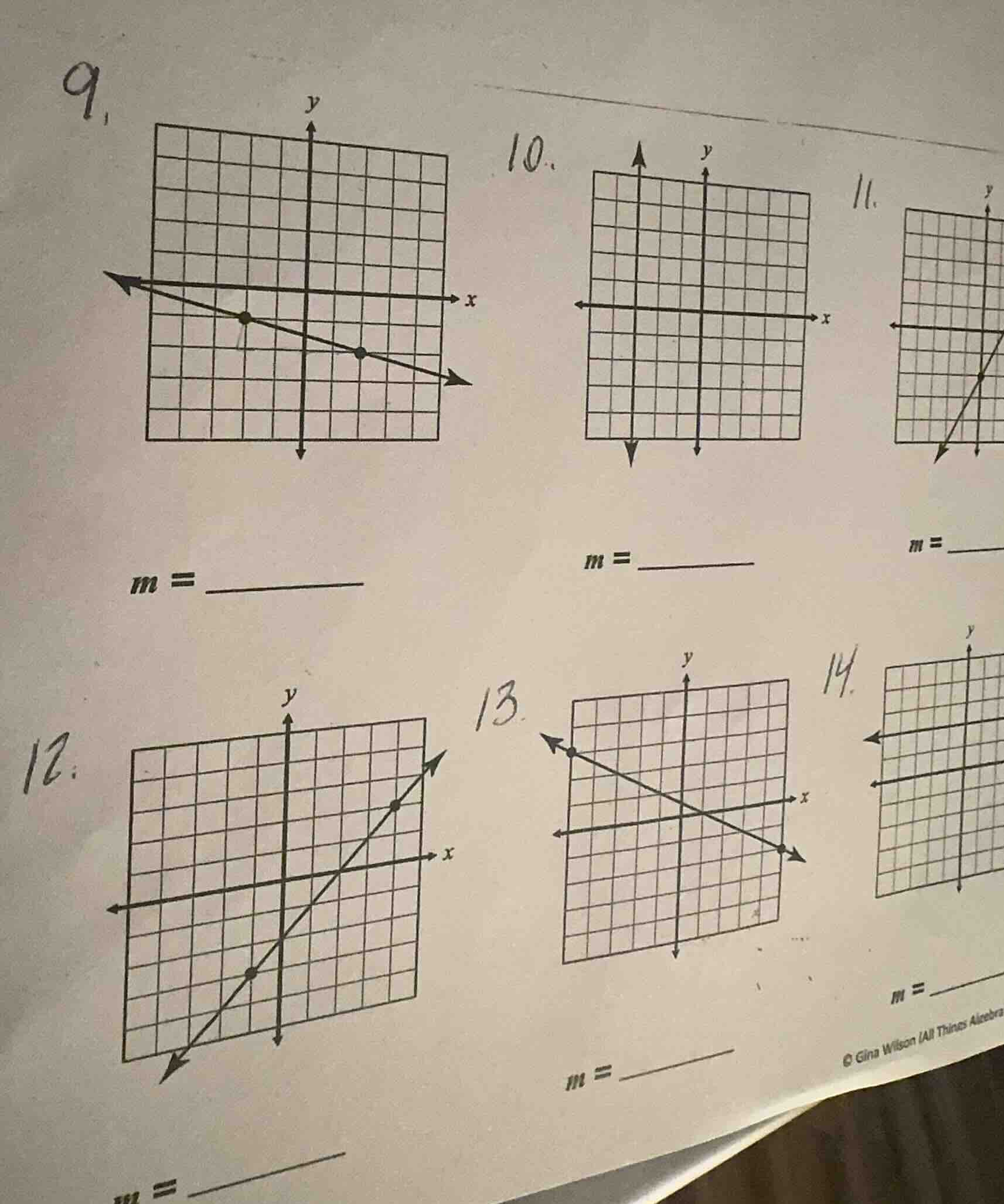
Question
9.
m =
10.
m =
11.
m =
12.
m =
13.
m =
14.
m =
© gina wilson (all things algebra)
Let's solve each problem one by one (we'll take problem 9 as an example, and the process is similar for others).
Problem 9:
Step1: Identify two points on the line.
Looking at the graph, let's find two clear points. Let's say the first point is \((-3, -1)\) and the second point is \((2, -2)\) (we can count the grid squares to determine the coordinates).
Step2: Use the slope formula \(m = \frac{y_2 - y_1}{x_2 - x_1}\).
Substitute \(x_1 = -3\), \(y_1 = -1\), \(x_2 = 2\), \(y_2 = -2\) into the formula:
\(m=\frac{-2 - (-1)}{2 - (-3)}=\frac{-2 + 1}{2 + 3}=\frac{-1}{5}=-\frac{1}{5}\)
Step1: Recognize the type of line.
This is a horizontal line (parallel to the x - axis). For a horizontal line, the slope \(m\) is 0 because there is no vertical change (the \(y\) - values are constant) as \(x\) changes.
Mathematically, if we take two points \((x_1,y)\) and \((x_2,y)\) on the line, then \(m=\frac{y - y}{x_2 - x_1}=\frac{0}{x_2 - x_1}=0\) (where \(x_1
eq x_2\))
Step1: Identify two points on the line.
Let's find two points. For example, if we take the point \((-1, -3)\) and \((3, 3)\) (by counting the grid).
Step2: Use the slope formula \(m=\frac{y_2 - y_1}{x_2 - x_1}\).
Substitute \(x_1=-1\), \(y_1 = - 3\), \(x_2 = 3\), \(y_2=3\) into the formula:
\(m=\frac{3-(-3)}{3 - (-1)}=\frac{3 + 3}{3 + 1}=\frac{6}{4}=\frac{3}{2}\)

Snap & solve any problem in the app
Get step-by-step solutions on Sovi AI
Photo-based solutions with guided steps
Explore more problems and detailed explanations
\(m = -\frac{1}{5}\)